SOLUZIONE CONSIGLIATA
Suggested solution. Solution conseillée . Empfohlene Lösung
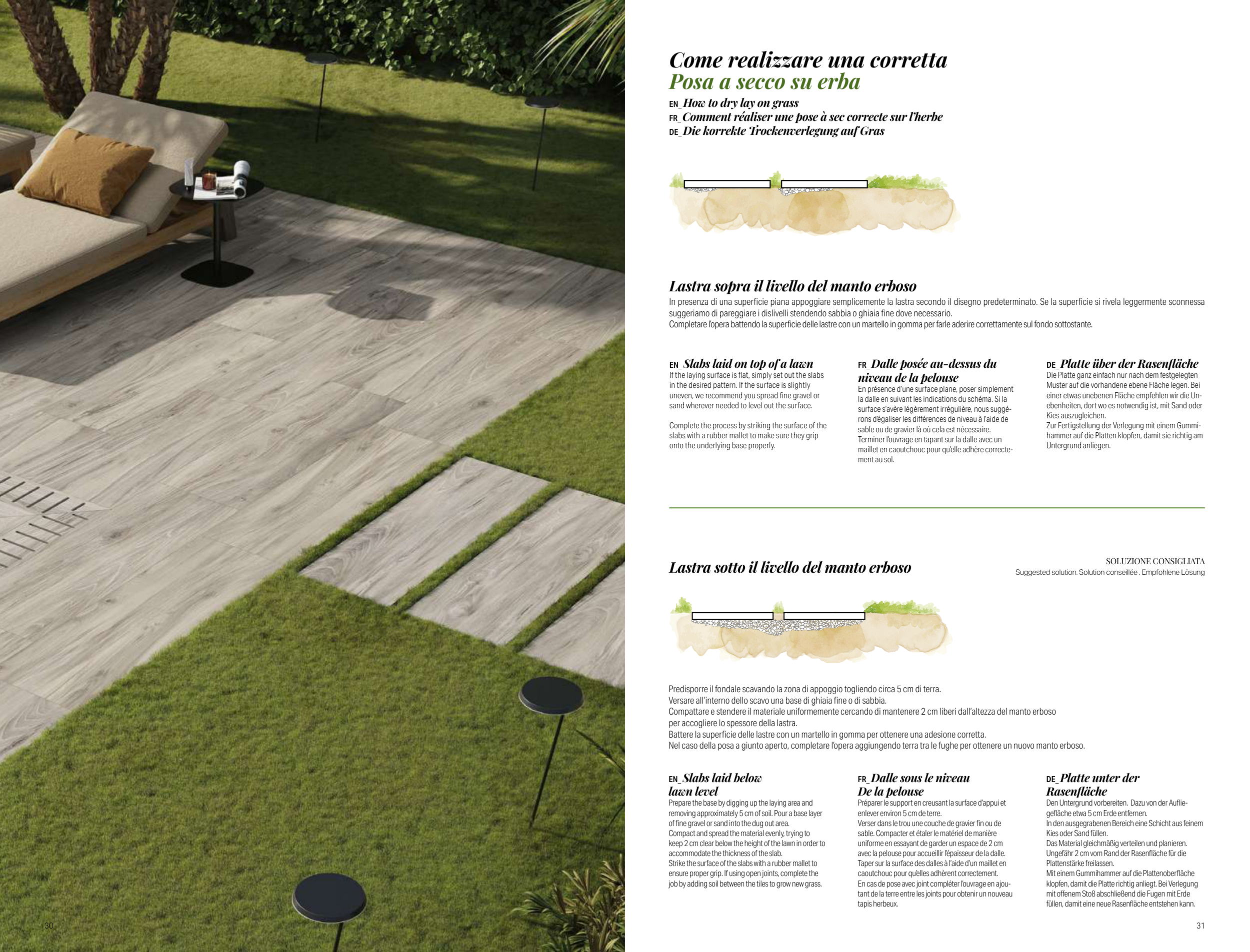
Predisporre il fondale scavando la zona di appoggio togliendo circa 5 cm di terra.
Versare all’interno dello scavo una base di ghiaia fine o di sabbia.
Compattare e stendere il materiale uniformemente cercando di mantenere 2 cm liberi dall’altezza del manto erboso
per accogliere lo spessore della lastra.
Battere la superficie delle lastre con un martello in gomma per ottenere una adesione corretta.
Nel caso della posa a giunto aperto, completare l’opera aggiungendo terra tra le fughe per ottenere un nuovo manto erboso.
FR_ Dalle sous le niveau
De la pelouse
Préparer le support en creusant la surface d’appui et
enlever environ 5 cm de terre.
Verser dans le trou une couche de gravier fin ou de
sable. Compacter et étaler le matériel de manière
uniforme en essayant de garder un espace de 2 cm
avec la pelouse pour accueillir l’épaisseur de la dalle.
Taper sur la surface des dalles à l’aide d’un maillet en
caoutchouc pour qu’elles adhèrent correctement.
En cas de pose avec joint compléter l’ouvrage en ajou-
tant de la terre entre les joints pour obtenir un nouveau
tapis herbeux.
EN_ Slabs laid below
lawn level
Prepare the base by digging up the laying area and
removing approximately 5 cm of soil. Pour a base layer
of fine gravel or sand into the dug out area.
Compact and spread the material evenly, trying to
keep 2 cm clear below the height of the lawn in order to
accommodate the thickness of the slab.
Strike the surface of the slabs with a rubber mallet to
ensure proper grip. If using open joints, complete the
job by adding soil between the tiles to grow new grass.
DE_ Platte unter der
Rasenfläche
Den Untergrund vorbereiten. Dazu von der Auflie-
gefläche etwa 5 cm Erde entfernen.
In den ausgegrabenen Bereich eine Schicht aus feinem
Kies oder Sand füllen.
Das Material gleichmäßig verteilen und planieren.
Ungefähr 2 cm vom Rand der Rasenfläche für die
Plattenstärke freilassen.
Mit einem Gummihammer auf die Plattenoberfläche
klopfen, damit die Platte richtig anliegt. Bei Verlegung
mit offenem Stoß abschließend die Fugen mit Erde
füllen, damit eine neue Rasenfläche entstehen kann.
Lastra sopra il livello del manto erboso
In presenza di una superficie piana appoggiare semplicemente la lastra secondo il disegno predeterminato. Se la superficie si rivela leggermente sconnessa
suggeriamo di pareggiare i dislivelli stendendo sabbia o ghiaia fine dove necessario.
Completare l’opera battendo la superficie delle lastre con un martello in gomma per farle aderire correttamente sul fondo sottostante.
EN_ Slabs laid on top of a lawn
If the laying surface is flat, simply set out the slabs
in the desired pattern. If the surface is slightly
uneven, we recommend you spread fine gravel or
sand wherever needed to level out the surface.
Complete the process by striking the surface of the
slabs with a rubber mallet to make sure they grip
onto the underlying base properly.
FR_ Dalle posée au-dessus du
niveau de la pelouse
En présence d’une surface plane, poser simplement
la dalle en suivant les indications du schéma. Si la
surface s’avère légèrement irrégulière, nous suggé-
rons d’égaliser les différences de niveau à l’aide de
sable ou de gravier là où cela est nécessaire.
Terminer l’ouvrage en tapant sur la dalle avec un
maillet en caoutchouc pour qu’elle adhère correcte-
ment au sol.
DE_ Platte über der Rasenfläche
Die Platte ganz einfach nur nach dem festgelegten
Muster auf die vorhandene ebene Fläche legen. Bei
einer etwas unebenen Fläche empfehlen wir die Un-
ebenheiten, dort wo es notwendig ist, mit Sand oder
Kies auszugleichen.
Zur Fertigstellung der Verlegung mit einem Gummi-
hammer auf die Platten klopfen, damit sie richtig am
Untergrund anliegen.
Lastra sotto il livello del manto erboso
Come realizzare una corretta
Posa a secco su erba
EN_ How to dry lay on grass
FR_ Comment réaliser une pose à sec correcte sur l’herbe
DE_ Die korrekte Trockenverlegung auf Gras
31
30