338
339
BABINI Luca
BADULESCU E.
BAILEY David
BARBIERI G.P.
BEECROFT V.
BROSCH Iris
CATTELAN M.
CHATELAIN Alex
DE VILLIERS J.
FERRI Fabrizio
FERRUA David
GAYTE Pierre
GLAVIANO Alessia
GLAVIANO Marco LACHAPELLE D.
LINDBERGH Peter
TESTINO Mario
WALKER Tim
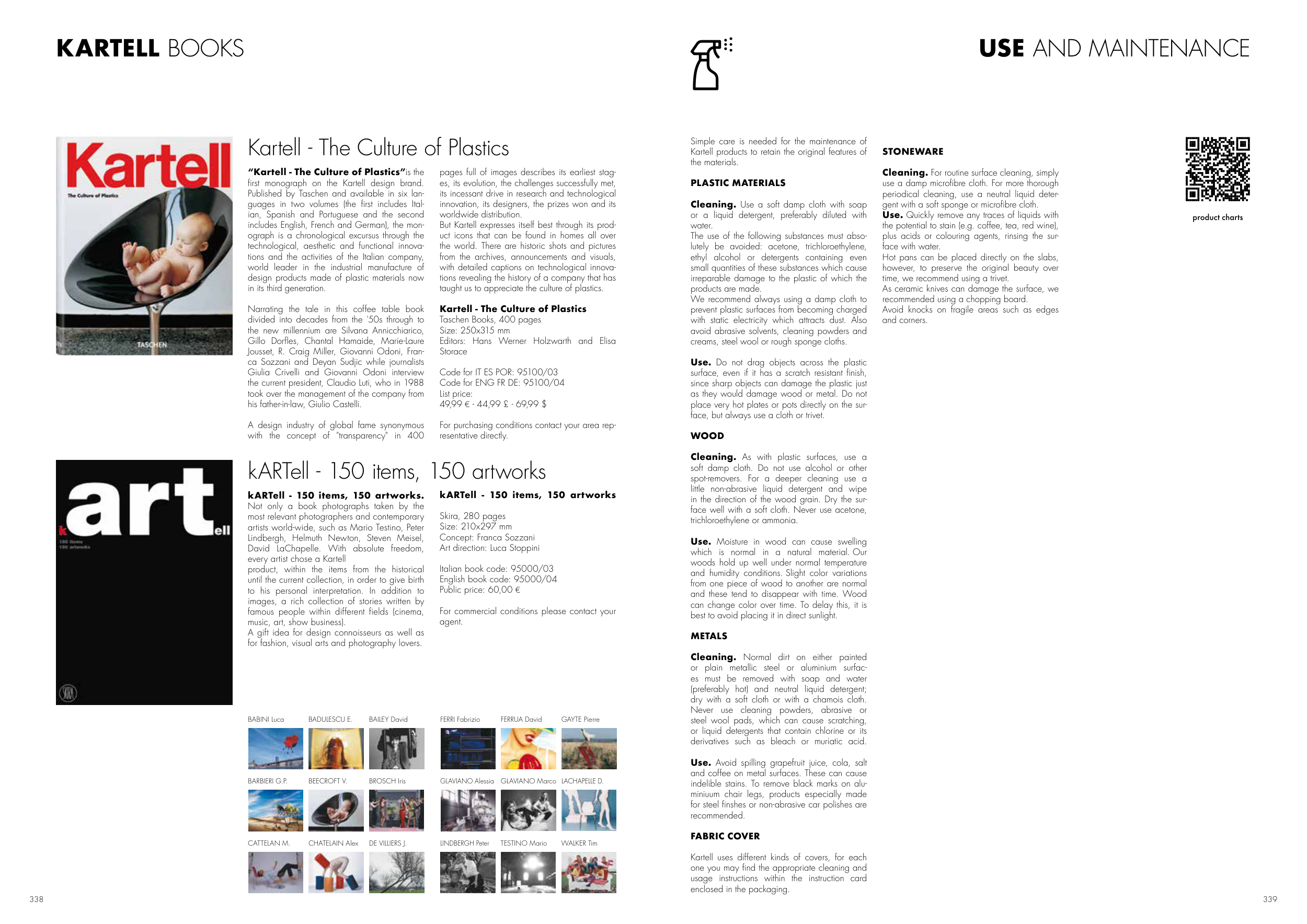
Kartell - The Culture of Plastics
kARTell - 150 items, 150 artworks
“Kartell - The Culture of Plastics”is the
first monograph on the Kartell design brand.
Published by Taschen and available in six lan-
guages in two volumes (the first includes Ital-
ian, Spanish and Portuguese and the second
includes English, French and German), the mon-
ograph is a chronological excursus through the
technological, aesthetic and functional innova-
tions and the activities of the Italian company,
world leader in the industrial manufacture of
design products made of plastic materials now
in its third generation.
Narrating the tale in this coffee table book
divided into decades from the '50s through to
the new millennium are Silvana Annicchiarico,
Gillo Dorfles, Chantal Hamaide, Marie-Laure
Jousset, R. Craig Miller, Giovanni Odoni, Fran-
ca Sozzani and Deyan Sudjic while journalists
Giulia Crivelli and Giovanni Odoni interview
the current president, Claudio Luti, who in 1988
took over the management of the company from
his father-in-law, Giulio Castelli.
A design industry of global fame synonymous
with the concept of "transparency" in 400
pages full of images describes its earliest stag-
es, its evolution, the challenges successfully met,
its incessant drive in research and technological
innovation, its designers, the prizes won and its
worldwide distribution.
But Kartell expresses itself best through its prod-
uct icons that can be found in homes all over
the world. There are historic shots and pictures
from the archives, announcements and visuals,
with detailed captions on technological innova-
tions revealing the history of a company that has
taught us to appreciate the culture of plastics.
Kartell - The Culture of Plastics
Taschen Books, 400 pages
Size: 250x315 mm
Editors: Hans Werner Holzwarth and Elisa
Storace
Code for IT ES POR: 95100/03
Code for ENG FR DE: 95100/04
List price:
49,99 € - 44,99 £ - 69,99 $
For purchasing conditions contact your area rep-
resentative directly.
kARTell - 150 items, 150 artworks.
Not only a book photographs taken by the
most relevant photographers and contemporary
artists world-wide, such as Mario Testino, Peter
Lindbergh, Helmuth Newton, Steven Meisel,
David LaChapelle. With absolute freedom,
every artist chose a Kartell
product, within the items from the historical
until the current collection, in order to give birth
to his personal interpretation. In addition to
images, a rich collection of stories written by
famous people within different fields (cinema,
music, art, show business).
A gift idea for design connoisseurs as well as
for fashion, visual arts and photography lovers.
kARTell - 150 items, 150 artworks
Skira, 280 pages
Size: 210x297 mm
Concept: Franca Sozzani
Art direction: Luca Stoppini
Italian book code: 95000/03
English book code: 95000/04
Public price: 60,00 €
For commercial conditions please contact your
agent.
KARTELL BOOKS
Simple care is needed for the maintenance of
Kartell products to retain the original features of
the materials.
PLASTIC MATERIALS
Cleaning. Use a soft damp cloth with soap
or a liquid detergent, preferably diluted with
water.
The use of the following substances must abso-
lutely be avoided: acetone, trichloroethylene,
ethyl alcohol or detergents containing even
small quantities of these substances which cause
irreparable damage to the plastic of which the
products are made.
We recommend always using a damp cloth to
prevent plastic surfaces from becoming charged
with static electricity which attracts dust. Also
avoid abrasive solvents, cleaning powders and
creams, steel wool or rough sponge cloths.
Use. Do not drag objects across the plastic
surface, even if it has a scratch resistant finish,
since sharp objects can damage the plastic just
as they would damage wood or metal. Do not
place very hot plates or pots directly on the sur-
face, but always use a cloth or trivet.
WOOD
Cleaning. As with plastic surfaces, use a
soft damp cloth. Do not use alcohol or other
spot-removers. For a deeper cleaning use a
little non-abrasive liquid detergent and wipe
in the direction of the wood grain. Dry the sur-
face well with a soft cloth. Never use acetone,
trichloroethylene or ammonia.
Use. Moisture in wood can cause swelling
which is normal in a natural material. Our
woods hold up well under normal temperature
and humidity conditions. Slight color variations
from one piece of wood to another are normal
and these tend to disappear with time. Wood
can change color over time. To delay this, it is
best to avoid placing it in direct sunlight.
METALS
Cleaning. Normal dirt on either painted
or plain metallic steel or aluminium surfac-
es must be removed with soap and water
(preferably hot) and neutral liquid detergent;
dry with a soft cloth or with a chamois cloth.
Never use cleaning powders, abrasive or
steel wool pads, which can cause scratching,
or liquid detergents that contain chlorine or its
derivatives such as bleach or muriatic acid.
Use. Avoid spilling grapefruit juice, cola, salt
and coffee on metal surfaces. These can cause
indelible stains. To remove black marks on alu-
miniuum chair legs, products especially made
for steel finshes or non-abrasive car polishes are
recommended.
FABRIC COVER
Kartell uses different kinds of covers, for each
one you may find the appropriate cleaning and
usage instructions within the instruction card
enclosed in the packaging.
STONEWARE
Cleaning. For routine surface cleaning, simply
use a damp microfibre cloth. For more thorough
periodical cleaning, use a neutral liquid deter-
gent with a soft sponge or microfibre cloth.
Use. Quickly remove any traces of liquids with
the potential to stain (e.g. coffee, tea, red wine),
plus acids or colouring agents, rinsing the sur-
face with water.
Hot pans can be placed directly on the slabs,
however, to preserve the original beauty over
time, we recommend using a trivet.
As ceramic knives can damage the surface, we
recommended using a chopping board.
Avoid knocks on fragile areas such as edges
and corners.
USE AND MAINTENANCE
product charts