incantesimo design
18
Hora Sexta - art. 191
da muro - wall clock - 24h
Incantesimo disegna l’orologio ventiquattrore Hora Sexta. Nell’antica
Roma il giorno iniziava al levare del sole e il periodo tra l’alba ed il tramonto
veniva diviso in 12 ore (horae).
La durata delle ore era variabile in quanto dipendeva dal tempo effettivo
di luce. All’equinozio la durata di un’ora era pari ad una nostra ora, ma al
solstizio d’inverno era minore ed al solstizio d’estate era maggiore. Il punto
mediano era l’hora sexta, mezzogiorno (meridies).
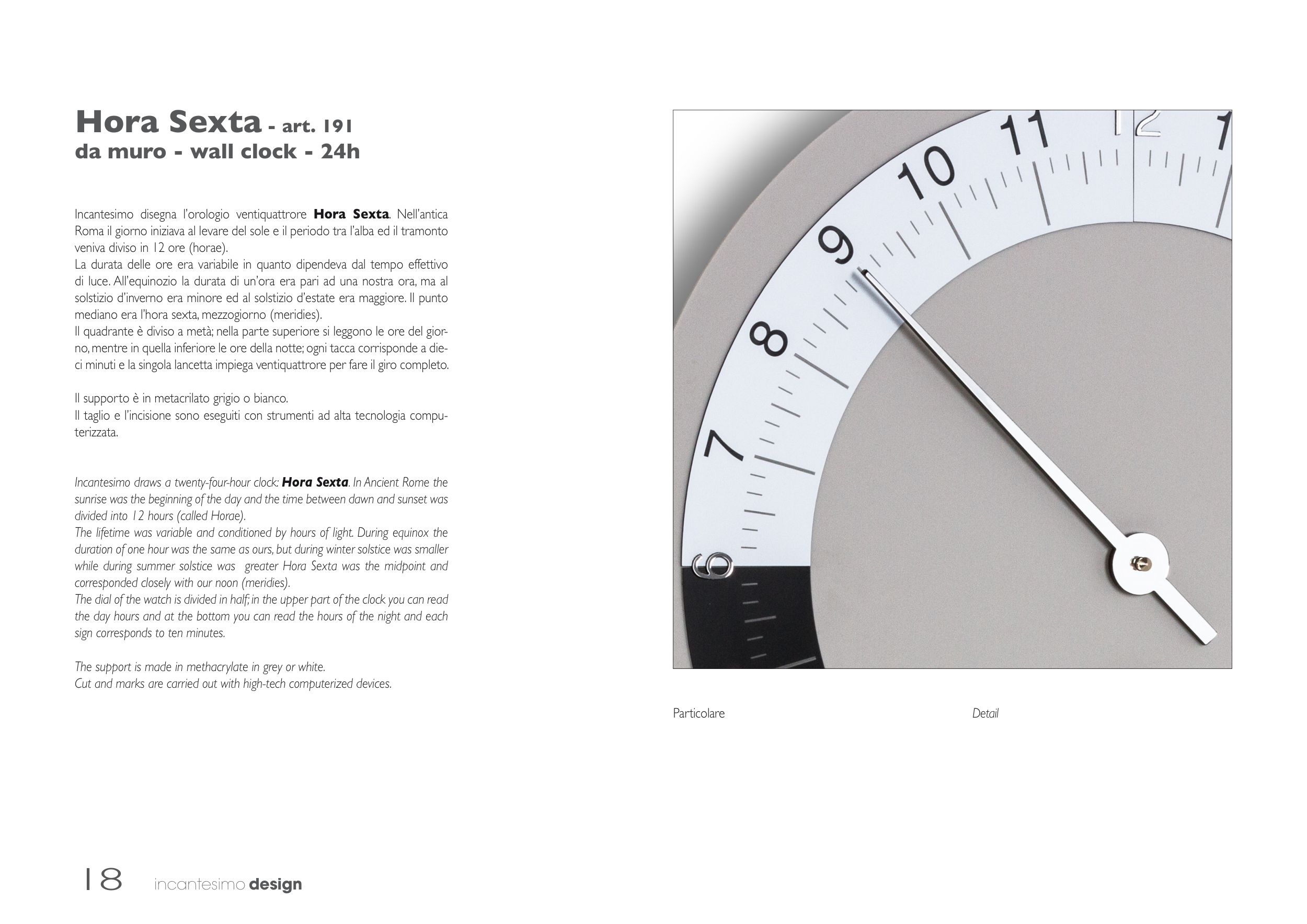
Il quadrante è diviso a metà; nella parte superiore si leggono le ore del gior-
no, mentre in quella inferiore le ore della notte; ogni tacca corrisponde a die-
ci minuti e la singola lancetta impiega ventiquattrore per fare il giro completo.
Il supporto è in metacrilato grigio o bianco.
Il taglio e l’incisione sono eseguiti con strumenti ad alta tecnologia compu-
terizzata.
Incantesimo draws a twenty-four-hour clock: Hora Sexta. In Ancient Rome the
sunrise was the beginning of the day and the time between da wn and sunset was
divided into 12 hours (called Horae).
The lifetime was variable and conditioned by hours of light. During equinox the
duration of one hour was the same as ours, but during winter solstice was smaller
while during summer solstice was greater Hora Sexta was the midpoint and
corresponded closely with our noon (meridies).
The dial of the watch is divided in half; in the upper part of the clock you can read
the day hours and at the bottom you can read the hours of the night and each
sign corresponds to ten minutes.
The support is made in methacrylate in grey or white.
Cut and marks are carried out with high-tech computerized devices.
Particolare
Detail