15
14
Raisonné 03
Paavo Tynell was born the seventh of nine children
in a working-class family. His parents could not afford an
education for their son beyond elementary school, so at
the age of 16, he went straight into an apprenticeship at
G.M. Sohlberg’s metalsmith workshop. Tynell spent six
years as a sheet-metal worker before taking on another
year’s training as a blacksmith at Koru Oy, a metal
workshop set up by the architect Eino Schroderus that
specialized in electric light fixtures. Tynell’s final project
of the year was a light fixture in brass – the material he
became renowned for.
Tynell supplemented his practical experience at Koru
with evening classes at Helsinki’s Central School of
Applied Arts (now part of Aalto University). In 1916 he
left Koru and continued his studies in metal embossing at
the Central School as a day student. Here, he was taught
by the polymath artist and designer Eric O.W. Ehrström,
and within a year, Tynell’s skills had so impressed the
faculty that he was invited to take up a post as a metalwork
teacher, which he held from 1917 to 1928.
In 1918, Tynell joined his former teacher Ehrström,
metalsmith Frans Nykänen, sculptor Emil Wickström,
and industrialist Gösta Serlachius to found the company
Taito Oy (named after the Finnish word for ‘skill’). As
managing director, Tynell oversaw the production of
a range of light fittings, functional metal objects and
sculptures, as well as large-scale custom designs, from the
company’s foundry.
Tynell served as Taito’s principal designer throughout
the 1920s, supported by a roster of other designers, artists,
and sculptors, including Alvar Aalto, Henry Ericsson,
and Ville Vallgren. By the 1930s, Taito was exclusively
a lighting company, having leaned into the growing
electrification of a newly independent Finland. During the
interwar years, the company earned the reputation as the
trendsetter in the Finnish lighting industry. Tynell’s own
international reputation grew in parallel, largely thanks to
high-profile lighting projects such as Parliament House in
Helsinki, designed by architect Johan Sigfrid Sirén, and
collaborations with leading modernist architects, notably
Alvar Aalto.
MASTERING METAL
One of the key figures in the birth of
modern lighting, Paavo Tynell left behind a
legacy as one of the biggest influences on
early electric lighting design both in
Finland and beyond.
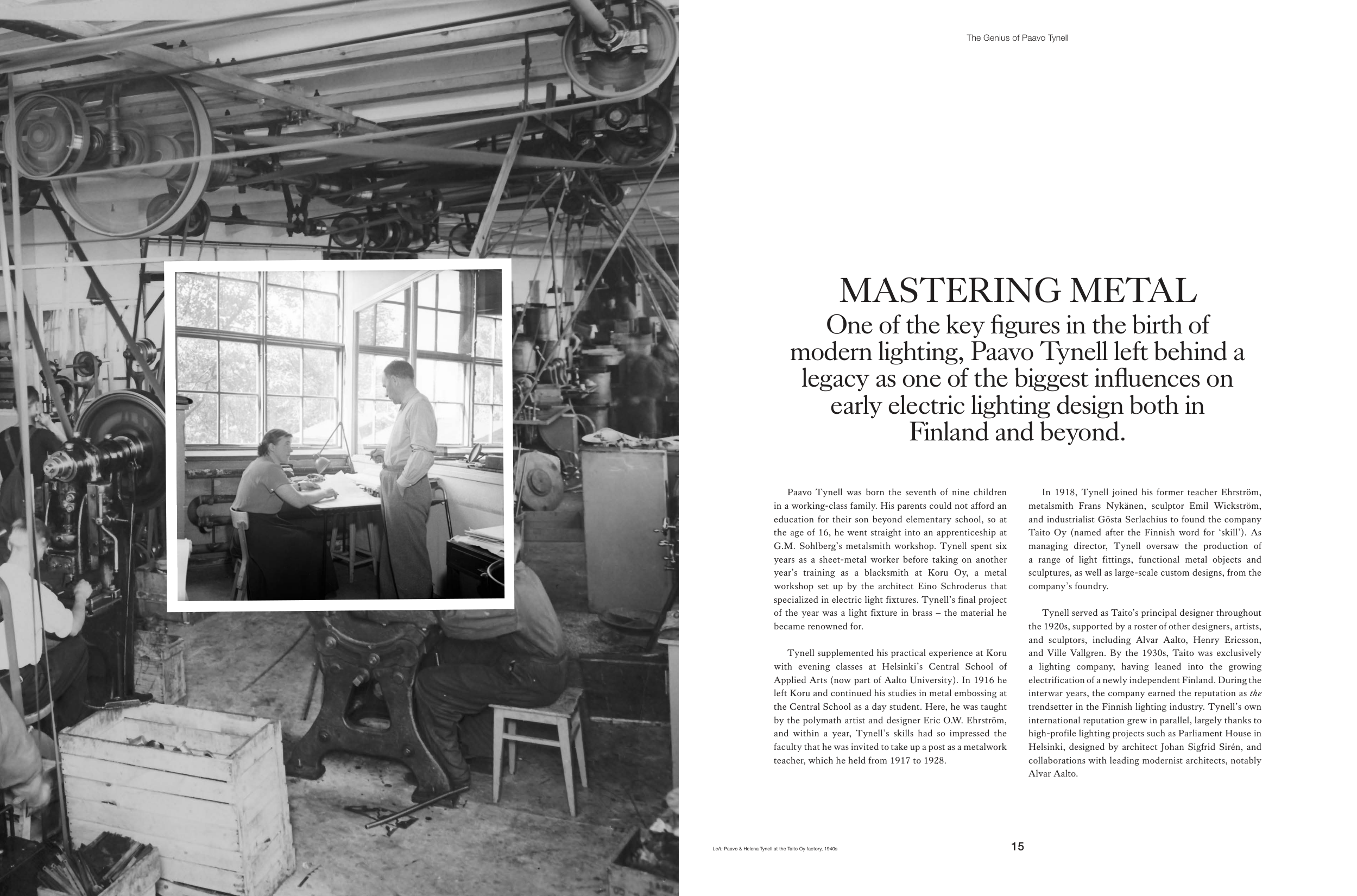
Left: Paavo & Helena Tynell at the Taito Oy factory, 1940s
The Genius of Paavo Tynell