70
The Doric Coffee Table by GamFratesi takes its name
from the Doric order of ancient Greek – and later Roman
– architecture. The oldest and least ornamental of the
three Classical orders, Doric architecture is characterized
by restraint, symmetry, and simplicity, with decorative
features generally limited to the vertical fluting that is
so closely associated with the Doric column. Greek
and Roman architects discovered that carving grooves
into the stone made the pillars present a more rounded
profile than a smooth surface, as well as introducing a
sense of rhythm and balance to the form of the building.
A response to the architectural traditions of the Classical
era, GamFratesi’s Doric Table continues an exploration
that the duo began with the Epic Table, and extends the
studio’s material investigation into the aesthetic and
functional possibilities of limestone. The result is two
very different expressions, and two distinct responses
to the same inspiration: the Classical column. The
tables are crafted either from travertine or lime-stone –
building materials that have been used since the Roman
era. Although different in color, both varieties of natural
stone have a raw materiality that adds a rich texture and
depth to the table, and a natural veining that brings an
inherent visual interest to each table’s expression.
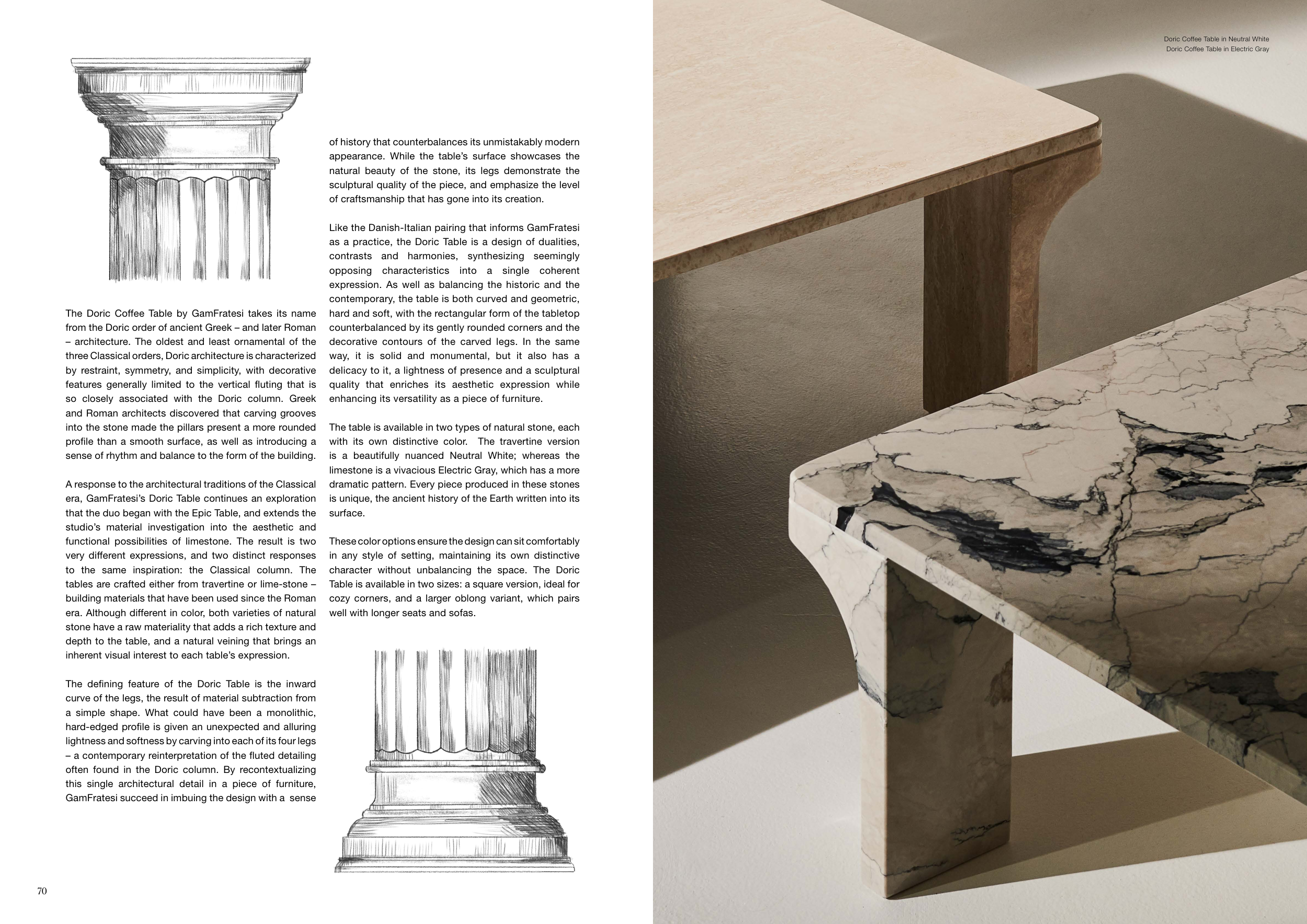
The defining feature of the Doric Table is the inward
curve of the legs, the result of material subtraction from
a simple shape. What could have been a monolithic,
hard-edged profile is given an unexpected and alluring
lightness and softness by carving into each of its four legs
– a contemporary reinterpretation of the fluted detailing
often found in the Doric column. By recontextualizing
this single architectural detail in a piece of furniture,
GamFratesi succeed in imbuing the design with a sense
of history that counterbalances its unmistakably modern
appearance. While the table’s surface showcases the
natural beauty of the stone, its legs demonstrate the
sculptural quality of the piece, and emphasize the level
of craftsmanship that has gone into its creation.
Like the Danish-Italian pairing that informs GamFratesi
as a practice, the Doric Table is a design of dualities,
contrasts and harmonies, synthesizing seemingly
opposing characteristics into a single coherent
expression. As well as balancing the historic and the
contemporary, the table is both curved and geometric,
hard and soft, with the rectangular form of the tabletop
counterbalanced by its gently rounded corners and the
decorative contours of the carved legs. In the same
way, it is solid and monumental, but it also has a
delicacy to it, a lightness of presence and a sculptural
quality that enriches its aesthetic expression while
enhancing its versatility as a piece of furniture.
The table is available in two types of natural stone, each
with its own distinctive color. The travertine version
is a beautifully nuanced Neutral White; whereas the
limestone is a vivacious Electric Gray, which has a more
dramatic pattern. Every piece produced in these stones
is unique, the ancient history of the Earth written into its
surface.
These color options ensure the design can sit comfortably
in any style of setting, maintaining its own distinctive
character without unbalancing the space. The Doric
Table is available in two sizes: a square version, ideal for
cozy corners, and a larger oblong variant, which pairs
well with longer seats and sofas.
Doric Coffee Table in Neutral White
Doric Coffee Table in Electric Gray