46
47
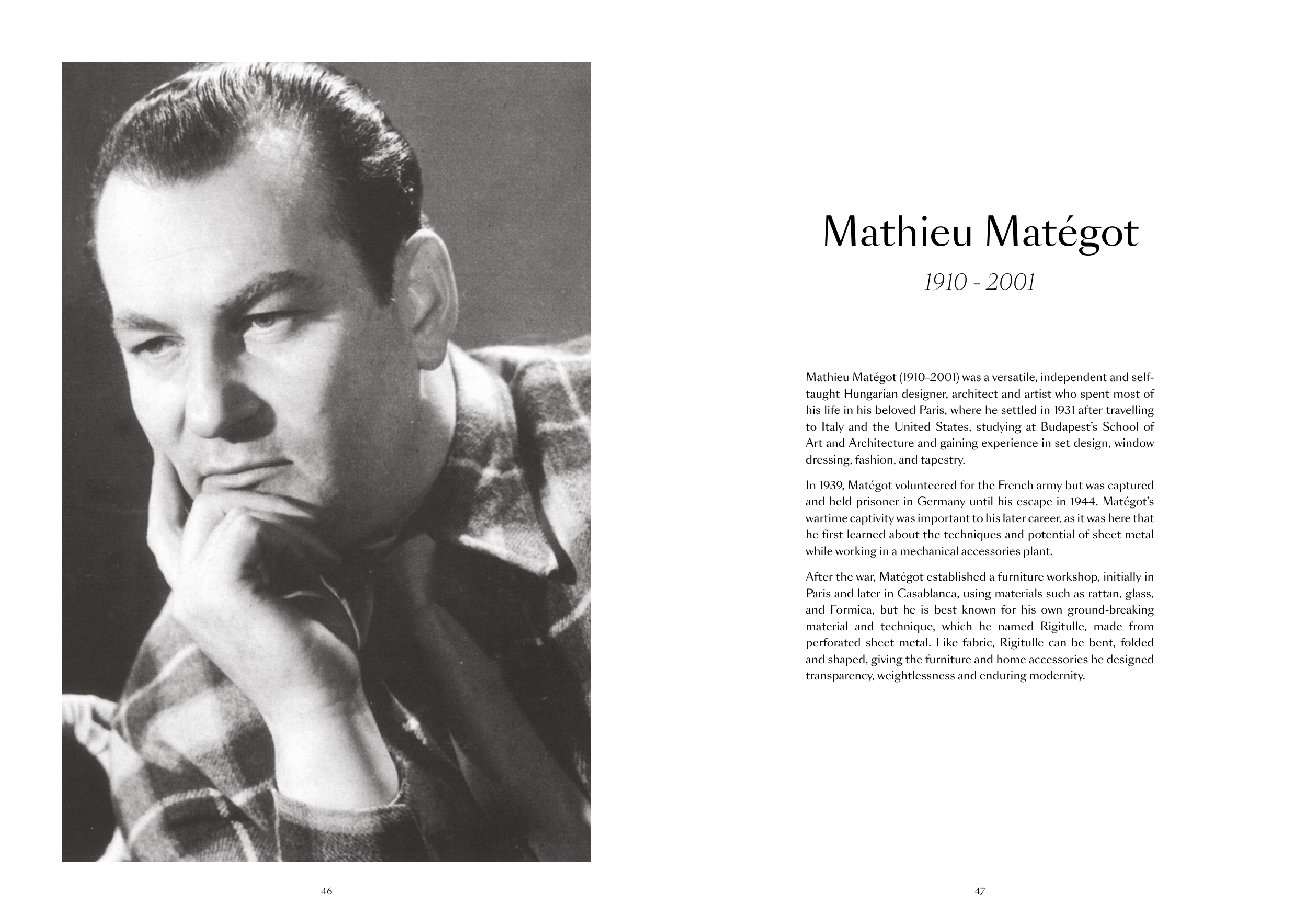
Mathieu Matégot (1910–2001) was a versatile, independent and self-
taught Hungarian designer, architect and artist who spent most of
his life in his beloved Paris, where he settled in 1931 after travelling
to Italy and the United States, studying at Budapest’s School of
Art and Architecture and gaining experience in set design, window
dressing, fashion, and tapestry.
In 1939, Matégot volunteered for the French army but was captured
and held prisoner in Germany until his escape in 1944. Matégot’s
wartime captivity was important to his later career, as it was here that
he first learned about the techniques and potential of sheet metal
while working in a mechanical accessories plant.
After the war, Matégot established a furniture workshop, initially in
Paris and later in Casablanca, using materials such as rattan, glass,
and Formica, but he is best known for his own ground-breaking
material and technique, which he named Rigitulle, made from
perforated sheet metal. Like fabric, Rigitulle can be bent, folded
and shaped, giving the furniture and home accessories he designed
transparency, weightlessness and enduring modernity.
1910 - 2001
Mathieu Matégot