59
58
Raisonné 03
Tynell’s early successes with Finland House
ensured that, throughout the early 1950s, he
received a steady stream of invitations to tender,
and Taito was flooded with commissions. Architects
turned to him for support in a great variety of high-
profile projects, including restaurants and private
houses in the U.S., as well as other parts of the
American continents. Tynell fulfilled a number of
orders for clients in locations such as Cuba and oil-
rich Venezuela.
From Havana, for example, Tynell received an
order for bespoke large-scale lighting fixtures, with
an integrated lift mechanism, for a casino. The cost
of transporting the meter-wide lamps by air came
to around $3,000 – an extraordinary sum for the
time, but one the client was all too happy to pay to
acquire a Tynell original.
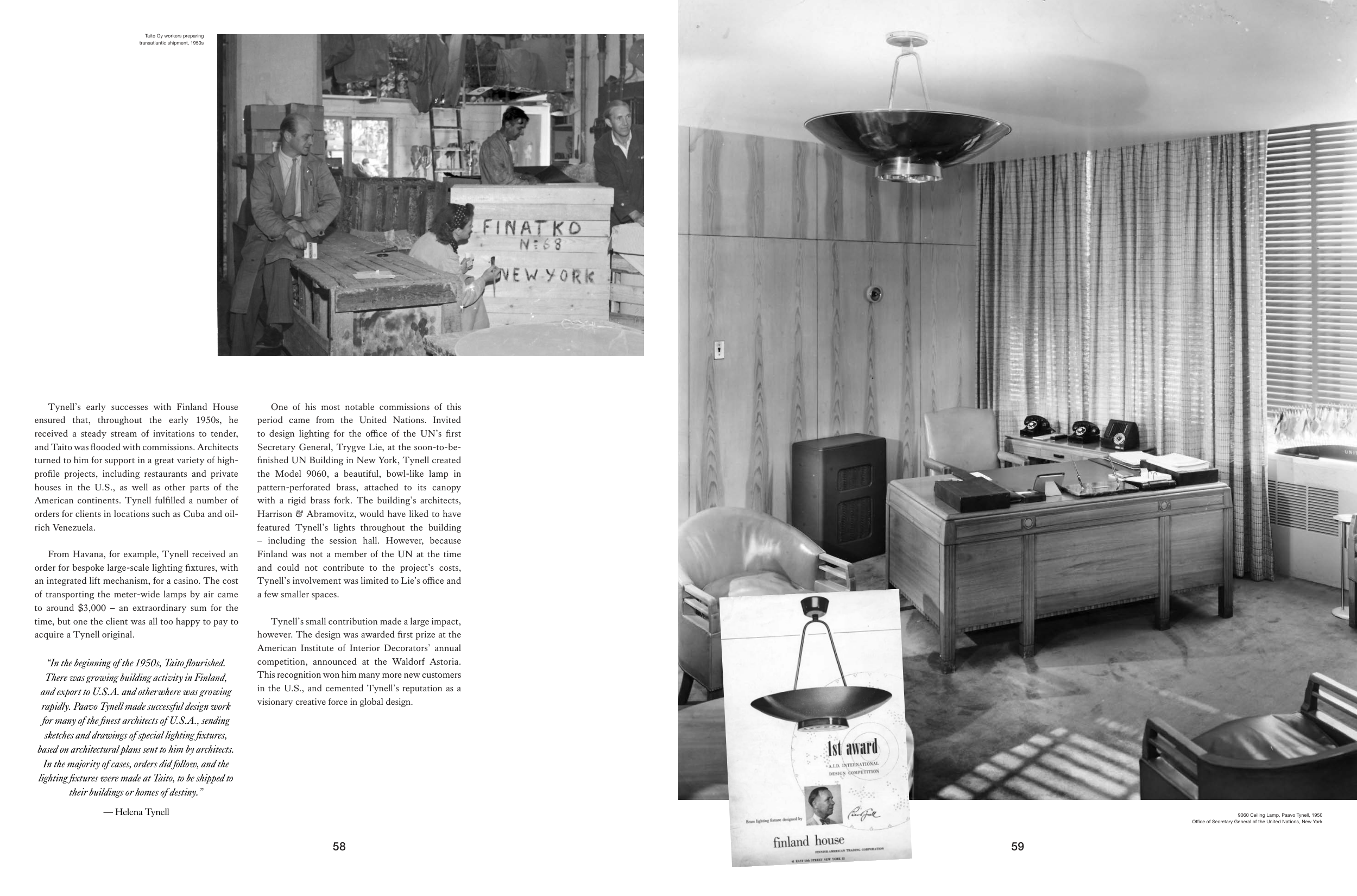
One of his most notable commissions of this
period came from the United Nations. Invited
to design lighting for the office of the UN’s first
Secretary General, Trygve Lie, at the soon-to-be-
finished UN Building in New York, Tynell created
the Model 9060, a beautiful, bowl-like lamp in
pattern-perforated brass, attached to its canopy
with a rigid brass fork. The building’s architects,
Harrison & Abramovitz, would have liked to have
featured Tynell’s lights throughout the building
– including the session hall. However, because
Finland was not a member of the UN at the time
and could not contribute to the project’s costs,
Tynell’s involvement was limited to Lie’s office and
a few smaller spaces.
Tynell’s small contribution made a large impact,
however. The design was awarded first prize at the
American Institute of Interior Decorators’ annual
competition, announced at the Waldorf Astoria.
This recognition won him many more new customers
in the U.S., and cemented Tynell’s reputation as a
visionary creative force in global design.
“In the beginning of the 1950s, Taito flourished.
There was growing building activity in Finland,
and export to U.S.A. and otherwhere was growing
rapidly. Paavo Tynell made successful design work
for many of the finest architects of U.S.A., sending
sketches and drawings of special lighting fixtures,
based on architectural plans sent to him by architects.
In the majority of cases, orders did follow, and the
lighting fixtures were made at Taito, to be shipped to
their buildings or homes of destiny.”
— Helena Tynell
9060 Ceiling Lamp, Paavo Tynell, 1950
Office of Secretary General of the United Nations, New York
Taito Oy workers preparing
transatlantic shipment, 1950s