55
54
Raisonné 03
One day in 1948, at one o’clock in the morning,
Paavo Tynell arrived in New York, hours behind
schedule, speaking no English, and with no money
in his pocket except a check for $1,000 issued by
the Bank of Finland. Encouraged by Taito Oy’s
board chairman Einar Ahlstrom, Tynell was
there to oversee the installation of Taito’s latest
lighting models at Finland House – the Finnish-
American Trading Corporation’s great hope for
the transatlantic triumph of Finnish design.
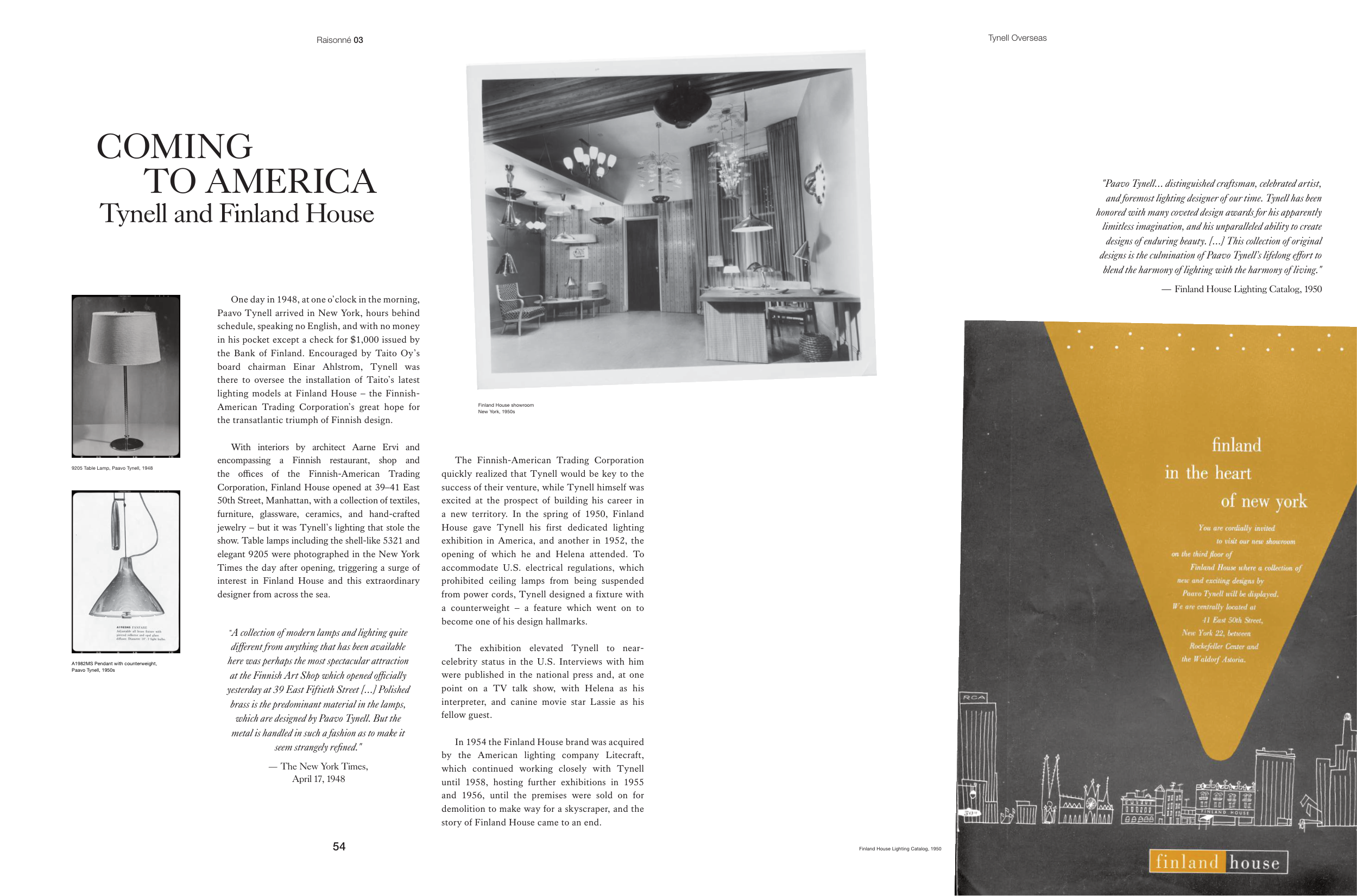
With interiors by architect Aarne Ervi and
encompassing a Finnish restaurant, shop and
the offices of the Finnish-American Trading
Corporation, Finland House opened at 39–41 East
50th Street, Manhattan, with a collection of textiles,
furniture, glassware, ceramics, and hand-crafted
jewelry – but it was Tynell’s lighting that stole the
show. Table lamps including the shell-like 5321 and
elegant 9205 were photographed in the New York
Times the day after opening, triggering a surge of
interest in Finland House and this extraordinary
designer from across the sea.
The Finnish-American Trading Corporation
quickly realized that Tynell would be key to the
success of their venture, while Tynell himself was
excited at the prospect of building his career in
a new territory. In the spring of 1950, Finland
House gave Tynell his first dedicated lighting
exhibition in America, and another in 1952, the
opening of which he and Helena attended. To
accommodate U.S. electrical regulations, which
prohibited ceiling lamps from being suspended
from power cords, Tynell designed a fixture with
a counterweight – a feature which went on to
become one of his design hallmarks.
The exhibition elevated Tynell to near-
celebrity status in the U.S. Interviews with him
were published in the national press and, at one
point on a TV talk show, with Helena as his
interpreter, and canine movie star Lassie as his
fellow guest.
In 1954 the Finland House brand was acquired
by the American lighting company Litecraft,
which continued working closely with Tynell
until 1958, hosting further exhibitions in 1955
and 1956, until the premises were sold on for
demolition to make way for a skyscraper, and the
story of Finland House came to an end.
Finland House showroom
New York, 1950s
9205 Table Lamp, Paavo Tynell, 1948
"A collection of modern lamps and lighting quite
different from anything that has been available
here was perhaps the most spectacular attraction
at the Finnish Art Shop which opened officially
yesterday at 39 East Fiftieth Street […] Polished
brass is the predominant material in the lamps,
which are designed by Paavo Tynell. But the
metal is handled in such a fashion as to make it
seem strangely refined."
— The New York Times,
April 17, 1948
Finland House Lighting Catalog, 1950
Tynell Overseas
"Paavo Tynell… distinguished craftsman, celebrated artist,
and foremost lighting designer of our time. Tynell has been
honored with many coveted design awards for his apparently
limitless imagination, and his unparalleled ability to create
designs of enduring beauty. […] This collection of original
designs is the culmination of Paavo Tynell’s lifelong effort to
blend the harmony of lighting with the harmony of living."
— Finland House Lighting Catalog, 1950
A1982MS Pendant with counterweight,
Paavo Tynell, 1950s
COMING
TO AMERICA
Tynell and Finland House