184
185
The client named the restaurant Tomo after his grandmother, Tomoko, and the
Japanese “tomodachi”, meaning ‘friend’. Friendship and familial connection is
a throughline in how the restaurant approaches both its service and its place in
a developing area south of Seattle.
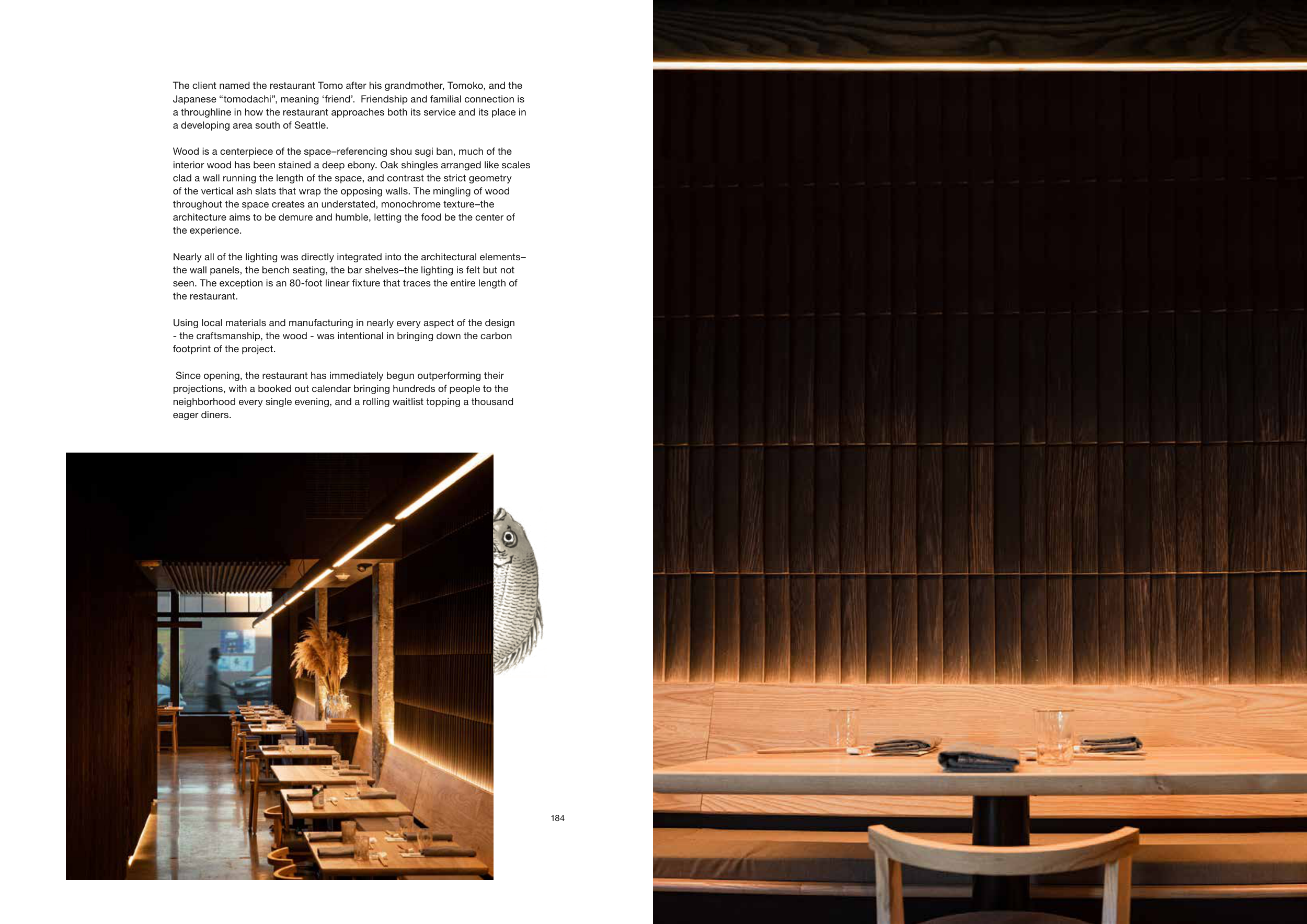
Wood is a centerpiece of the space–referencing shou sugi ban, much of the
interior wood has been stained a deep ebony. Oak shingles arranged like scales
clad a wall running the length of the space, and contrast the strict geometry
of the vertical ash slats that wrap the opposing walls. The mingling of wood
throughout the space creates an understated, monochrome texture–the
architecture aims to be demure and humble, letting the food be the center of
the experience.
Nearly all of the lighting was directly integrated into the architectural elements–
the wall panels, the bench seating, the bar shelves–the lighting is felt but not
seen. The exception is an 80-foot linear fixture that traces the entire length of
the restaurant.
Using local materials and manufacturing in nearly every aspect of the design
- the craftsmanship, the wood - was intentional in bringing down the carbon
footprint of the project.
Since opening, the restaurant has immediately begun outperforming their
projections, with a booked out calendar bringing hundreds of people to the
neighborhood every single evening, and a rolling waitlist topping a thousand
eager diners.