PAVIMENTO POSA TRADIZIONALE
La posa delle lastre
richiede condizioni di posa simili a quelle richieste per lastre in
formato tradizionale.
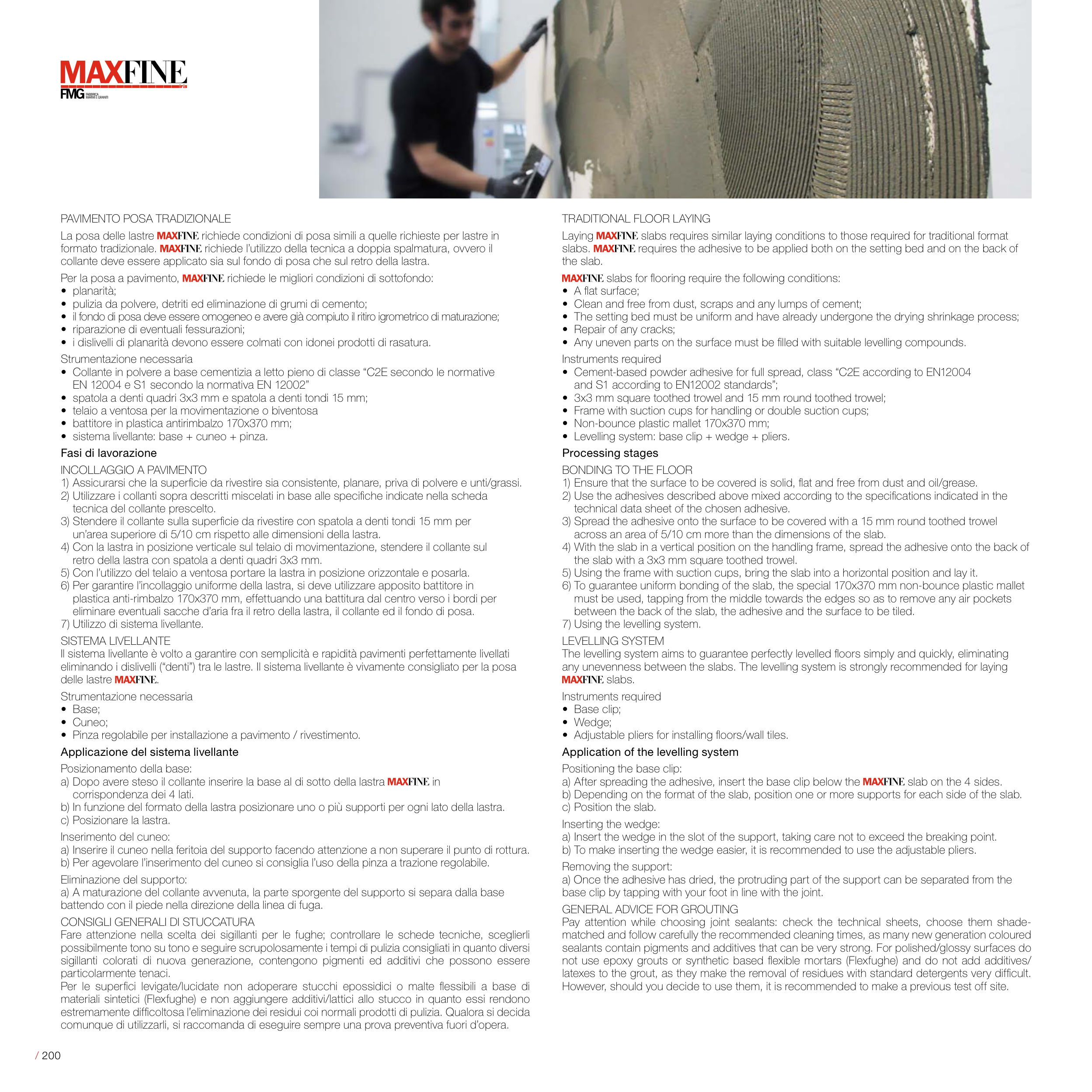
richiede l’utilizzo della tecnica a doppia spalmatura, ovvero il
collante deve essere applicato sia sul fondo di posa che sul retro della lastra.
Per la posa a pavimento,
richiede le migliori condizioni di sottofondo:
• planarità;
• pulizia da polvere, detriti ed eliminazione di grumi di cemento;
• il fondo di posa deve essere omogeneo e avere già compiuto il ritiro igrometrico di maturazione;
• riparazione di eventuali fessurazioni;
• i dislivelli di planarità devono essere colmati con idonei prodotti di rasatura.
Strumentazione necessaria
• Collante in polvere a base cementizia a letto pieno di classe “C2E secondo le normative
EN 12004 e S1 secondo la normativa EN 12002”
• spatola a denti quadri 3x3 mm e spatola a denti tondi 15 mm;
• telaio a ventosa per la movimentazione o biventosa
• battitore in plastica antirimbalzo 170x370 mm;
• sistema livellante: base + cuneo + pinza.
Fasi di lavorazione
INCOLLAGGIO A PAVIMENTO
1) Assicurarsi che la superficie da rivestire sia consistente, planare, priva di polvere e unti/grassi.
2) Utilizzare i collanti sopra descritti miscelati in base alle specifiche indicate nella scheda
tecnica del collante prescelto.
3) Stendere il collante sulla superficie da rivestire con spatola a denti tondi 15 mm per
un’area superiore di 5/10 cm rispetto alle dimensioni della lastra.
4) Con la lastra in posizione verticale sul telaio di movimentazione, stendere il collante sul
retro della lastra con spatola a denti quadri 3x3 mm.
5) Con l’utilizzo del telaio a ventosa portare la lastra in posizione orizzontale e posarla.
6) Per garantire l’incollaggio uniforme della lastra, si deve utilizzare apposito battitore in
plastica anti-rimbalzo 170x370 mm, effettuando una battitura dal centro verso i bordi per
eliminare eventuali sacche d’aria fra il retro della lastra, il collante ed il fondo di posa.
7) Utilizzo di sistema livellante.
SISTEMA LIVELLANTE
Il sistema livellante è volto a garantire con semplicità e rapidità pavimenti perfettamente livellati
eliminando i dislivelli (“denti”) tra le lastre. Il sistema livellante è vivamente consigliato per la posa
delle lastre
.
Strumentazione necessaria
• Base;
• Cuneo;
• Pinza regolabile per installazione a pavimento / rivestimento.
Applicazione del sistema livellante
Posizionamento della base:
a) Dopo avere steso il collante inserire la base al di sotto della lastra
in
corrispondenza dei 4 lati.
b) In funzione del formato della lastra posizionare uno o più supporti per ogni lato della lastra.
c) Posizionare la lastra.
Inserimento del cuneo:
a) Inserire il cuneo nella feritoia del supporto facendo attenzione a non superare il punto di rottura.
b) Per agevolare l’inserimento del cuneo si consiglia l’uso della pinza a trazione regolabile.
Eliminazione del supporto:
a) A maturazione del collante avvenuta, la parte sporgente del supporto si separa dalla base
battendo con il piede nella direzione della linea di fuga.
CONSIGLI GENERALI DI STUCCATURA
Fare attenzione nella scelta dei sigillanti per le fughe; controllare le schede tecniche, sceglierli
possibilmente tono su tono e seguire scrupolosamente i tempi di pulizia consigliati in quanto diversi
sigillanti colorati di nuova generazione, contengono pigmenti ed additivi che possono essere
particolarmente tenaci.
Per le superfici levigate/lucidate non adoperare stucchi epossidici o malte flessibili a base di
materiali sintetici (Flexfughe) e non aggiungere additivi/lattici allo stucco in quanto essi rendono
estremamente difficoltosa l’eliminazione dei residui coi normali prodotti di pulizia. Qualora si decida
comunque di utilizzarli, si raccomanda di eseguire sempre una prova preventiva fuori d’opera.
TRADITIONAL FLOOR LAYING
Laying
slabs requires similar laying conditions to those required for traditional format
slabs.
requires the adhesive to be applied both on the setting bed and on the back of
the slab.
slabs for flooring require the following conditions:
• A flat surface;
• Clean and free from dust, scraps and any lumps of cement;
• The setting bed must be uniform and have already undergone the drying shrinkage process;
• Repair of any cracks;
• Any uneven parts on the surface must be filled with suitable levelling compounds.
Instruments required
• Cement-based powder adhesive for full spread, class “C2E according to EN12004
and S1 according to EN12002 standards”;
• 3x3 mm square toothed trowel and 15 mm round toothed trowel;
• Frame with suction cups for handling or double suction cups;
• Non-bounce plastic mallet 170x370 mm;
• Levelling system: base clip + wedge + pliers.
Processing stages
BONDING TO THE FLOOR
1) Ensure that the surface to be covered is solid, flat and free from dust and oil/grease.
2) Use the adhesives described above mixed according to the specifications indicated in the
technical data sheet of the chosen adhesive.
3) Spread the adhesive onto the surface to be covered with a 15 mm round toothed trowel
across an area of 5/10 cm more than the dimensions of the slab.
4) With the slab in a vertical position on the handling frame, spread the adhesive onto the back of
the slab with a 3x3 mm square toothed trowel.
5) Using the frame with suction cups, bring the slab into a horizontal position and lay it.
6) To guarantee uniform bonding of the slab, the special 170x370 mm non-bounce plastic mallet
must be used, tapping from the middle towards the edges so as to remove any air pockets
between the back of the slab, the adhesive and the surface to be tiled.
7) Using the levelling system.
LEVELLING SYSTEM
The levelling system aims to guarantee perfectly levelled floors simply and quickly, eliminating
any unevenness between the slabs. The levelling system is strongly recommended for laying
slabs.
Instruments required
• Base clip;
• Wedge;
• Adjustable pliers for installing floors/wall tiles.
Application of the levelling system
Positioning the base clip:
a) After spreading the adhesive, insert the base clip below the
slab on the 4 sides.
b) Depending on the format of the slab, position one or more supports for each side of the slab.
c) Position the slab.
Inserting the wedge:
a) Insert the wedge in the slot of the support, taking care not to exceed the breaking point.
b) To make inserting the wedge easier, it is recommended to use the adjustable pliers.
Removing the support:
a) Once the adhesive has dried, the protruding part of the support can be separated from the
base clip by tapping with your foot in line with the joint.
GENERAL ADVICE FOR GROUTING
Pay attention while choosing joint sealants: check the technical sheets, choose them shade-
matched and follow carefully the recommended cleaning times, as many new generation coloured
sealants contain pigments and additives that can be very strong. For polished/glossy surfaces do
not use epoxy grouts or synthetic based flexible mortars (Flexfughe) and do not add additives/
latexes to the grout, as they make the removal of residues with standard detergents very difficult.
However, should you decide to use them, it is recommended to make a previous test off site.
/ 200