1987
È una stagione di grande energia per tutti quelli
che sono coinvolti in questo progetto.
Lorena Nera lo ricorda così: «Imbustavamo i
cataloghi nella sala riunioni, Messina compreso.
Eravamo in tre, lo facevamo il sabato e la
domenica mattina. Il suo era un coinvolgimento
totale, un entusiasmo che sapeva passare ai
dipendenti. Io arrivavo a casa e parlavo solo
della Flou. Era brillante, spiritoso. Non diceva
‘io’, ma ‘noi’. Teneva la porta dell’ufficio aperta,
era convinto della necessità che tutti sapessero
tutto. Si metteva in gioco: ‘Se vi dico di no,
ritornate’. Voleva a tutti i costi fare qualcosa di
grande».
In azienda il lavoro va svelto: gli elementi per la
struttura del letto arrivano da fornitori esterni, lì
si procede alle fasi finali e più delicate,
assemblaggio e rivestimento.
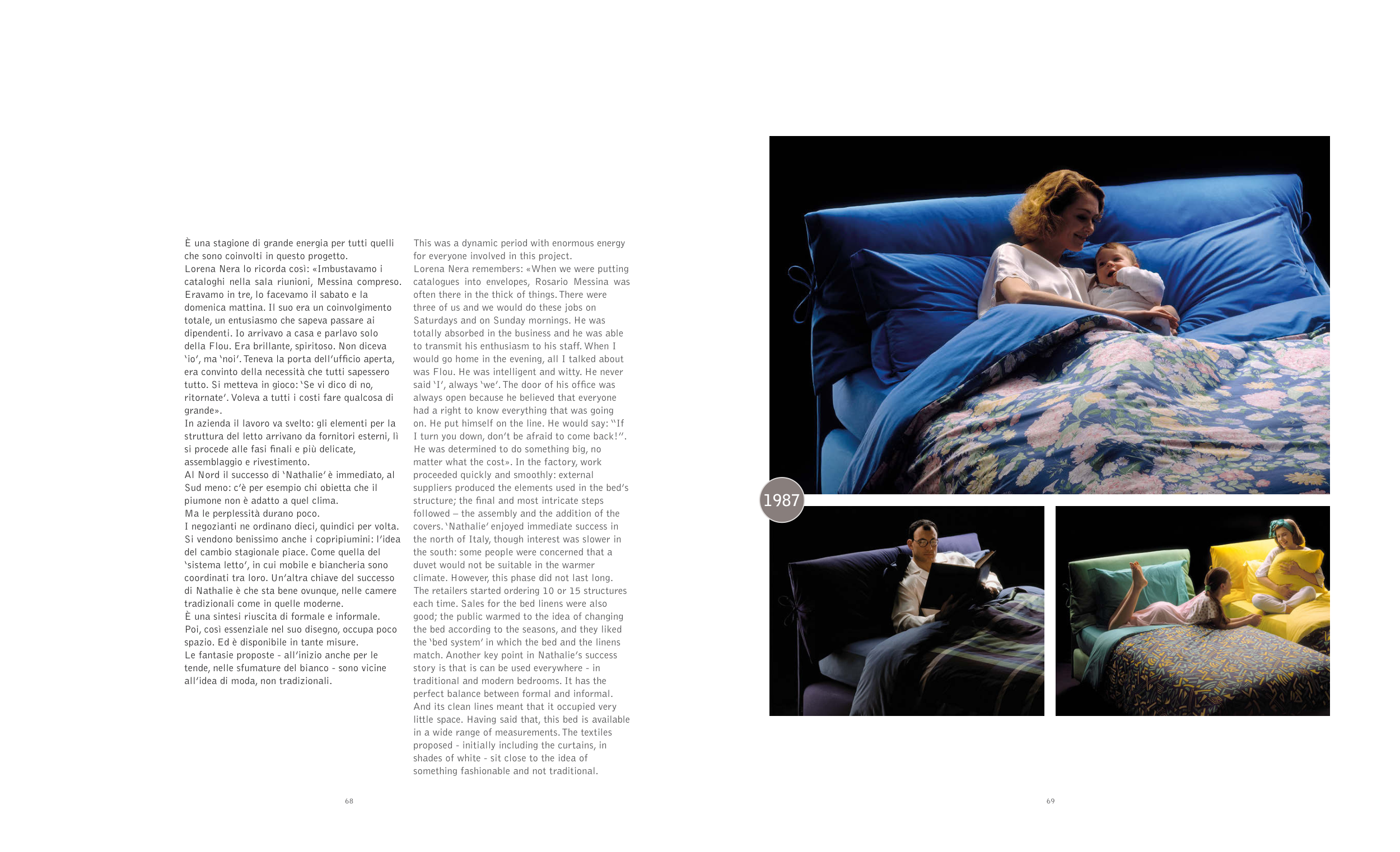
Al Nord il successo di ‘Nathalie’ è immediato, al
Sud meno: c’è per esempio chi obietta che il
piumone non è adatto a quel clima.
Ma le perplessità durano poco.
I negozianti ne ordinano dieci, quindici per volta.
Si vendono benissimo anche i copripiumini: l’idea
del cambio stagionale piace. Come quella del
‘sistema letto’, in cui mobile e biancheria sono
coordinati tra loro. Un’altra chiave del successo
di Nathalie è che sta bene ovunque, nelle camere
tradizionali come in quelle moderne.
È una sintesi riuscita di formale e informale.
Poi, così essenziale nel suo disegno, occupa poco
spazio. Ed è disponibile in tante misure.
Le fantasie proposte - all’inizio anche per le
tende, nelle sfumature del bianco - sono vicine
all’idea di moda, non tradizionali.
This was a dynamic period with enormous energy
for everyone involved in this project.
Lorena Nera remembers: «When we were putting
catalogues into envelopes, Rosario Messina was
often there in the thick of things. There were
three of us and we would do these jobs on
Saturdays and on Sunday mornings. He was
totally absorbed in the business and he was able
to transmit his enthusiasm to his staff. When I
would go home in the evening, all I talked about
was Flou. He was intelligent and witty. He never
said ‘I’, always ‘we’. The door of his office was
always open because he believed that everyone
had a right to know everything that was going
on. He put himself on the line. He would say: “If
I turn you down, don’t be afraid to come back!”.
He was determined to do something big, no
matter what the cost». In the factory, work
proceeded quickly and smoothly: external
suppliers produced the elements used in the bed’s
structure; the final and most intricate steps
followed – the assembly and the addition of the
covers. ‘Nathalie’ enjoyed immediate success in
the north of Italy, though interest was slower in
the south: some people were concerned that a
duvet would not be suitable in the warmer
climate. However, this phase did not last long.
The retailers started ordering 10 or 15 structures
each time. Sales for the bed linens were also
good; the public warmed to the idea of changing
the bed according to the seasons, and they liked
the ‘bed system’ in which the bed and the linens
match. Another key point in Nathalie’s success
story is that is can be used everywhere - in
traditional and modern bedrooms. It has the
perfect balance between formal and informal.
And its clean lines meant that it occupied very
little space. Having said that, this bed is available
in a wide range of measurements. The textiles
proposed - initially including the curtains, in
shades of white - sit close to the idea of
something fashionable and not traditional.
68
69