Progetta molti interni, disegna ville, inizia a
insegnare al Royal College of Art di Londra,
inventa mobili di grande successo, gli vengono
dedicate mostre. Continua a essere attivo fino
all’ultimo: muore nel 2006, pochi mesi dopo
aver firmato un nuovo progetto.
Vico Magistretti è stato uno dei grandi
protagonisti dell’Italian Design, che ha
contribuito a far nascere e che ha spesso
definito ‘miracoloso’, verificatosi solo grazie
all’incontro tra progettisti e produttori.
Il suo modo di lavorare era veloce e quasi
astratto. Schizzava disegni veloci, colorati, dove
capitava: un foglio d’agenda, un bloc-notes,
un biglietto di tram. Idee acchiappate appena si
formavano. La messa in pratica si concretizzava
in un dialogo serrato con collaboratori esterni
che davano forma alle sue intuizioni.
Lui vedeva come avevano tradotto i suoi disegni,
ascoltava le loro considerazioni, aggiustava il
tiro se c’era bisogno di farlo.
È presente nella collezione del MoMA di New
York con dodici oggetti, tra cui la famosa
‘Eclisse’: che non è sulla sua tomba, come
temeva, ma è davvero un piccolo monumento.
Soprattutto al suo modo di fare progetto, che poi
era un modo di pensare. Per lui l’abilità del
designer era saper guardare le cose di tutti i
giorni con occhi diversi: «Perché tutto già c’è, è
solo un po’ nascosto». Il suo punto di partenza
non era uno stile o uno schema decorativo, ma
il ragionamento su una funzione. Spesso resa
concreta da un oggetto-archetipo.
Per ‘Eclisse’ era stata una lanterna cieca citata
da Victor Hugo ne ‘I miserabili’; per il divano
‘Maralunga’, la catena di bicicletta; per il letto
‘Tadao’, ideato sempre per Flou, la tapparella.
Ha realizzato anche molti interni: non decorativi
ma funzionali, «perché chi abiterà la casa ha già
la sua cultura, la sua storia, il suo gusto».
Amava l’essenzialità, andare diritto al cuore
delle cose. A chi lo assisteva nei progetti
chiedeva «Non ricamare!». E cioè: non aggiungere
cose inutili. Una visione di stampo modernista in
cui, però, c’era spazio per un attimo di sorpresa,
per il particolare inatteso. Che spesso diventava
la chiave di volta di tutto.
La bellezza dell’idea.
He designed interiors, detached villas, he began
teaching in London’s Royal College of Art, he
continued creating highly successful pieces of
furniture, exhibitions were dedicated to his work.
His creative energy continued to the end of his
days: sadly he died in 2006, just a few months
after having completed a new project.
Vico Magistretti was one of the greatest
protagonists of Italian Design. He was one of its
founding fathers and defined its success as
something miraculous, unequivocally confirmed
through the interaction between designers and
manufacturers. He worked quickly, in an almost
abstract manner. His sketches were rapid,
colorful, thrown down anywhere - on the page of
a diary, in a notebook, on a tram ticket. His ideas
were immortalized on paper the moment they
came into his mind. The articles would then take
shape through fast-paced, intense dialogue
with external collaborators who moulded his
intuitive ideas into something tangible and real.
He would see how they translated his designs,
he listened to their thoughts, he tweaked them if
required. Twelve of his articles are on display in
the MoMA museum in New York, including the
famous ‘Eclisse’: it was not left on his grave as
he feared; nevertheless, it is a monument to this
great designer, particularly his way of designing
that reflected his way of thinking. He believed
that a designer’s creative ability stemmed from
being able to observe everyday items from a
different perspective: «Because everything exists
already, it is just hidden from view». His starting
point was not a style or a decorative orientation,
but based on the logic of the function, and this
often led to archetypes. The inspiration for
‘Eclisse’ was a closed lantern Victor Hugo
mentioned in ‘Les Miserables’; for the sofa
‘Maralunga’, the chain of a bicycle; the bed
‘Tadao’ that he designed for Flou, was inspired
by roller shutters on external doors and windows,
used for security or as sunblinds. He designed
countless interiors - not decorative but highly
functional, «because the people who live in that
home already have their own culture, their own
history, their own taste». He was passionate
about minimalism, he loved targeting the heart
of the article. He demanded that the people who
helped him with his projects avoided ‘any
embroidery’; he did not want them to add
anything useless or superfluous. His vision was
modernist yet there was always room for the
element of surprise, for something unexpected.
And these quirky twists often became the
lynchpin of the entire design, expressing the
beauty of the idea.
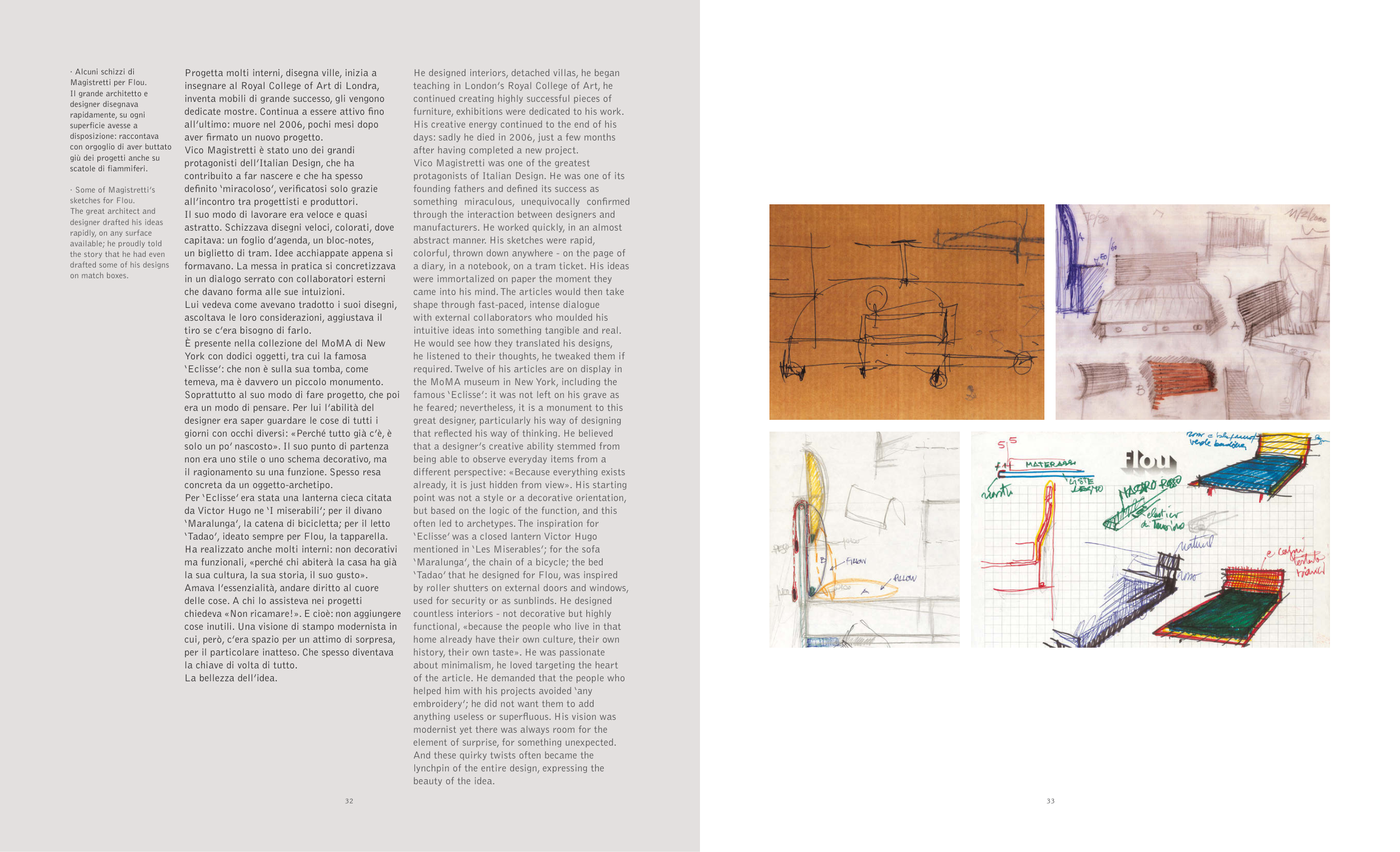
· Alcuni schizzi di
Magistretti per Flou.
Il grande architetto e
designer disegnava
rapidamente, su ogni
superficie avesse a
disposizione: raccontava
con orgoglio di aver buttato
giù dei progetti anche su
scatole di fiammiferi.
· Some of Magistretti’s
sketches for Flou.
The great architect and
designer drafted his ideas
rapidly, on any surface
available; he proudly told
the story that he had even
drafted some of his designs
on match boxes.
32
33