In uno dei primi incontri, Magistretti abbozza su
un foglio, in velocità, due ovali morbidi.
Uno lungo, orizzontale e uno più piccolo,
verticale: «Una base così, una testata così,
e il letto è fatto».
Dove i due ovali rappresentano il piumone,
che nella sua idea deve salire anche sulla testata.
Nel tempo il concetto si perfeziona. Per dare
risalto alla morbidezza del piumone sulla testata
Magistretti suggerisce di tenderlo a metà altezza,
lasciandolo libero di gonfiarsi in alto e in basso.
Come fanno i bottoni nelle classiche imbottiture
capitonné, ma in modo infinitamente più
semplice e leggero.
Il designer fa alcune prove in azienda su un
modello di letto con una tavola di legno come
testata. Alla fine della giornata un piumone
rimane appoggiato sullo schienale, per poi poter
continuare a sperimentare dal vero, l’indomani,
possibili sistemazioni.
Per evitare spostamenti o cadute un operaio lo
fissa con uno spago, che annoda a fiocco sul lato.
Magistretti lo vede e decide: la tensione che crea
è perfetta. Quel fiocco è la soluzione che stava
cercando. Era necessario. Perché, come diceva,
«I dettagli nascono mentre progetto, sono
funzionali all’insieme».
One was long and horizontal and the other was
smaller and vertical: «A base, then a headboard
and voilà! the bed has been designed» The two
oval shapes represented the duvet; in his mind,
the duvet also had to cover the headboard. Over
time, this concept was improved, tweaked and
perfected. To enhance the softness and comfort
of the duvet, Magistretti suggested anchoring it
halfway, leaving it free to fluff up at the top and
at the bottom - similar to the buttons used in the
classical capitonné padding and upholstery.
However, Magistretti’s vision was infinitely
lighter and easier. The designer completed a few
test runs in the factory on a model of bed with
a large wooden plank as the headboard. At the
end of that days’ work, the duvet was left draped
over the backrest so that experimentation could
continue the following day, with changes or
modifications that were felt necessary. To prevent
the duvet moving or falling to the ground, one of
the staff anchored it with a piece of string tied
in a bow on one side. When Magistretti saw it, he
decided that the effect created by the string was
perfect. The bow was the solution he was looking
for. It was a eureka moment! He explained,
«The fine details emerge as the design process
progresses; they are functional developments of
the ensemble».
That is what it was like working with Magistretti;
a lot of the decisions were based on instant
intuitive decisions, opinions that were given or
received, brainstorming.
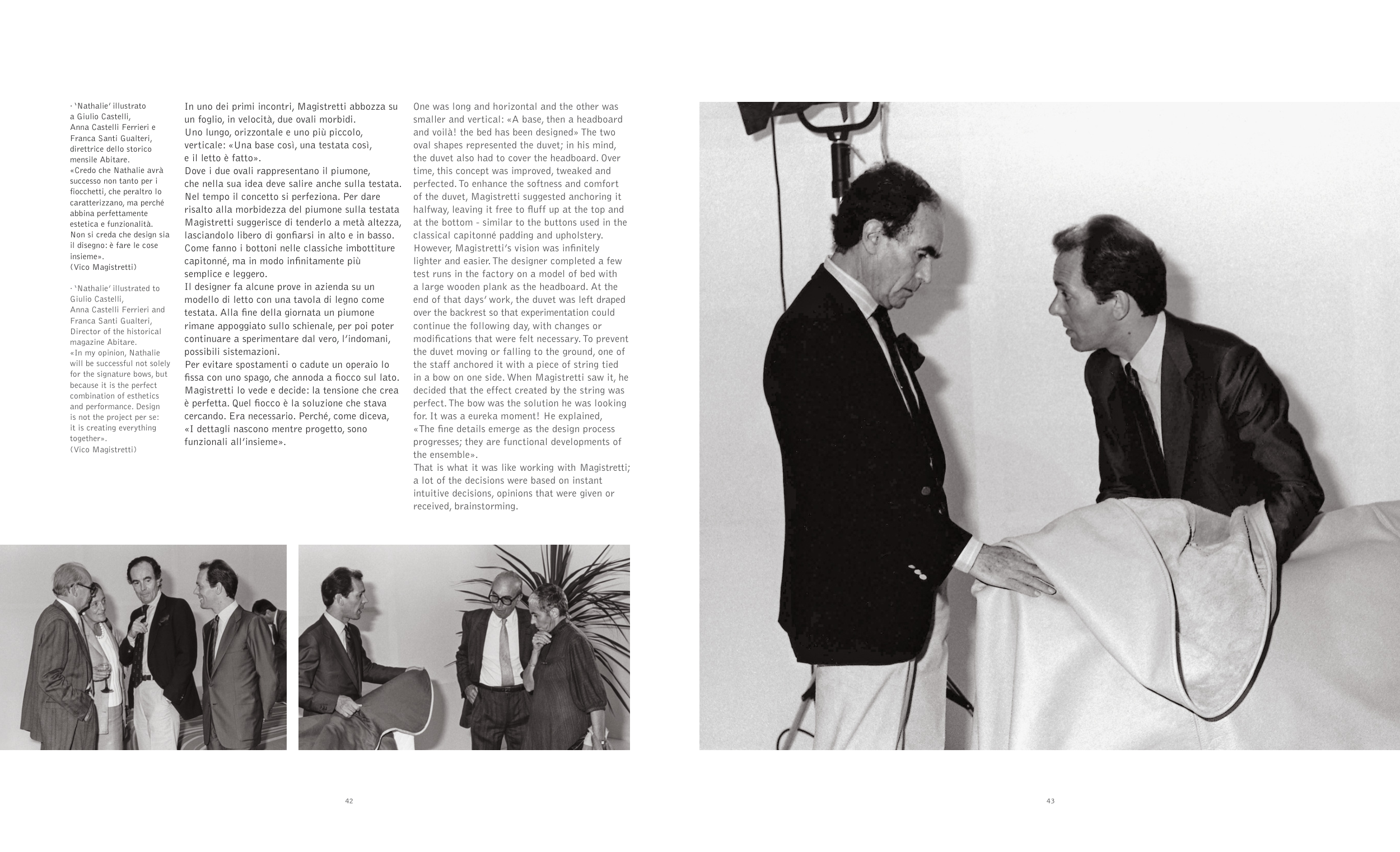
· ‘Nathalie’ illustrato
a Giulio Castelli,
Anna Castelli Ferrieri e
Franca Santi Gualteri,
direttrice dello storico
mensile Abitare.
«Credo che Nathalie avrà
successo non tanto per i
fiocchetti, che peraltro lo
caratterizzano, ma perché
abbina perfettamente
estetica e funzionalità.
Non si creda che design sia
il disegno: è fare le cose
insieme».
(Vico Magistretti)
· ‘Nathalie’ illustrated to
Giulio Castelli,
Anna Castelli Ferrieri and
Franca Santi Gualteri,
Director of the historical
magazine Abitare.
«In my opinion, Nathalie
will be successful not solely
for the signature bows, but
because it is the perfect
combination of esthetics
and performance. Design
is not the project per se:
it is creating everything
together».
(Vico Magistretti)
42
43