Come tanti architetti dell’epoca, Magistretti
lavora su due scale diverse: quella degli edifici
e quella degli oggetti.
Nel 1946 presenta a una mostra alcuni piccoli
mobili, nei due anni seguenti partecipa alle
esposizioni che Fede Cheti, creatrice di tessuti
per l’arredamento, organizza per dare visibilità
al lavoro dei giovani progettisti dell’epoca.
Si trovano insieme personaggi diversi ma che di
lì a pochi anni saranno tutti dei protagonisti di
spicco dell’architettura e del design italiano.
E si riveleranno fondamentali nell’elaborazione
di una brillante cultura del progetto. Insieme a
Vico ci sono infatti Marco Zanuso, Achille
Castiglioni, Ignazio Gardella, Franco Albini:
è, in modo informale, la nascita di un’epoca.
Negli anni successivi Magistretti fa moltissime
cose: progetta, insieme ad altri architetti,
14 interventi per INA-Casa; partecipa al
Quartiere Triennale 8, impresa collettiva pensata
per dare casa agli sfollati della guerra; riceve
la medaglia d’oro alla IX Triennale di Milano
(1951) e il gran premio della seguente (1954).
Nel 1956 è tra i soci fondatori dell’Associazione
Disegno Industriale e fa parte della giuria del
premio Compasso d’Oro, nato da un’idea di
Gio Ponti e sostenuto dalla Rinascente.
Un premio che riceverà lui stesso undici anni
dopo (il primo dei quattro che riceverà in tutta
la sua carriera), nel 1967, con la lampada
‘Eclisse’, disegnata per Artemide, una lampada
geniale che invita al gioco; un oggetto che
diventerà talmente famoso da fargli dire, un
giorno, «me la metteranno pure sulla tomba».
Nello stesso periodo realizza, insieme a
Luigi Caccia Dominioni, il quartiere residenziale
di Milano San Felice a Segrate.
Lavora con i più prestigiosi produttori di mobili,
è direttore artistico di aziende.
È per lui un momento straordinariamente felice
nel suo percorso creativo e professionale.
Questo è anche il periodo in cui inizia la
collaborazione con Rosario Messina e con Flou:
nasce il letto ‘Nathalie’ (1978) a cui seguono
‘Andrej’ (1980), ‘Tadao’ (1993) e molti altri;
l’ultimo sarà ‘Nouvelle’, del 2005.
Like many architects of that time, Magistretti
worked in two different scales: large buildings
and small design items.
In 1946, he presented some small pieces of
furniture at an exhibition; in the two years that
followed, he took part in the exhibitions that
Fede Cheti, creator of upholstery textiles,
organized to promote the work of some of the
young designers emerging at that time. The mixed
group of people was eclectic to say the least but
within the space of a few years, they would
become the cutting-edge protagonists of Italian
architecture and design. They were ultimately the
essential ingredients necessary for the
preparation of a brilliant design culture. Vico
found himself in the company of Marco Zanuso,
Achille Castiglioni, Ignazio Gardella, Franco
Albini: this was undeniably the informal birth of
a design era. In the years that followed,
Magistretti did a whole range of things: with
other architects, he designed 14 projects for
INA-Casa social housing complexes; he was
involved in the construction of the Quartiere
Triennale 8, a collective initiative devised to
provide housing for veterans or people who had
been made homeless or had been evacuated
during the war; he was awarded the Medaglia
d’Oro (gold medal) at the IX Triennale in Milan
(1951) and received the Gran Premio in the
following edition (1954). In 1956, he was a
founding partner of ADI (Industrial Design
Association) and was a member of the jury for
the Compasso d’Oro prize - Gio Ponti’s idea and
supported by La Rinascente. He was a
recipient of this prize eleven years later (the first
of the four he received over his lifetime): in 1967
for the lamp ‘Eclisse’, designed for Artemide, an
ingenious design that invited play and handling;
this article became so famous he stated that
«they will place it on my grave!».
During that same period, along with Luigi
Caccia Dominioni, he created the residential
quarter of Milano San Felice in Segrate. Over
the years, he worked with the leading furniture
manufacturers and was Art director with
numerous companies. It was an extraordinarily
happy and successful period of his creative and
professional career. At this point, he also started
working with Rosario Messina and Flou:
the bed ‘Nathalie’ (1978) arrived and this was
followed by ‘Andrej’ (1980), ‘Tadao’ (1993) and
many more; his last piece was ‘Nouvelle’,
in 2005.
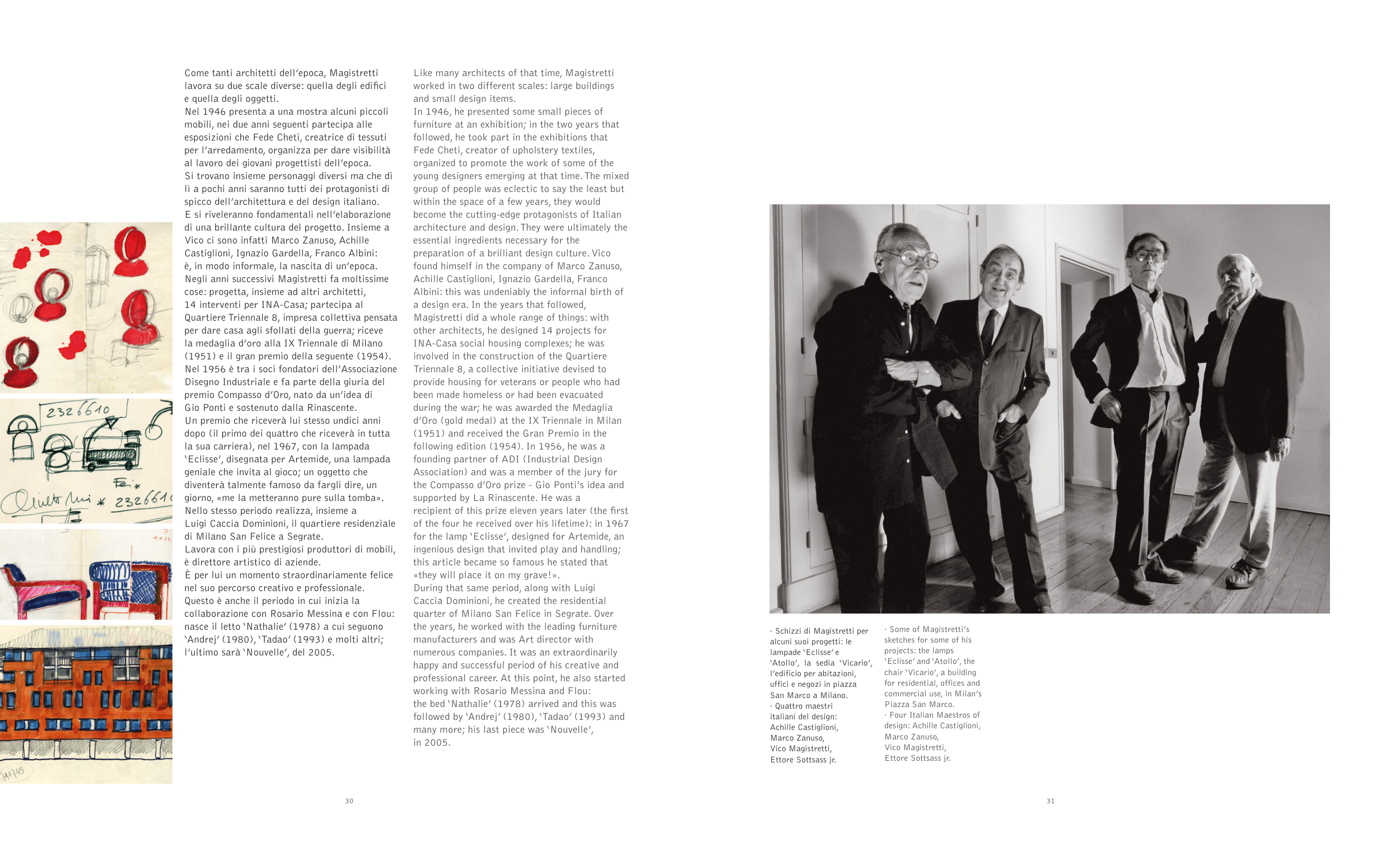
· Schizzi di Magistretti per
alcuni suoi progetti: le
lampade ‘Eclisse’ e
‘Atollo’, la sedia ‘Vicario’,
l’edificio per abitazioni,
uffici e negozi in piazza
San Marco a Milano.
· Quattro maestri
italiani del design:
Achille Castiglioni,
Marco Zanuso,
Vico Magistretti,
Ettore Sottsass jr.
· Some of Magistretti’s
sketches for some of his
projects: the lamps
‘Eclisse’ and ‘Atollo’, the
chair ‘Vicario’, a building
for residential, offices and
commercial use, in Milan’s
Piazza San Marco.
· Four Italian Maestros of
design: Achille Castiglioni,
Marco Zanuso,
Vico Magistretti,
Ettore Sottsass jr.
30
31