«A me piace il concept design, quello che è
talmente chiaro che puoi anche non disegnarlo.
Molti dei miei progetti li ho trasmessi al
telefono». Basta questa citazione per inquadrare
il personaggio di Ludovico - ma per quasi tutta
la vita solo Vico - Magistretti, grande progettista
di architetture e di oggetti, nonché uno dei padri
del design italiano.
Nato a Milano il 6 ottobre del 1920, la sua è una
famiglia di architetti molto attivi in città.
Lo era il bisnonno Gaetano Besia, che aveva
progettato il palazzo Archinto di via Passione; lo
è il padre Pier Giulio Magistretti, che nel 1937
firmerà insieme a Enrico Griffini, Giovanni Muzio
e Piero Portaluppi il progetto per l’Arengario in
piazza del Duomo. Il giovane Ludovico, terminato
il liceo classico, si iscrive al Politecnico di
Milano. È l’autunno del 1939, in Europa si
respira già aria di guerra.
Dopo l’armistizio del 1943 Magistretti, che
all’epoca svolge il servizio di leva, si trasferisce
in Svizzera. Qui continua a studiare e conosce
l’architetto Ernesto Nathan Rogers, triestino
ma milanese d’adozione, uno dei fondatori dello
studio BBPR, che sarà per lui un maestro.
Nel 1945 Magistretti rientra a Milano e si
laurea in Architettura. Nel frattempo è mancato
il padre Pier Giulio: Vico si installa nel suo
studio, insieme al collega Paolo Chessa, entrando
così nella tradizione professionale di famiglia.
Per l’Italia sono anni difficili ed esaltanti. È
l’epoca della ricostruzione, nasce la Repubblica.
Si affermano nuove idee.
Si disegna il futuro.
«I like concept design, the type that is so clear
that there is almost no need to design it. Many of
my projects were relayed by telephone». This
quote succinctly defines the personality of
Ludovico - known for most of his life as Vico -
Magistretti, one of the great creators of
architecture and design articles, in addition to
being one of the fathers of Italian design. He was
born in Milan on October 6, 1920 into a family
of extremely active Milanese architects. For
example, his great-grandfather, Gaetano Besia
designed the Archinto Building in Via Passione;
and his father, Pier Giulio Magistretti, worked
with Enrico Griffini, Giovanni Muzio and Piero
Portaluppi in 1937 to design the plans for the
Palazzo dell’Arengario in the city’s Piazza del
Duomo. When young Ludovico finished his High
School (classical studies), he enrolled in Milan’s
Polytechnic. It was the Fall of 1939, and the
winds of war were howling around Europe.
Following Armistice Day in 1943, Magistretti
who had been conscripted, moved to Switzerland.
There he continued his studies and met the
architect Ernesto Nathan Rogers - originally
from Trieste but Milanese by adoption; Rogers was
one of the founders of studio BBPR and became
a Master mentor for Magistretti.
In 1945, Magistretti returned to Milan and
graduated in Architecture. During this period, his
father Pier Giulio died and Vico took over his
father’s studio with a colleague, Paolo Chessa, to
carry on the family tradition. These were difficult
yet exciting years in Italy. It was the period of
reconstruction, the Republic of Italy was created.
New ideas were emerging.
The future was being designed.
3. VICO MAGISTRETTI
Dalle architetture agli oggetti, il pensiero di uno dei padri del design italiano.
From architecture to household items, the thought-train of one of the fathers of Italian design.
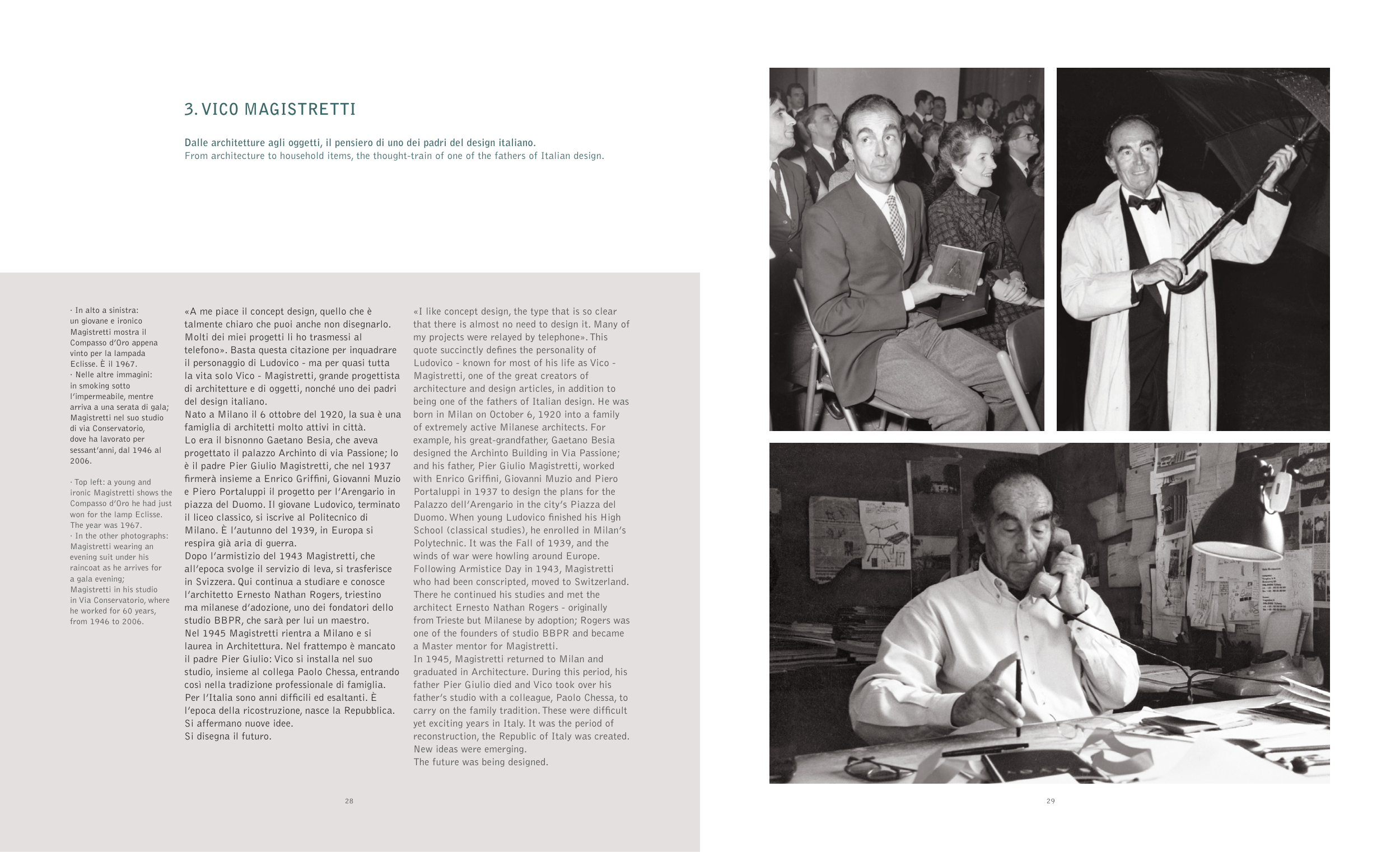
· In alto a sinistra:
un giovane e ironico
Magistretti mostra il
Compasso d’Oro appena
vinto per la lampada
Eclisse. È il 1967.
· Nelle altre immagini:
in smoking sotto
l’impermeabile, mentre
arriva a una serata di gala;
Magistretti nel suo studio
di via Conservatorio,
dove ha lavorato per
sessant’anni, dal 1946 al
2006.
· Top left: a young and
ironic Magistretti shows the
Compasso d’Oro he had just
won for the lamp Eclisse.
The year was 1967.
· In the other photographs:
Magistretti wearing an
evening suit under his
raincoat as he arrives for
a gala evening;
Magistretti in his studio
in Via Conservatorio, where
he worked for 60 years,
from 1946 to 2006.
28
29