80.81
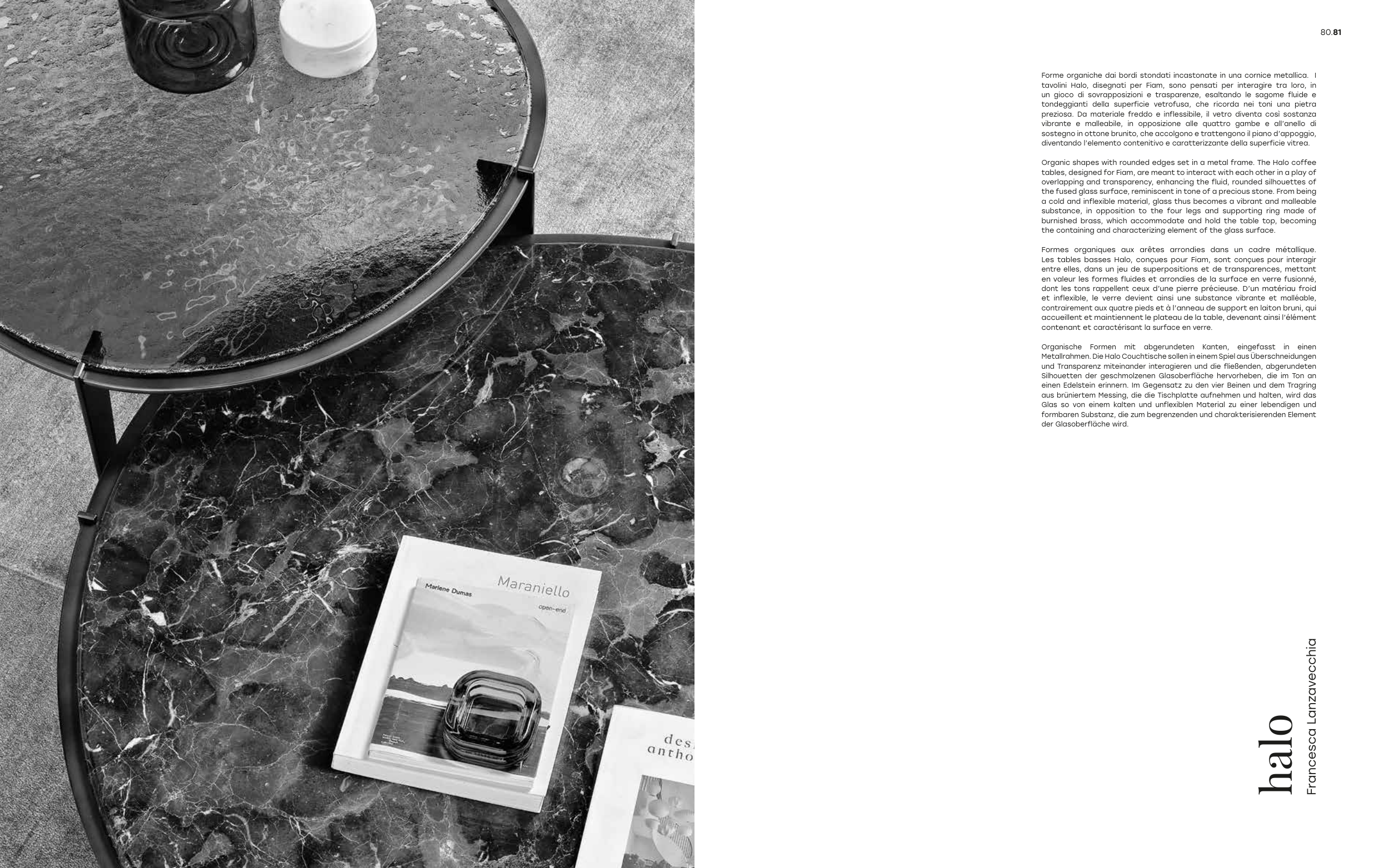
Forme organiche dai bordi stondati incastonate in una cornice metallica. I
tavolini Halo, disegnati per Fiam, sono pensati per interagire tra loro, in
un gioco di sovrapposizioni e trasparenze, esaltando le sagome fluide e
tondeggianti della superficie vetrofusa, che ricorda nei toni una pietra
preziosa. Da materiale freddo e inflessibile, il vetro diventa così sostanza
vibrante e malleabile, in opposizione alle quattro gambe e all’anello di
sostegno in ottone brunito, che accolgono e trattengono il piano d’appoggio,
diventando l’elemento contenitivo e caratterizzante della superficie vitrea.
Organic shapes with rounded edges set in a metal frame. The Halo coffee
tables, designed for Fiam, are meant to interact with each other in a play of
overlapping and transparency, enhancing the fluid, rounded silhouettes of
the fused glass surface, reminiscent in tone of a precious stone. From being
a cold and inflexible material, glass thus becomes a vibrant and malleable
substance, in opposition to the four legs and supporting ring made of
burnished brass, which accommodate and hold the table top, becoming
the containing and characterizing element of the glass surface.
Formes organiques aux arêtes arrondies dans un cadre métallique.
Les tables basses Halo, conçues pour Fiam, sont conçues pour interagir
entre elles, dans un jeu de superpositions et de transparences, mettant
en valeur les formes fluides et arrondies de la surface en verre fusionné,
dont les tons rappellent ceux d’une pierre précieuse. D’un matériau froid
et inflexible, le verre devient ainsi une substance vibrante et malléable,
contrairement aux quatre pieds et à l’anneau de support en laiton bruni, qui
accueillent et maintiennent le plateau de la table, devenant ainsi l’élément
contenant et caractérisant la surface en verre.
Organische
Formen
mit
abgerundeten
Kanten,
eingefasst
in
einen
Metallrahmen. Die Halo Couchtische sollen in einem Spiel aus Überschneidungen
und Transparenz miteinander interagieren und die fließenden, abgerundeten
Silhouetten der geschmolzenen Glasoberfläche hervorheben, die im Ton an
einen Edelstein erinnern. Im Gegensatz zu den vier Beinen und dem Tragring
aus brüniertem Messing, die die Tischplatte aufnehmen und halten, wird das
Glas so von einem kalten und unflexiblen Material zu einer lebendigen und
formbaren Substanz, die zum begrenzenden und charakterisierenden Element
der Glasoberfläche wird.
halo
Francesca Lanzavecchia