“The term quasar originated as a contraction of QUASi-stellAR radio source. It indicates an extremely
luminous active galactic nucleus (AGN), generally very distant from the Earth. The name comes from the fact
that these objects were initially discovered as powerful sources of radio-wave emission of unknown physical
origin, and at visible wavelengths they resembled faint star-like points of light.
Their extreme redshift could imply great distance and velocity. It is commonly believed that their great
luminosity comes from the friction caused by gas and dust falling into a massive black hole.
The first quasars were discovered with radio telescopes at the start of the 1960s and the term QUASAR was
first used in a paper in 1964 by the astrophysicist Hong- Yee Chiu.”
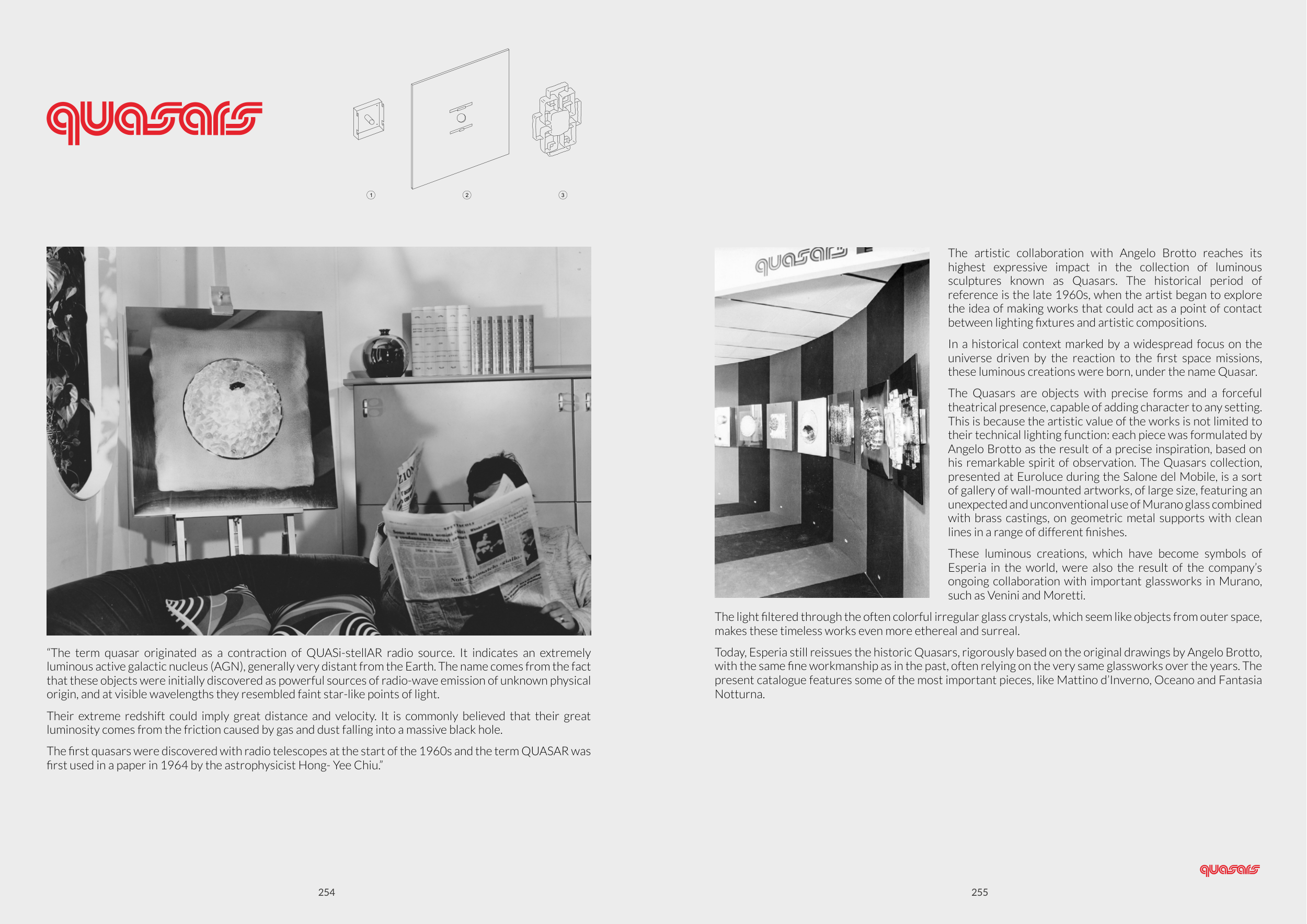
The artistic collaboration with Angelo Brotto reaches its
highest expressive impact in the collection of luminous
sculptures known as Quasars. The historical period of
reference is the late 1960s, when the artist began to explore
the idea of making works that could act as a point of contact
between lighting fixtures and artistic compositions.
In a historical context marked by a widespread focus on the
universe driven by the reaction to the first space missions,
these luminous creations were born, under the name Quasar.
The Quasars are objects with precise forms and a forceful
theatrical presence, capable of adding character to any setting.
This is because the artistic value of the works is not limited to
their technical lighting function: each piece was formulated by
Angelo Brotto as the result of a precise inspiration, based on
his remarkable spirit of observation. The Quasars collection,
presented at Euroluce during the Salone del Mobile, is a sort
of gallery of wall-mounted artworks, of large size, featuring an
unexpected and unconventional use of Murano glass combined
with brass castings, on geometric metal supports with clean
lines in a range of different finishes.
These luminous creations, which have become symbols of
Esperia in the world, were also the result of the company’s
ongoing collaboration with important glassworks in Murano,
such as Venini and Moretti.
The light filtered through the often colorful irregular glass crystals, which seem like objects from outer space,
makes these timeless works even more ethereal and surreal.
Today, Esperia still reissues the historic Quasars, rigorously based on the original drawings by Angelo Brotto,
with the same fine workmanship as in the past, often relying on the very same glassworks over the years. The
present catalogue features some of the most important pieces, like Mattino d’Inverno, Oceano and Fantasia
Notturna.
1
2
3
255
254