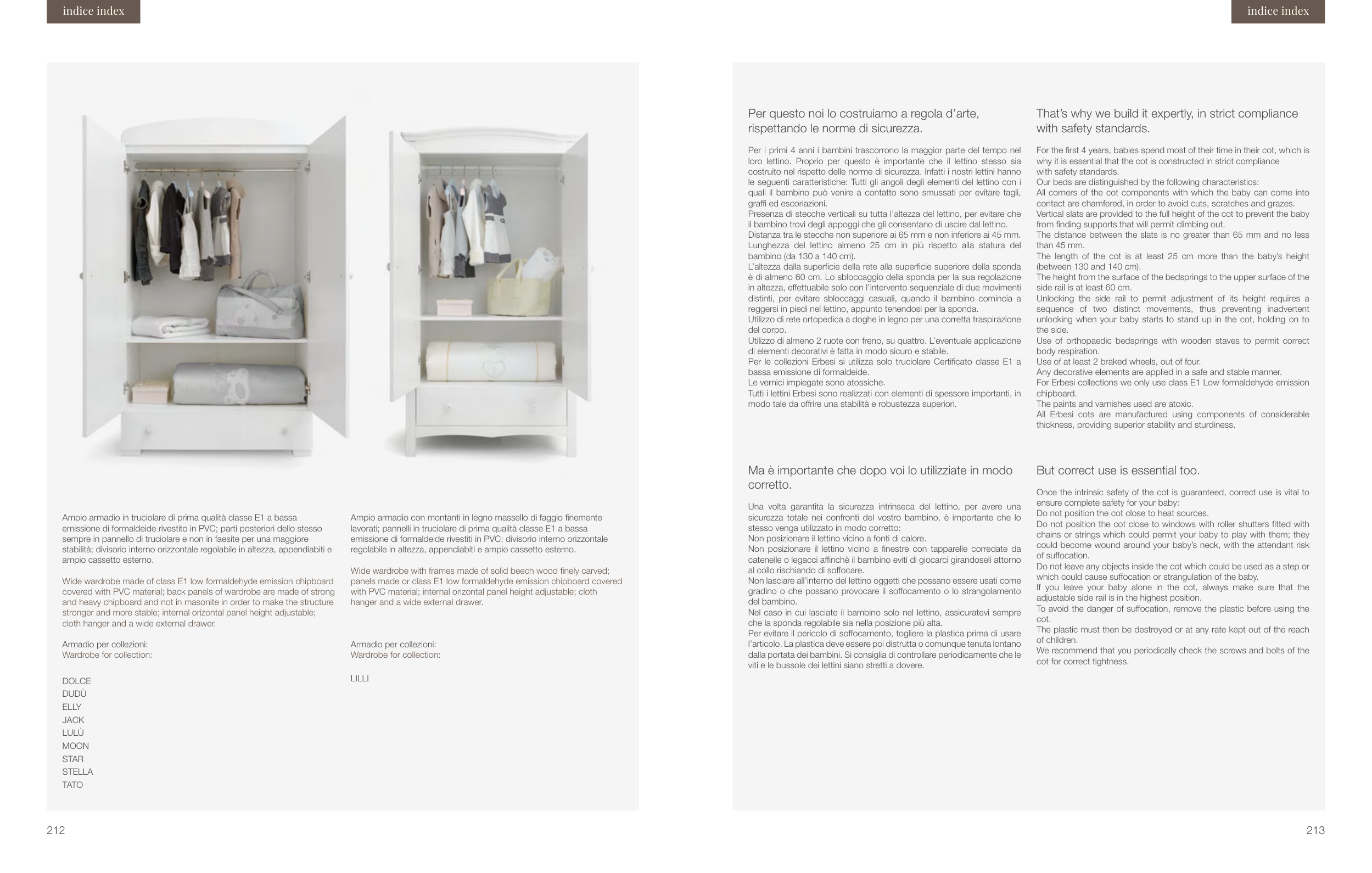
Ampio armadio in truciolare di prima qualità classe E1 a bassa
emissione di formaldeide rivestito in PVC; parti posteriori dello stesso
sempre in pannello di truciolare e non in faesite per una maggiore
stabilità; divisorio interno orizzontale regolabile in altezza, appendiabiti e
ampio cassetto esterno.
Wide wardrobe made of class E1 low formaldehyde emission chipboard
covered with PVC material; back panels of wardrobe are made of strong
and heavy chipboard and not in masonite in order to make the structure
stronger and more stable; internal orizontal panel height adjustable;
cloth hanger and a wide external drawer.
Armadio per collezioni:
Wardrobe for collection:
DOLCE
DUDÙ
ELLY
JACK
LULÙ
MOON
STAR
STELLA
TATO
Ampio armadio con montanti in legno massello di faggio finemente
lavorati; pannelli in truciolare di prima qualità classe E1 a bassa
emissione di formaldeide rivestiti in PVC; divisorio interno orizzontale
regolabile in altezza, appendiabiti e ampio cassetto esterno.
Wide wardrobe with frames made of solid beech wood finely carved;
panels made or class E1 low formaldehyde emission chipboard covered
with PVC material; internal orizontal panel height adjustable; cloth
hanger and a wide external drawer.
Armadio per collezioni:
Wardrobe for collection:
LILLI
Per questo noi lo costruiamo a regola d’arte,
rispettando le norme di sicurezza.
Per i primi 4 anni i bambini trascorrono la maggior parte del tempo nel
loro lettino. Proprio per questo è importante che il lettino stesso sia
costruito nel rispetto delle norme di sicurezza. Infatti i nostri lettini hanno
le seguenti caratteristiche: Tutti gli angoli degli elementi del lettino con i
quali il bambino può venire a contatto sono smussati per evitare tagli,
graffi ed escoriazioni.
Presenza di stecche verticali su tutta l’altezza del lettino, per evitare che
il bambino trovi degli appoggi che gli consentano di uscire dal lettino.
Distanza tra le stecche non superiore ai 65 mm e non inferiore ai 45 mm.
Lunghezza del lettino almeno 25 cm in più rispetto alla statura del
bambino (da 130 a 140 cm).
L’altezza dalla superficie della rete alla superficie superiore della sponda
è di almeno 60 cm. Lo sbloccaggio della sponda per la sua regolazione
in altezza, effettuabile solo con l’intervento sequenziale di due movimenti
distinti, per evitare sbloccaggi casuali, quando il bambino comincia a
reggersi in piedi nel lettino, appunto tenendosi per la sponda.
Utilizzo di rete ortopedica a doghe in legno per una corretta traspirazione
del corpo.
Utilizzo di almeno 2 ruote con freno, su quattro. L’eventuale applicazione
di elementi decorativi è fatta in modo sicuro e stabile.
Per le collezioni Erbesi si utilizza solo truciolare Certificato classe E1 a
bassa emissione di formaldeide.
Le vernici impiegate sono atossiche.
Tutti i lettini Erbesi sono realizzati con elementi di spessore importanti, in
modo tale da offrire una stabilità e robustezza superiori.
Ma è importante che dopo voi lo utilizziate in modo
corretto.
Una volta garantita la sicurezza intrinseca del lettino, per avere una
sicurezza totale nei confronti del vostro bambino, è importante che lo
stesso venga utilizzato in modo corretto:
Non posizionare il lettino vicino a fonti di calore.
Non posizionare il lettino vicino a finestre con tapparelle corredate da
catenelle o legacci affinchè il bambino eviti di giocarci girandoseli attorno
al collo rischiando di soffocare.
Non lasciare all’interno del lettino oggetti che possano essere usati come
gradino o che possano provocare il soffocamento o lo strangolamento
del bambino.
Nel caso in cui lasciate il bambino solo nel lettino, assicuratevi sempre
che la sponda regolabile sia nella posizione più alta.
Per evitare il pericolo di soffocamento, togliere la plastica prima di usare
l’articolo. La plastica deve essere poi distrutta o comunque tenuta lontano
dalla portata dei bambini. Si consiglia di controllare periodicamente che le
viti e le bussole dei lettini siano stretti a dovere.
That’s why we build it expertly, in strict compliance
with safety standards.
For the first 4 years, babies spend most of their time in their cot, which is
why it is essential that the cot is constructed in strict compliance
with safety standards.
Our beds are distinguished by the following characteristics:
All corners of the cot components with which the baby can come into
contact are chamfered, in order to avoid cuts, scratches and grazes.
Vertical slats are provided to the full height of the cot to prevent the baby
from finding supports that will permit climbing out.
The distance between the slats is no greater than 65 mm and no less
than 45 mm.
The length of the cot is at least 25 cm more than the baby’s height
(between 130 and 140 cm).
The height from the surface of the bedsprings to the upper surface of the
side rail is at least 60 cm.
Unlocking the side rail to permit adjustment of its height requires a
sequence of two distinct movements, thus preventing inadvertent
unlocking when your baby starts to stand up in the cot, holding on to
the side.
Use of orthopaedic bedsprings with wooden staves to permit correct
body respiration.
Use of at least 2 braked wheels, out of four.
Any decorative elements are applied in a safe and stable manner.
For Erbesi collections we only use class E1 Low formaldehyde emission
chipboard.
The paints and varnishes used are atoxic.
All Erbesi cots are manufactured using components of considerable
thickness, providing superior stability and sturdiness.
But correct use is essential too.
Once the intrinsic safety of the cot is guaranteed, correct use is vital to
ensure complete safety for your baby:
Do not position the cot close to heat sources.
Do not position the cot close to windows with roller shutters fitted with
chains or strings which could permit your baby to play with them; they
could become wound around your baby’s neck, with the attendant risk
of suffocation.
Do not leave any objects inside the cot which could be used as a step or
which could cause suffocation or strangulation of the baby.
If you leave your baby alone in the cot, always make sure that the
adjustable side rail is in the highest position.
To avoid the danger of suffocation, remove the plastic before using the
cot.
The plastic must then be destroyed or at any rate kept out of the reach
of children.
We recommend that you periodically check the screws and bolts of the
cot for correct tightness.
213
212
indice index
indice index