miei genitori, dove ora sorge la casa prima c’era un orto. Il
giardino è rimasto molto controllato, ma la casa da un lato
si affaccia sul bosco. Ho voluto che gli alberi rimanessero
vicini, addirittura “addosso”. D’estate i rami fanno ombra e la
casa si raffresca in modo naturale; d’inverno le foglie cadono
e la luce entra. È una relazione diretta, quasi fisica. C’è una
ricerca di orizzontalità attraverso un grande tetto verde che
contiene graminacee, che si autogestiscono senza bisogno
di grande manutenzione; c’è persino cresciuto un alberello
che non ho mai piantato. Il tetto sporge rispetto ai volumi, li
avvolge. C’è, anche simbolicamente, l’idea di dormire sotto le
radici. Questa imprevedibilità, in un certo senso “infestante”
e non voluta, mi affascina. Il verde qui è parte integrante
dell’architettura: protegge, isola, racconta.
Laura Arrighi: Suono, luce, silenzio. C’è un elemento naturale
che senti più tuo?
Valentina Moretti: Sicuramente il suono, che qui è
potentissimo. A volte me ne dimentico ma, quando ascolto
un video girato in casa, rimango stupita: uccelli, fruscii,
vento. Il suono “pauroso” della pioggia incessante durante
un temporale mi affascina. Poi c’è il silenzio della notte, che è
quasi assoluto. E ovviamente la luce: ogni stagione, ogni ora,
trasforma lo spazio. Al mattino, la prima cosa che vedo è la
finestra del mio bagno: 90 x 90 centimetri, un quadro vivente
di foglie. Quando arriva l’autunno il paesaggio cambia ogni
giorno. È anche un modo per essere in sintonia con il ritmo
del mondo.
Laura Arrighi: Rimaniamo sulla luce, come gestisci quella
artificiale?
Valentina Moretti: L’illuminazione è fondamentale nel definire
l’atmosfera di uno spazio. Non sopporto gli spazi illuminati
solo da faretti, che danno l’effetto di un aeroporto, troppo
piatti e impersonali. Preferisco usare lampade da appoggio,
da terra e lampadari, che creano delle macchie di luce e
cambiano completamente lo scenario. La luce deve adattarsi
ai momenti della giornata e alle attività che faccio e mi piace
che possa cambiare l’atmosfera.
Laura Arrighi: Hai parlato di ritmo del mondo, di adattamento
della luce. La casa può educare al rapporto con il “naturale”?
Valentina Moretti: Una casa così educa prima di tutto alla
ciclicità. Dimostra che nulla è statico: la natura cambia, e
con lei la casa. Abitua all’idea che non esiste il “per sempre”:
che ogni cosa si trasforma, anche il nostro modo di abitare.
La natura insegna che invecchiare non è un difetto, è un
processo normale. E invita a vivere di più all’esterno, ad
alzarsi, uscire, condividere. Questo ha un impatto educativo
anche sui bambini: imparano che il cambiamento è parte del
gioco della vita.
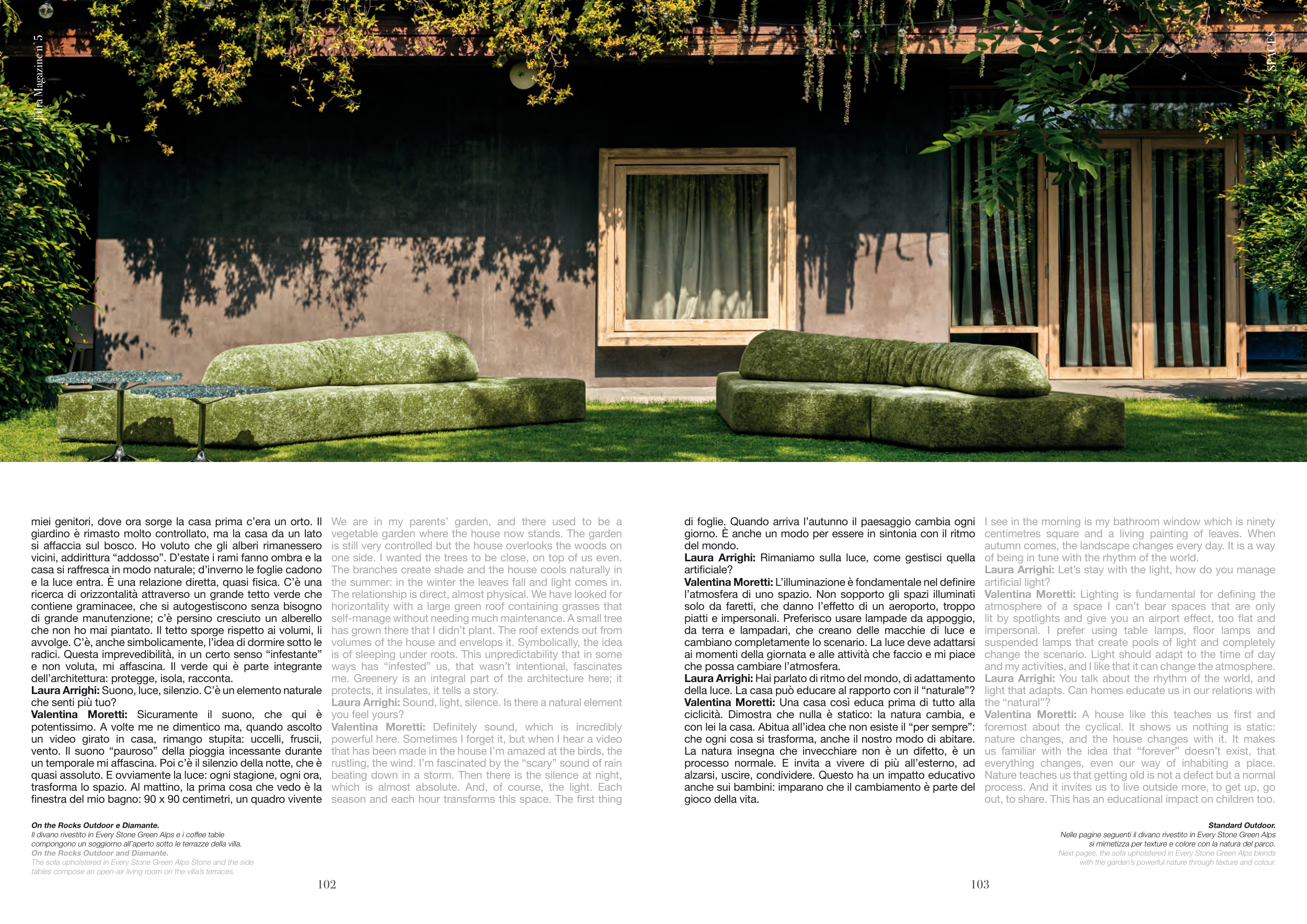
On the Rocks Outdoor e Diamante.
Il divano rivestito in Every Stone Green Alps e i coffee table
compongono un soggiorno all’aperto sotto le terrazze della villa.
On the Rocks Outdoor and Diamante.
The sofa upholstered in Every Stone Green Alps Stone and the side
tables compose an open-air living room on the villa’s terraces.
Standard Outdoor.
Nelle pagine seguenti il divano rivestito in Every Stone Green Alps
si mimetizza per texture e colore con la natura del parco.
Next pages, the sofa upholstered in Every Stone Green Alps blends
with the garden’s powerful nature through texture and colour.
We are in my parents’ garden, and there used to be a
vegetable garden where the house now stands. The garden
is still very controlled but the house overlooks the woods on
one side. I wanted the trees to be close, on top of us even.
The branches create shade and the house cools naturally in
the summer: in the winter the leaves fall and light comes in.
The relationship is direct, almost physical. We have looked for
horizontality with a large green roof containing grasses that
self-manage without needing much maintenance. A small tree
has grown there that I didn’t plant. The roof extends out from
volumes of the house and envelops it. Symbolically, the idea
is of sleeping under roots. This unpredictability that in some
ways has “infested” us, that wasn’t intentional, fascinates
me. Greenery is an integral part of the architecture here; it
protects, it insulates, it tells a story.
Laura Arrighi: Sound, light, silence. Is there a natural element
you feel yours?
Valentina Moretti: Definitely sound, which is incredibly
powerful here. Sometimes I forget it, but when I hear a video
that has been made in the house I’m amazed at the birds, the
rustling, the wind. I’m fascinated by the “scary” sound of rain
beating down in a storm. Then there is the silence at night,
which is almost absolute. And, of course, the light. Each
season and each hour transforms this space. The first thing
I see in the morning is my bathroom window which is ninety
centimetres square and a living painting of leaves. When
autumn comes, the landscape changes every day. It is a way
of being in tune with the rhythm of the world.
Laura Arrighi: Let’s stay with the light, how do you manage
artificial light?
Valentina Moretti: Lighting is fundamental for defining the
atmosphere of a space I can’t bear spaces that are only
lit by spotlights and give you an airport effect, too flat and
impersonal. I prefer using table lamps, floor lamps and
suspended lamps that create pools of light and completely
change the scenario. Light should adapt to the time of day
and my activities, and I like that it can change the atmosphere.
Laura Arrighi: You talk about the rhythm of the world, and
light that adapts. Can homes educate us in our relations with
the “natural”?
Valentina Moretti: A house like this teaches us first and
foremost about the cyclical. It shows us nothing is static:
nature changes, and the house changes with it. It makes
us familiar with the idea that “forever” doesn’t exist, that
everything changes, even our way of inhabiting a place.
Nature teaches us that getting old is not a defect but a normal
process. And it invites us to live outside more, to get up, go
out, to share. This has an educational impact on children too.
Edra Magazine n°5
102
103
SPACES