portare l’attenzione dello spettatore sulla realtà dell’Ignoto,
sulla contemplazione dell’Universo, su quello che c’è oltre la
Terra. Cambia ancora il rapporto tra l’Uomo e la Natura con
Caravaggio, che spinge la sua ricerca in un’altra direzione. Con
la Canestra di frutta (1597-98) della Pinacoteca Ambrosiana
di Milano, il maestro della luce vuole che i protagonisti della
sua opera siano frutti troppo maturi, già intaccati dagli insetti
e con le foglie rinsecchite: una mela bacata, un fico spaccato,
acini d’uva qua e là appassiti. E così, usando l’allegoria del
Memento Mori, attraverso i segni del decadimento, l’artista ci
ricorda che anche l’Uomo è un essere mortale, e la sua esistenza
è effimera, breve quanto foglie
e frutti. Facendo nascere il
genere della Natura Morta,
Caravaggio ci vuole mettere in
guardia dai rischi della Vanitas.
Ora, con un salto temporale di
qualche secolo, arriviamo alla
rappresentazione della Natura
nell’Arte
contemporanea.
E
così ci rendiamo conto che
questa è oggi testimonianza
di qualcosa di compromesso,
segno di un dissolvimento
inarrestabile. Le opere, spesso
affidate alla forza d’impatto
della fotografia, ci restituiscono
la verità delle ferite inflitte
dall’Uomo al Pianeta. La ricerca
artistica passa dal particolare al
generale: se quattro secoli fa
la fugacità della vita umana era
espressa attraverso una foglia
avvizzita e un frutto marcio,
oggi la minaccia al futuro della
Natura ha l’impatto di immagini
prese dall’alto che mostrano centinaia di ettari di territorio
devastati. La morale, neanche troppo velata, è che l’Uomo ha
depredato senza riguardi quello che non ha mai considerato il
suo giardino, spingendosi a un punto di non ritorno. E l’arte va
a indagare le prove della sua colpevolezza. Un primo esempio
viene da Vik Muniz, artista brasiliano che lavora da trent’anni
con materiali di scarto, spesso usando montagne di spazzatura.
Il suo progetto Waste Land, un documentario girato per tre
anni all’interno di Jardim Gramacho, la più grande discarica
a cielo aperto del Sudamerica, ha dato origine ai Pictures of
Garbage, ovvero riproduzioni gigantesche di capolavori della
storia dell’arte fatte di rifiuti. Come il celebre quadro de La
Morte di Marat di Jacques-Louis David, assemblato con l’aiuto
paziente dei catadores, che recuperano tra i rifiuti quel poco che
serve a sopravvivere appena. L’aspetto documentaristico della
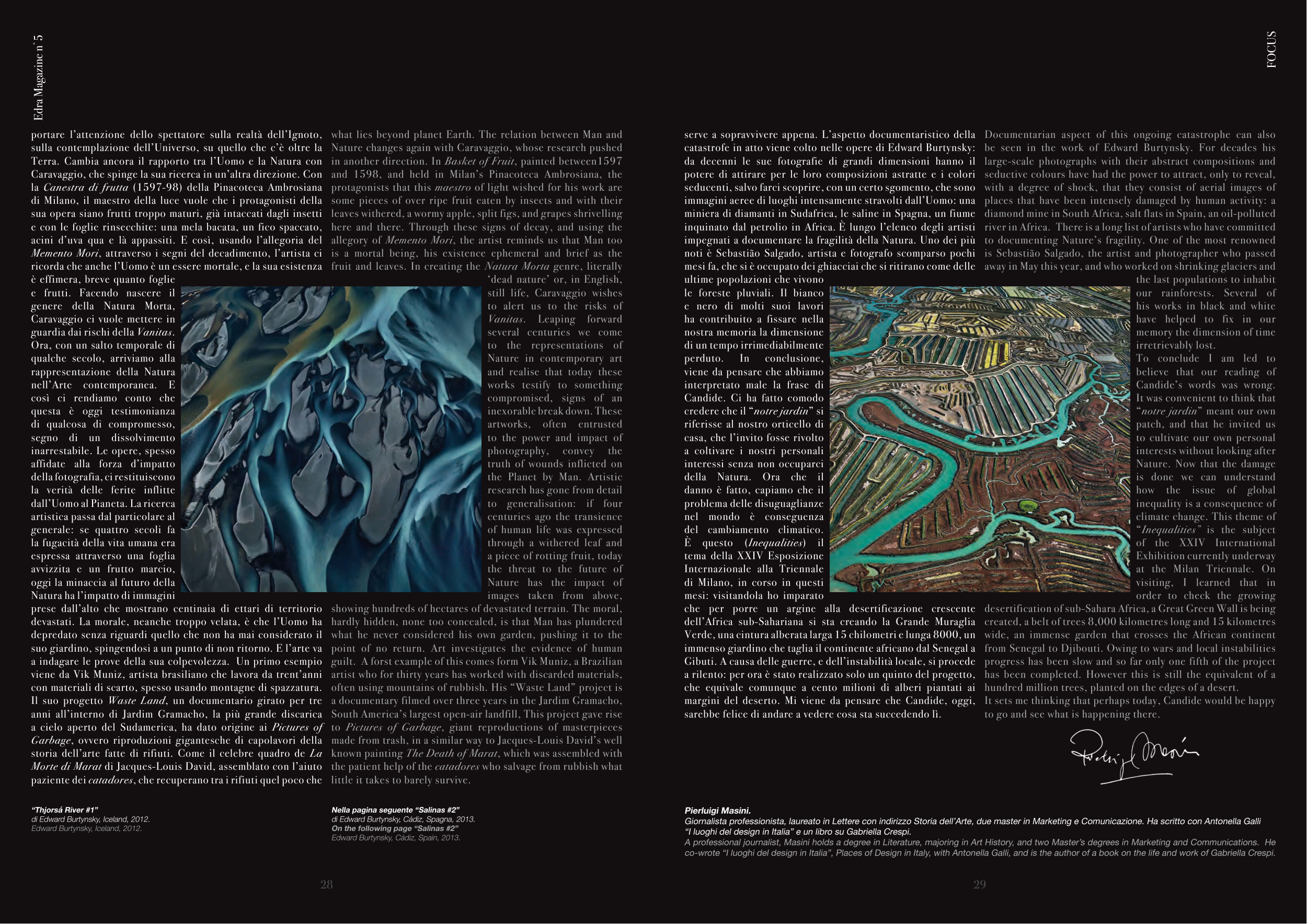
catastrofe in atto viene colto nelle opere di Edward Burtynsky:
da decenni le sue fotografie di grandi dimensioni hanno il
potere di attirare per le loro composizioni astratte e i colori
seducenti, salvo farci scoprire, con un certo sgomento, che sono
immagini aeree di luoghi intensamente stravolti dall’Uomo: una
miniera di diamanti in Sudafrica, le saline in Spagna, un fiume
inquinato dal petrolio in Africa. È lungo l’elenco degli artisti
impegnati a documentare la fragilità della Natura. Uno dei più
noti è Sebastião Salgado, artista e fotografo scomparso pochi
mesi fa, che si è occupato dei ghiacciai che si ritirano come delle
ultime popolazioni che vivono
le foreste pluviali. Il bianco
e nero di molti suoi lavori
ha contribuito a fissare nella
nostra memoria la dimensione
di un tempo irrimediabilmente
perduto.
In
conclusione,
viene da pensare che abbiamo
interpretato male la frase di
Candide. Ci ha fatto comodo
credere che il “notre jardin” si
riferisse al nostro orticello di
casa, che l’invito fosse rivolto
a coltivare i nostri personali
interessi senza non occuparci
della Natura. Ora che il
danno è fatto, capiamo che il
problema delle disuguaglianze
nel mondo è conseguenza
del cambiamento climatico.
È
questo
(Inequalities)
il
tema della XXIV Esposizione
Internazionale alla Triennale
di Milano, in corso in questi
mesi: visitandola ho imparato
che per porre un argine alla desertificazione crescente
dell’Africa sub-Sahariana si sta creando la Grande Muraglia
Verde, una cintura alberata larga 15 chilometri e lunga 8000, un
immenso giardino che taglia il continente africano dal Senegal a
Gibuti. A causa delle guerre, e dell’instabilità locale, si procede
a rilento: per ora è stato realizzato solo un quinto del progetto,
che equivale comunque a cento milioni di alberi piantati ai
margini del deserto. Mi viene da pensare che Candide, oggi,
sarebbe felice di andare a vedere cosa sta succedendo lì.
Pierluigi Masini.
Giornalista professionista, laureato in Lettere con indirizzo Storia dell’Arte, due master in Marketing e Comunicazione. Ha scritto con Antonella Galli
“I luoghi del design in Italia” e un libro su Gabriella Crespi.
A professional journalist, Masini holds a degree in Literature, majoring in Art History, and two Master’s degrees in Marketing and Communications. He
co-wrote “I luoghi del design in Italia”, Places of Design in Italy, with Antonella Galli, and is the author of a book on the life and work of Gabriella Crespi.
“Thjorsá River #1”
di Edward Burtynsky, Iceland, 2012.
Edward Burtynsky, Iceland, 2012.
Nella pagina seguente “Salinas #2”
di Edward Burtynsky, Cádiz, Spagna, 2013.
On the following page “Salinas #2”
Edward Burtynsky, Cádiz, Spain, 2013.
what lies beyond planet Earth. The relation between Man and
Nature changes again with Caravaggio, whose research pushed
in another direction. In Basket of Fruit, painted between1597
and 1598, and held in Milan’s Pinacoteca Ambrosiana, the
protagonists that this maestro of light wished for his work are
some pieces of over ripe fruit eaten by insects and with their
leaves withered, a wormy apple, split figs, and grapes shrivelling
here and there. Through these signs of decay, and using the
allegory of Memento Mori, the artist reminds us that Man too
is a mortal being, his existence ephemeral and brief as the
fruit and leaves. In creating the Natura Morta genre, literally
‘dead nature’ or, in English,
still life, Caravaggio wishes
to alert us to the risks of
Vanitas.
Leaping
forward
several centuries we come
to the representations of
Nature in contemporary art
and realise that today these
works testify to something
compromised, signs of an
inexorable break down. These
artworks,
often
entrusted
to the power and impact of
photography,
convey
the
truth of wounds inflicted on
the Planet by Man. Artistic
research has gone from detail
to generalisation: if four
centuries ago the transience
of human life was expressed
through a withered leaf and
a piece of rotting fruit, today
the threat to the future of
Nature has the impact of
images taken from above,
showing hundreds of hectares of devastated terrain. The moral,
hardly hidden, none too concealed, is that Man has plundered
what he never considered his own garden, pushing it to the
point of no return. Art investigates the evidence of human
guilt. A forst example of this comes form Vik Muniz, a Brazilian
artist who for thirty years has worked with discarded materials,
often using mountains of rubbish. His “Waste Land” project is
a documentary filmed over three years in the Jardim Gramacho,
South America’s largest open-air landfill, This project gave rise
to Pictures of Garbage, giant reproductions of masterpieces
made from trash, in a similar way to Jacques-Louis David’s well
known painting The Death of Marat, which was assembled with
the patient help of the catadores who salvage from rubbish what
little it takes to barely survive.
Documentarian aspect of this ongoing catastrophe can also
be seen in the work of Edward Burtynsky. For decades his
large-scale photographs with their abstract compositions and
seductive colours have had the power to attract, only to reveal,
with a degree of shock, that they consist of aerial images of
places that have been intensely damaged by human activity: a
diamond mine in South Africa, salt flats in Spain, an oil-polluted
river in Africa. There is a long list of artists who have committed
to documenting Nature’s fragility. One of the most renowned
is Sebastião Salgado, the artist and photographer who passed
away in May this year, and who worked on shrinking glaciers and
the last populations to inhabit
our rainforests. Several of
his works in black and white
have helped to fix in our
memory the dimension of time
irretrievably lost.
To conclude I am led to
believe that our reading of
Candide’s words was wrong.
It was convenient to think that
“notre jardin” meant our own
patch, and that he invited us
to cultivate our own personal
interests without looking after
Nature. Now that the damage
is done we can understand
how
the
issue
of
global
inequality is a consequence of
climate change. This theme of
“Inequalities” is the subject
of the XXIV International
Exhibition currently underway
at the Milan Triennale. On
visiting, I learned that in
order to check the growing
desertification of sub-Sahara Africa, a Great Green Wall is being
created, a belt of trees 8,000 kilometres long and 15 kilometres
wide, an immense garden that crosses the African continent
from Senegal to Djibouti. Owing to wars and local instabilities
progress has been slow and so far only one fifth of the project
has been completed. However this is still the equivalent of a
hundred million trees, planted on the edges of a desert.
It sets me thinking that perhaps today, Candide would be happy
to go and see what is happening there.
Edra Magazine n°5
28
29
FOCUS