reinserire degli elementi che erano nella casa precedente
e dar loro una nuova vita. L’arredo è nomade, e anche in
questo ci trovo poesia”. Come conferma Olga: “Quando ci
trasferiamo lo stile della casa cambia sempre, ma ci sono
delle costanti: opere a cui siamo molto affezionati e che ci
seguono, come gli arredi Edra, che ci accompagnano da
vent’anni con la loro qualità e il comfort incredibile. Io vivo
su questo Standard giallo che è un’isola di colore sullo sfon-
do grigio. I mobili, quando sono d’autore, stanno bene in
qualsiasi casa”.
A fare da controcanto a tutto ciò che rimane “a vista”, c’è il
prodigio della tecnica, nascosta per far funzionare la mac-
china perfetta: domotica, prestazionale, a bilancio energe-
tico zero. Un eccezionale studio impiantistico, locali tecnici
che sono vere e proprie stanze delle meraviglie, con sistemi
geotermico e fotovoltaico, sistemi di riscaldamento e raf-
freddamento a pavimento per compensare l’effetto serra
delle vetrate. Anche lo studio illuminotecnico segue lo stes-
so principio. Non è un’appendice, ma nasce con l’architet-
tura e si integra nelle strutture. “L’illuminotecnica è la mia
passione – racconta Pinuccia Rubini – Il progetto è caratte-
rizzato da un’illuminazione architettonica. Ho inserito i punti
luce nei controsoffitti: grandi elementi geometrici morbidi
per bilanciare le linee squadrate della casa e faretti che pos-
sono disegnare differenti scenari e atmosfere”.
Tutto gioca sul rapporto con l’esterno che è parte integrante
dell’architettura. A una preliminare pulizia del bosco è segui-
to il progetto del paesaggio, curato dall’architetto Andreas
Kipar dello studio Land. Questo ridisegna gli spazi esterni in
rapporto alla casa. Al centro di un cortile verde con gradoni
di prato sui quali sedersi è incastonata la piscina a sfioro,
lunga quanto la casa. A incorniciarla, un giardino di rose
e, sul retro, un muro che scompare sotto una collezione di
ortensie.
Una nuova scala esterna con blocchi di cemento martelli-
nato scende ai garage, passando attraverso una galleria di
alberi di kiwi.
Anche per la pavimentazione esterna pochi materiali di pri-
missima scelta come il legno di Accoya, una conifera tratta-
ta con l’aceto che la rende più resistente all’acqua.
“Per l’esterno – conclude l’achitetta – ho seguito lo stesso
criterio di illuminazione dell’interno. Non ci sono luci puntate
sulla casa, ma solo segnapassi a terra. L’idea è che, grazie
alle grandi vetrate, sia la villa stessa a illuminare il paesaggio
all’imbrunire”.
Photo Pietro Savorelli
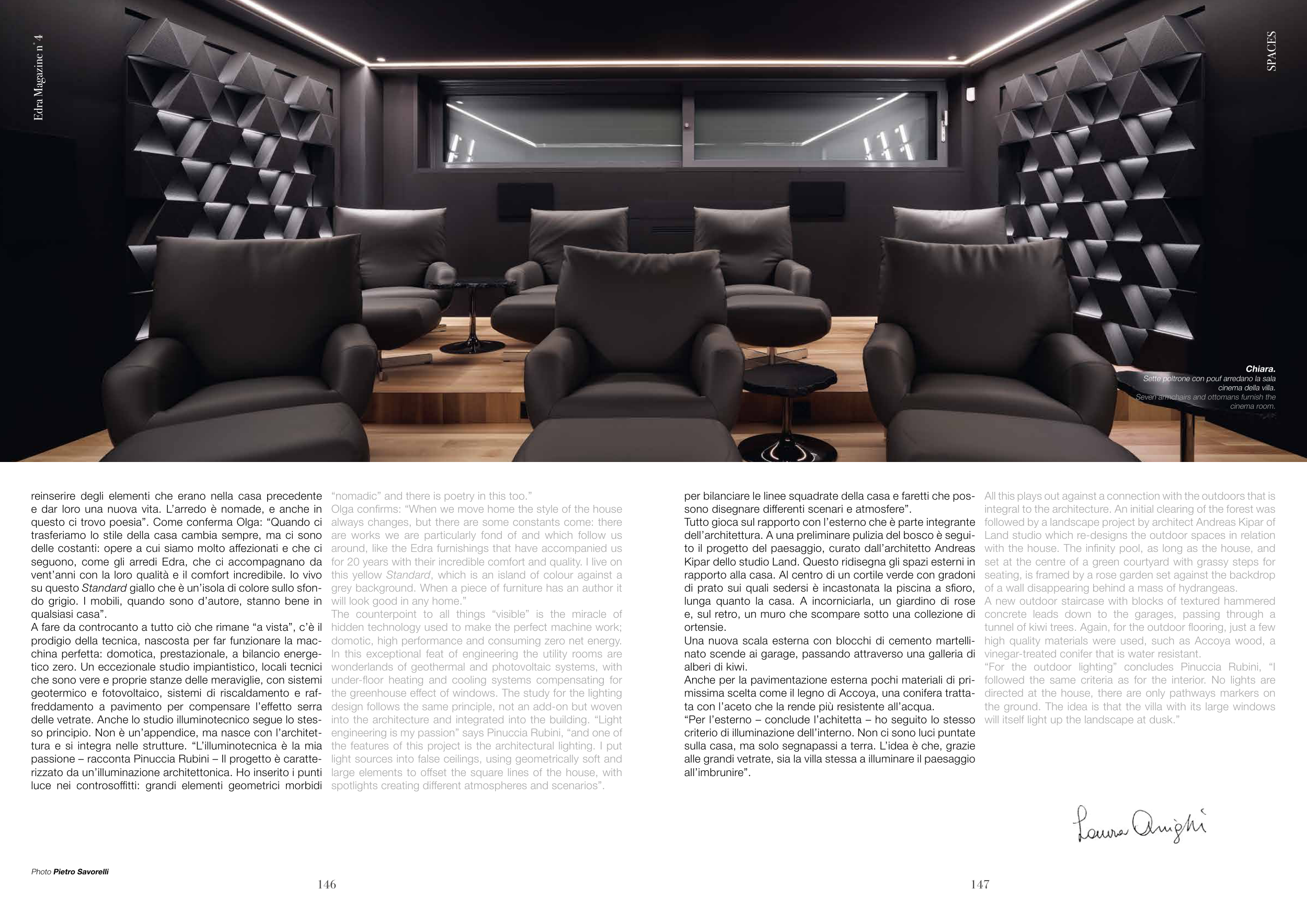
Chiara.
Sette poltrone con pouf arredano la sala
cinema della villa.
Seven armchairs and ottomans furnish the
cinema room.
“nomadic” and there is poetry in this too.”
Olga confirms: “When we move home the style of the house
always changes, but there are some constants come: there
are works we are particularly fond of and which follow us
around, like the Edra furnishings that have accompanied us
for 20 years with their incredible comfort and quality. I live on
this yellow Standard, which is an island of colour against a
grey background. When a piece of furniture has an author it
will look good in any home.”
The counterpoint to all things “visible” is the miracle of
hidden technology used to make the perfect machine work;
domotic, high performance and consuming zero net energy.
In this exceptional feat of engineering the utility rooms are
wonderlands of geothermal and photovoltaic systems, with
under-floor heating and cooling systems compensating for
the greenhouse effect of windows. The study for the lighting
design follows the same principle, not an add-on but woven
into the architecture and integrated into the building. “Light
engineering is my passion” says Pinuccia Rubini, “and one of
the features of this project is the architectural lighting. I put
light sources into false ceilings, using geometrically soft and
large elements to offset the square lines of the house, with
spotlights creating different atmospheres and scenarios”.
All this plays out against a connection with the outdoors that is
integral to the architecture. An initial clearing of the forest was
followed by a landscape project by architect Andreas Kipar of
Land studio which re-designs the outdoor spaces in relation
with the house. The infinity pool, as long as the house, and
set at the centre of a green courtyard with grassy steps for
seating, is framed by a rose garden set against the backdrop
of a wall disappearing behind a mass of hydrangeas.
A new outdoor staircase with blocks of textured hammered
concrete leads down to the garages, passing through a
tunnel of kiwi trees. Again, for the outdoor flooring, just a few
high quality materials were used, such as Accoya wood, a
vinegar-treated conifer that is water resistant.
“For the outdoor lighting” concludes Pinuccia Rubini, “I
followed the same criteria as for the interior. No lights are
directed at the house, there are only pathways markers on
the ground. The idea is that the villa with its large windows
will itself light up the landscape at dusk.”
Edra Magazine n°4
146
147
SPACES