niciata con smalti lucidi e performanti. Un uso moderato di
pietre e marmi viene fatto in alcuni bagni e nelle zone umide
dell’hammam.
I dettagli sartoriali, come lo zoccolino inserito in una doppia
lastra di cartongesso, rendono ancora più nette le geome-
trie. Gli specchi, ampi a parete o studiati in accordo con i
punti luce, ampliano visivamente gli spazi. Ci sono ambienti
che sono capolavori di tecnica. Come la cantina, ogget-
to tecnologicamente avanzato con accesso digitalizzato a
tre locali per vini rossi, vini bianchi e champagne. O la sala
cinema, arredata con sette poltrone Chiara con pouf, che
accolgono gli ospiti in una stanza altamente performante:
pannelli 3d su misura per migliorare il suono e un’illumina-
zione integrata con regressione lineare dimmerabile, verso
l’alto e verso il basso. Alla base del progetto, sia di architet-
tura sia di arredo, c’è una grande ricerca che Lella Valtorta
ritrova nel modus operandi di Edra. “Sono legata all’azienda
da oltre trent’anni e trovo molta affinità con la sua attitudine
alla ricerca di una grande qualità, anche artistica. Trovo in-
credibile come Edra sia riuscita ad applicare la manualità e
la poetica degli artisti alle logiche di produzione industriale.
Penso sia stata una delle prime aziende a farlo. E nella col-
lezione, con oggetti così differenti uno dall’altro, riconosco
l’approccio che ho anch’io nel progetto di interni domesti-
co. Ogni oggetto racconta una storia differente e questo per
me è meraviglioso”. Passando da una stanza all’altra si ha
infatti la sensazione di essere accompagnati lungo un per-
corso narrativo in un cui si intrecciano le storie personali con
quelle degli oggetti e del paesaggio incorniciato dalle fine-
stre a nastro. “Per me arredare vuol dire entrare nell’intimità
delle persone e farsi suggerire il giusto approccio da loro,
dall’architettura e dal contesto – prosegue Lella Valtorta –
Prima di tutto ascolto. Poi è come se allestissi una mostra.
I proprietari di Villa Olga hanno una speciale sensibilità per
il contemporaneo e apprezzano la bellezza di coniugare le
differenze, che per me è fondamentale. Quando c’è la quali-
tà, le differenze sono fantastiche”. Un approccio curatoriale
che emerge dalla varietà di autori e artisti, dagli emergenti
ai grandi maestri, che si armonizza in un progetto di arredo
complesso quanto equilibrato. In questo approccio rientra
anche il tema della mobilità degli oggetti, che per lei è una
prerogativa insostituibile. “Una sfida è stata la volontà di
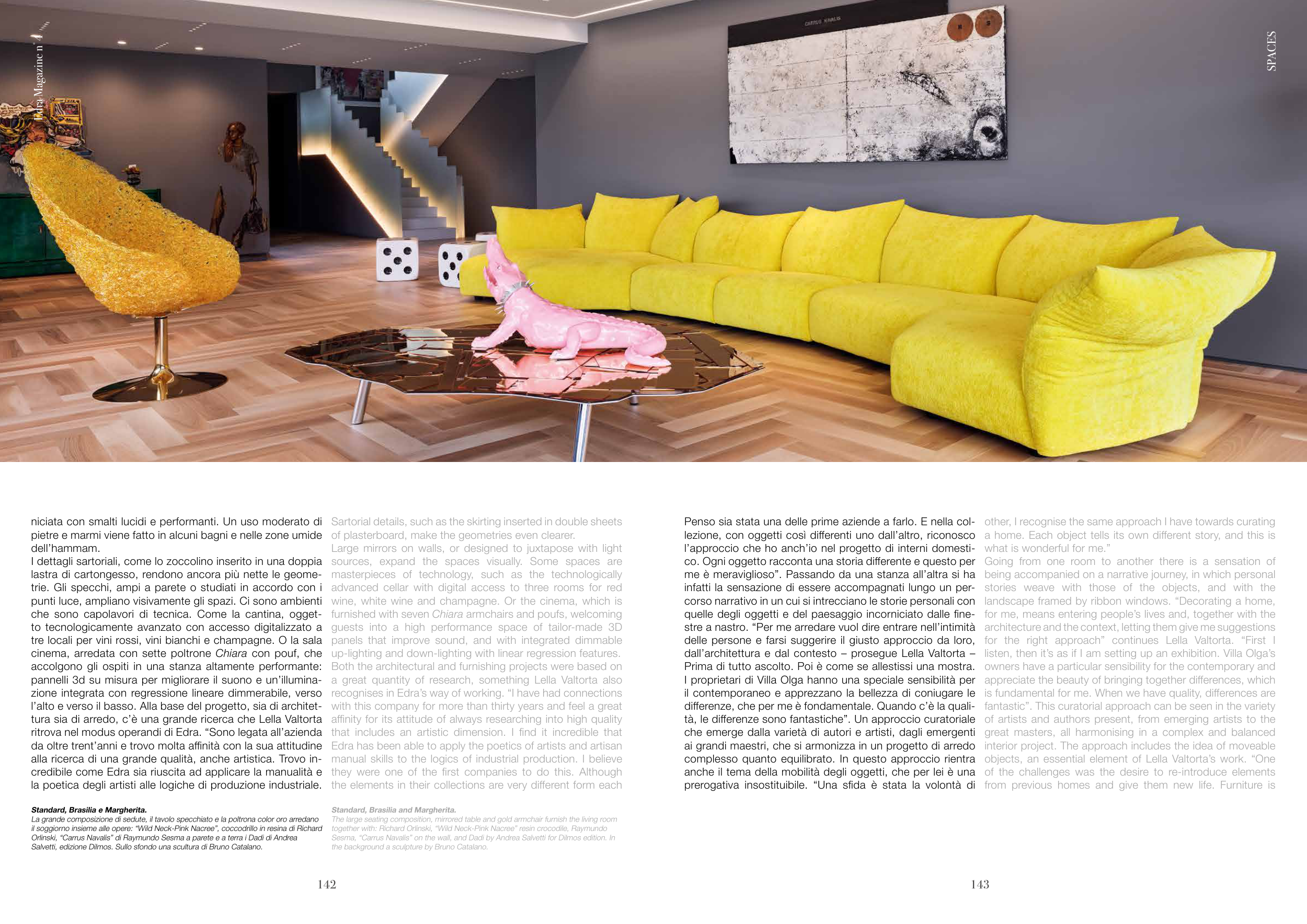
Standard, Brasilia e Margherita.
La grande composizione di sedute, il tavolo specchiato e la poltrona color oro arredano
il soggiorno insieme alle opere: “Wild Neck-Pink Nacree”, coccodrillo in resina di Richard
Orlinski, “Carrus Navalis” di Raymundo Sesma a parete e a terra i Dadi di Andrea
Salvetti, edizione Dilmos. Sullo sfondo una scultura di Bruno Catalano.
Standard, Brasilia and Margherita.
The large seating composition, mirrored table and gold armchair furnish the living room
together with: Richard Orlinski, “Wild Neck-Pink Nacree” resin crocodile, Raymundo
Sesma, “Carrus Navalis” on the wall, and Dadi by Andrea Salvetti for Dilmos edition. In
the background a sculpture by Bruno Catalano.
Sartorial details, such as the skirting inserted in double sheets
of plasterboard, make the geometries even clearer.
Large mirrors on walls, or designed to juxtapose with light
sources, expand the spaces visually. Some spaces are
masterpieces of technology, such as the technologically
advanced cellar with digital access to three rooms for red
wine, white wine and champagne. Or the cinema, which is
furnished with seven Chiara armchairs and poufs, welcoming
guests into a high performance space of tailor-made 3D
panels that improve sound, and with integrated dimmable
up-lighting and down-lighting with linear regression features.
Both the architectural and furnishing projects were based on
a great quantity of research, something Lella Valtorta also
recognises in Edra’s way of working. “I have had connections
with this company for more than thirty years and feel a great
affinity for its attitude of always researching into high quality
that includes an artistic dimension. I find it incredible that
Edra has been able to apply the poetics of artists and artisan
manual skills to the logics of industrial production. I believe
they were one of the first companies to do this. Although
the elements in their collections are very different form each
other, I recognise the same approach I have towards curating
a home. Each object tells its own different story, and this is
what is wonderful for me.”
Going from one room to another there is a sensation of
being accompanied on a narrative journey, in which personal
stories weave with those of the objects, and with the
landscape framed by ribbon windows. “Decorating a home,
for me, means entering people’s lives and, together with the
architecture and the context, letting them give me suggestions
for the right approach” continues Lella Valtorta. “First I
listen, then it’s as if I am setting up an exhibition. Villa Olga’s
owners have a particular sensibility for the contemporary and
appreciate the beauty of bringing together differences, which
is fundamental for me. When we have quality, differences are
fantastic”. This curatorial approach can be seen in the variety
of artists and authors present, from emerging artists to the
great masters, all harmonising in a complex and balanced
interior project. The approach includes the idea of moveable
objects, an essential element of Lella Valtorta’s work. “One
of the challenges was the desire to re-introduce elements
from previous homes and give them new life. Furniture is
Edra Magazine n°4
142
143
SPACES