Standway.
La dormeuse crea un’area relax nell’ampia
zona notte.
The daybed creates a place to relax in the
large sleeping area.
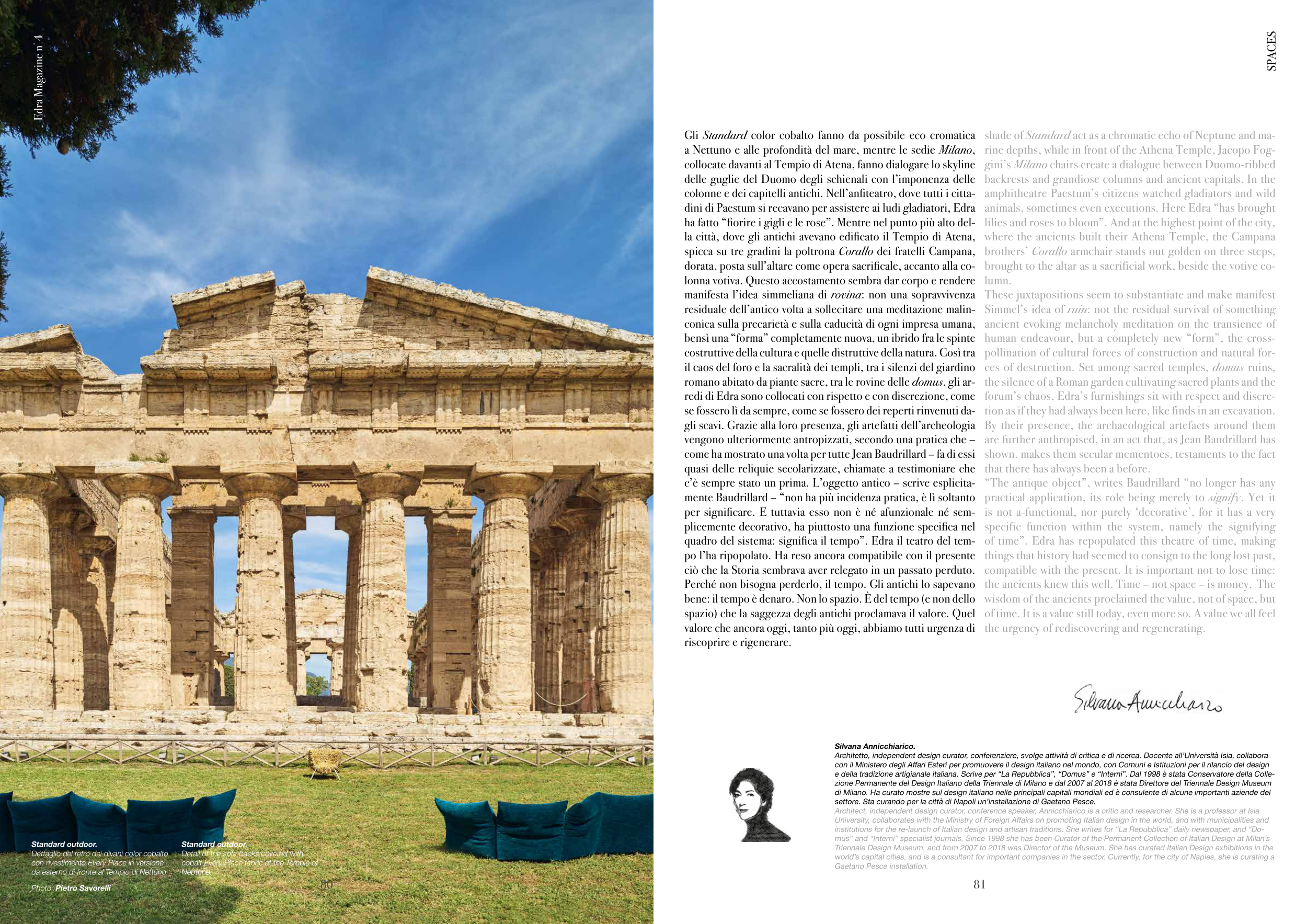
Gli Standard color cobalto fanno da possibile eco cromatica
a Nettuno e alle profondità del mare, mentre le sedie Milano,
collocate davanti al Tempio di Atena, fanno dialogare lo skyline
delle guglie del Duomo degli schienali con l’imponenza delle
colonne e dei capitelli antichi. Nell’anfiteatro, dove tutti i citta-
dini di Paestum si recavano per assistere ai ludi gladiatori, Edra
ha fatto “fiorire i gigli e le rose”. Mentre nel punto più alto del-
la città, dove gli antichi avevano edificato il Tempio di Atena,
spicca su tre gradini la poltrona Corallo dei fratelli Campana,
dorata, posta sull’altare come opera sacrificale, accanto alla co-
lonna votiva. Questo accostamento sembra dar corpo e rendere
manifesta l’idea simmeliana di rovina: non una sopravvivenza
residuale dell’antico volta a sollecitare una meditazione malin-
conica sulla precarietà e sulla caducità di ogni impresa umana,
bensì una “forma” completamente nuova, un ibrido fra le spinte
costruttive della cultura e quelle distruttive della natura. Così tra
il caos del foro e la sacralità dei templi, tra i silenzi del giardino
romano abitato da piante sacre, tra le rovine delle domus, gli ar-
redi di Edra sono collocati con rispetto e con discrezione, come
se fossero lì da sempre, come se fossero dei reperti rinvenuti da-
gli scavi. Grazie alla loro presenza, gli artefatti dell’archeologia
vengono ulteriormente antropizzati, secondo una pratica che –
come ha mostrato una volta per tutte Jean Baudrillard – fa di essi
quasi delle reliquie secolarizzate, chiamate a testimoniare che
c’è sempre stato un prima. L’oggetto antico – scrive esplicita-
mente Baudrillard – “non ha più incidenza pratica, è lì soltanto
per significare. E tuttavia esso non è né afunzionale né sem-
plicemente decorativo, ha piuttosto una funzione specifica nel
quadro del sistema: significa il tempo”. Edra il teatro del tem-
po l’ha ripopolato. Ha reso ancora compatibile con il presente
ciò che la Storia sembrava aver relegato in un passato perduto.
Perché non bisogna perderlo, il tempo. Gli antichi lo sapevano
bene: il tempo è denaro. Non lo spazio. È del tempo (e non dello
spazio) che la saggezza degli antichi proclamava il valore. Quel
valore che ancora oggi, tanto più oggi, abbiamo tutti urgenza di
riscoprire e rigenerare.
Silvana Annicchiarico.
Architetto, independent design curator, conferenziere, svolge attività di critica e di ricerca. Docente all’Università Isia, collabora
con il Ministero degli Affari Esteri per promuovere il design italiano nel mondo, con Comuni e Istituzioni per il rilancio del design
e della tradizione artigianale italiana. Scrive per “La Repubblica”, “Domus” e “Interni”. Dal 1998 è stata Conservatore della Colle-
zione Permanente del Design Italiano della Triennale di Milano e dal 2007 al 2018 è stata Direttore del Triennale Design Museum
di Milano. Ha curato mostre sul design italiano nelle principali capitali mondiali ed è consulente di alcune importanti aziende del
settore. Sta curando per la città di Napoli un’installazione di Gaetano Pesce.
Architect, independent design curator, conference speaker, Annicchiarico is a critic and researcher. She is a professor at Isia
University, collaborates with the Ministry of Foreign Affairs on promoting Italian design in the world, and with municipalities and
institutions for the re-launch of Italian design and artisan traditions. She writes for “La Repubblica” daily newspaper, and “Do-
mus” and “Interni” specialist journals. Since 1998 she has been Curator of the Permanent Collection of Italian Design at Milan’s
Triennale Design Museum, and from 2007 to 2018 was Director of the Museum. She has curated Italian Design exhibitions in the
world’s capital cities, and is a consultant for important companies in the sector. Currently, for the city of Naples, she is curating a
Gaetano Pesce installation.
Photo Pietro Savorelli
shade of Standard act as a chromatic echo of Neptune and ma-
rine depths, while in front of the Athena Temple, Jacopo Fog-
gini’s Milano chairs create a dialogue between Duomo-ribbed
backrests and grandiose columns and ancient capitals. In the
amphitheatre Paestum’s citizens watched gladiators and wild
animals, sometimes even executions. Here Edra “has brought
lilies and roses to bloom”. And at the highest point of the city,
where the ancients built their Athena Temple, the Campana
brothers’ Corallo armchair stands out golden on three steps,
brought to the altar as a sacrificial work, beside the votive co-
lumn.
These juxtapositions seem to substantiate and make manifest
Simmel’s idea of ruin: not the residual survival of something
ancient evoking melancholy meditation on the transience of
human endeavour, but a completely new “form”, the cross-
pollination of cultural forces of construction and natural for-
ces of destruction. Set among sacred temples, domus ruins,
the silence of a Roman garden cultivating sacred plants and the
forum’s chaos, Edra’s furnishings sit with respect and discre-
tion as if they had always been here, like finds in an excavation.
By their presence, the archaeological artefacts around them
are further anthropised, in an act that, as Jean Baudrillard has
shown, makes them secular mementoes, testaments to the fact
that there has always been a before.
“The antique object”, writes Baudrillard “no longer has any
practical application, its role being merely to signify. Yet it
is not a-functional, nor purely ‘decorative’, for it has a very
specific function within the system, namely the signifying
of time”. Edra has repopulated this theatre of time, making
things that history had seemed to consign to the long lost past,
compatible with the present. It is important not to lose time:
the ancients knew this well. Time – not space – is money. The
wisdom of the ancients proclaimed the value, not of space, but
of time. It is a value still today, even more so. A value we all feel
the urgency of rediscovering and regenerating.
Standard outdoor.
Dettaglio del retro dei divani color cobalto
con rivestimento Every Place in versione
da esterno di fronte al Tempio di Nettuno.
Standard outdoor.
Detail of the sofa backs covered with
cobalt Every Place fabric at the Temple of
Neptune.
Edra Magazine n°4
80
81
SPACES