Giampaolo Grassi.
Giornalista parlamentare dell’Ansa. Prima di occuparsi di politica, ha seguito la cronaca giudiziaria a Firenze e quella
finanziaria a Milano. Ha raccolto storia, ricordi e pensieri di Francesco Binfaré in un volume pubblicato dalla casa
editrice Mandragora.
Parliamentary journalist for the Ansa news agency. Before dealing with politics he reported on judiciary news in
Florence and financial news in Milan. He has worked with Francesco Binfaré on collecting his story, memories and
thinking for a book published by Mandragora.
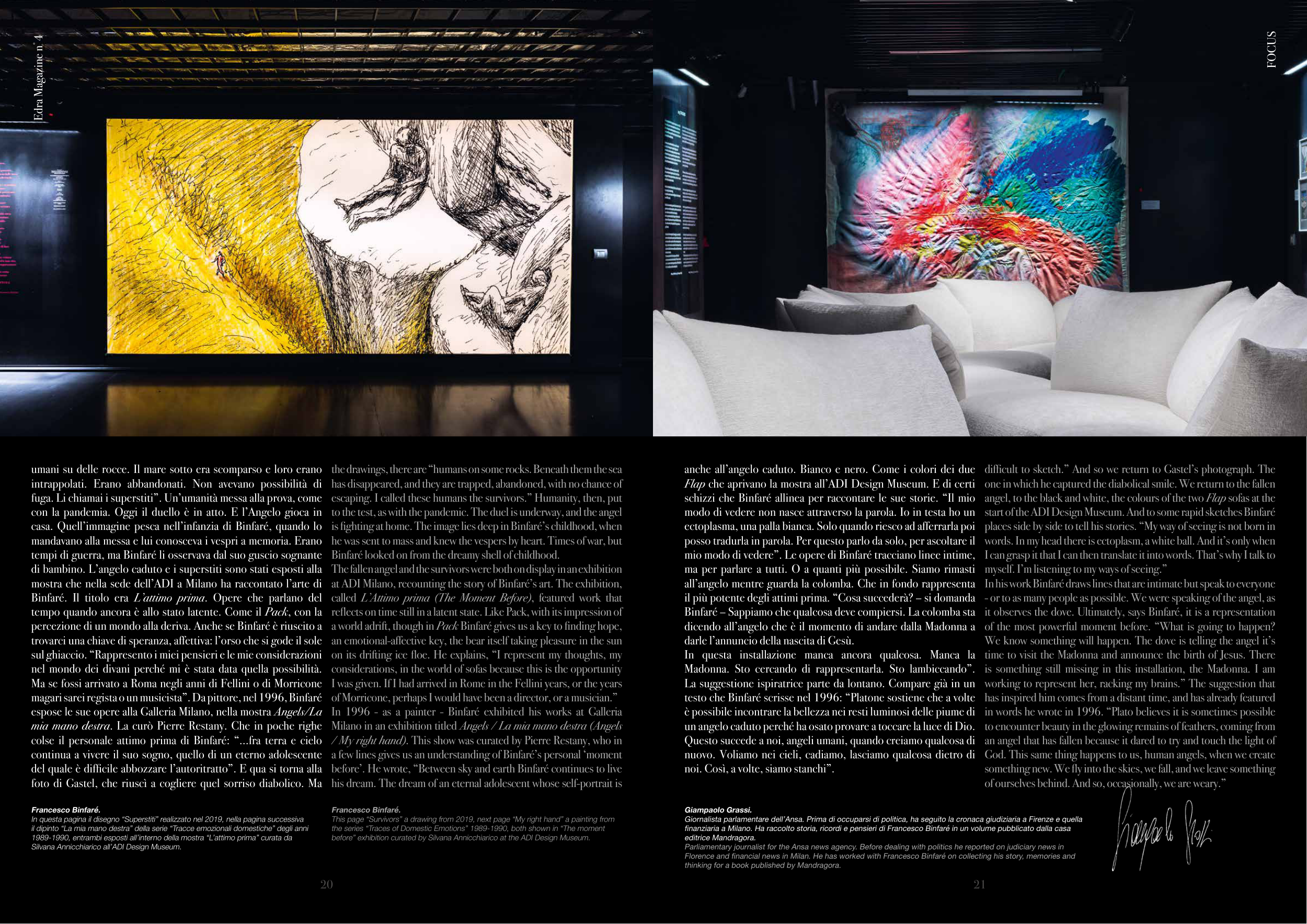
Francesco Binfaré.
In questa pagina il disegno “Superstiti” realizzato nel 2019, nella pagina successiva
il dipinto “La mia mano destra” della serie “Tracce emozionali domestiche” degli anni
1989-1990, entrambi esposti all’interno della mostra “L’attimo prima” curata da
Silvana Annicchiarico all’ADI Design Museum.
Francesco Binfaré.
This page “Survivors” a drawing from 2019, next page “My right hand” a painting from
the series “Traces of Domestic Emotions” 1989-1990, both shown in “The moment
before” exhibition curated by Silvana Annicchiarico at the ADI Design Museum.
umani su delle rocce. Il mare sotto era scomparso e loro erano
intrappolati. Erano abbandonati. Non avevano possibilità di
fuga. Li chiamai i superstiti”. Un’umanità messa alla prova, come
con la pandemia. Oggi il duello è in atto. E l’Angelo gioca in
casa. Quell’immagine pesca nell’infanzia di Binfaré, quando lo
mandavano alla messa e lui conosceva i vespri a memoria. Erano
tempi di guerra, ma Binfaré li osservava dal suo guscio sognante
di bambino. L’angelo caduto e i superstiti sono stati esposti alla
mostra che nella sede dell’ADI a Milano ha raccontato l’arte di
Binfaré. Il titolo era L’attimo prima. Opere che parlano del
tempo quando ancora è allo stato latente. Come il Pack, con la
percezione di un mondo alla deriva. Anche se Binfaré è riuscito a
trovarci una chiave di speranza, affettiva: l’orso che si gode il sole
sul ghiaccio. “Rappresento i miei pensieri e le mie considerazioni
nel mondo dei divani perché mi è stata data quella possibilità.
Ma se fossi arrivato a Roma negli anni di Fellini o di Morricone
magari sarei regista o un musicista”. Da pittore, nel 1996, Binfaré
espose le sue opere alla Galleria Milano, nella mostra Angels/La
mia mano destra. La curò Pierre Restany. Che in poche righe
colse il personale attimo prima di Binfaré: “...fra terra e cielo
continua a vivere il suo sogno, quello di un eterno adolescente
del quale è difficile abbozzare l’autoritratto”. E qua si torna alla
foto di Gastel, che riuscì a cogliere quel sorriso diabolico. Ma
anche all’angelo caduto. Bianco e nero. Come i colori dei due
Flap che aprivano la mostra all’ADI Design Museum. E di certi
schizzi che Binfaré allinea per raccontare le sue storie. “Il mio
modo di vedere non nasce attraverso la parola. Io in testa ho un
ectoplasma, una palla bianca. Solo quando riesco ad afferrarla poi
posso tradurla in parola. Per questo parlo da solo, per ascoltare il
mio modo di vedere”. Le opere di Binfaré tracciano linee intime,
ma per parlare a tutti. O a quanti più possibile. Siamo rimasti
all’angelo mentre guarda la colomba. Che in fondo rappresenta
il più potente degli attimi prima. “Cosa succederà? – si domanda
Binfaré – Sappiamo che qualcosa deve compiersi. La colomba sta
dicendo all’angelo che è il momento di andare dalla Madonna a
darle l’annuncio della nascita di Gesù.
In questa installazione manca ancora qualcosa. Manca la
Madonna. Sto cercando di rappresentarla. Sto lambiccando”.
La suggestione ispiratrice parte da lontano. Compare già in un
testo che Binfaré scrisse nel 1996: “Platone sostiene che a volte
è possibile incontrare la bellezza nei resti luminosi delle piume di
un angelo caduto perché ha osato provare a toccare la luce di Dio.
Questo succede a noi, angeli umani, quando creiamo qualcosa di
nuovo. Voliamo nei cieli, cadiamo, lasciamo qualcosa dietro di
noi. Così, a volte, siamo stanchi”.
the drawings, there are “humans on some rocks. Beneath them the sea
has disappeared, and they are trapped, abandoned, with no chance of
escaping. I called these humans the survivors.” Humanity, then, put
to the test, as with the pandemic. The duel is underway, and the angel
is fighting at home. The image lies deep in Binfaré’s childhood, when
he was sent to mass and knew the vespers by heart. Times of war, but
Binfaré looked on from the dreamy shell of childhood.
The fallen angel and the survivors were both on display in an exhibition
at ADI Milano, recounting the story of Binfaré’s art. The exhibition,
called L’Attimo prima (The Moment Before), featured work that
reflects on time still in a latent state. Like Pack, with its impression of
a world adrift, though in Pack Binfaré gives us a key to finding hope,
an emotional-affective key, the bear itself taking pleasure in the sun
on its drifting ice floe. He explains, “I represent my thoughts, my
considerations, in the world of sofas because this is the opportunity
I was given. If I had arrived in Rome in the Fellini years, or the years
of Morricone, perhaps I would have been a director, or a musician.”
In 1996 - as a painter - Binfaré exhibited his works at Galleria
Milano in an exhibition titled Angels / La mia mano destra (Angels
/ My right hand). This show was curated by Pierre Restany, who in
a few lines gives us an understanding of Binfaré’s personal ‘moment
before’. He wrote, “Between sky and earth Binfaré continues to live
his dream. The dream of an eternal adolescent whose self-portrait is
difficult to sketch.” And so we return to Gastel’s photograph. The
one in which he captured the diabolical smile. We return to the fallen
angel, to the black and white, the colours of the two Flap sofas at the
start of the ADI Design Museum. And to some rapid sketches Binfaré
places side by side to tell his stories. “My way of seeing is not born in
words. In my head there is ectoplasm, a white ball. And it’s only when
I can grasp it that I can then translate it into words. That’s why I talk to
myself. I’m listening to my ways of seeing.”
In his work Binfaré draws lines that are intimate but speak to everyone
- or to as many people as possible. We were speaking of the angel, as
it observes the dove. Ultimately, says Binfaré, it is a representation
of the most powerful moment before. “What is going to happen?
We know something will happen. The dove is telling the angel it’s
time to visit the Madonna and announce the birth of Jesus. There
is something still missing in this installation, the Madonna. I am
working to represent her, racking my brains.” The suggestion that
has inspired him comes from a distant time, and has already featured
in words he wrote in 1996. “Plato believes it is sometimes possible
to encounter beauty in the glowing remains of feathers, coming from
an angel that has fallen because it dared to try and touch the light of
God. This same thing happens to us, human angels, when we create
something new. We fly into the skies, we fall, and we leave something
of ourselves behind. And so, occasionally, we are weary.”
Edra Magazine n°4
20
21
FOCUS