69
68
WORDS Laura Arrighi
L’isola che non c’è invece c’è.
È al largo di Positano.
Da lì si riesce a vedere Capri.
Ci abitano ballerini rapiti da armonie di sirene.
Scrittori che intrecciano storie di un tempo eterno.
Architetti che progettano rifugi per l’anima.
Se cammini per i vicoli non puoi incontrarli. Perché la
loro epoca è un’altra, anche se non è mai passata.
Però sono attorno, dentro a ciò che vedi,
che fai, che pensi.
L’isola delle Sirene
Al largo di Positano, a metà strada dall’isola di Capri, si
trova il piccolo arcipelago chiamato Li Galli. È formato
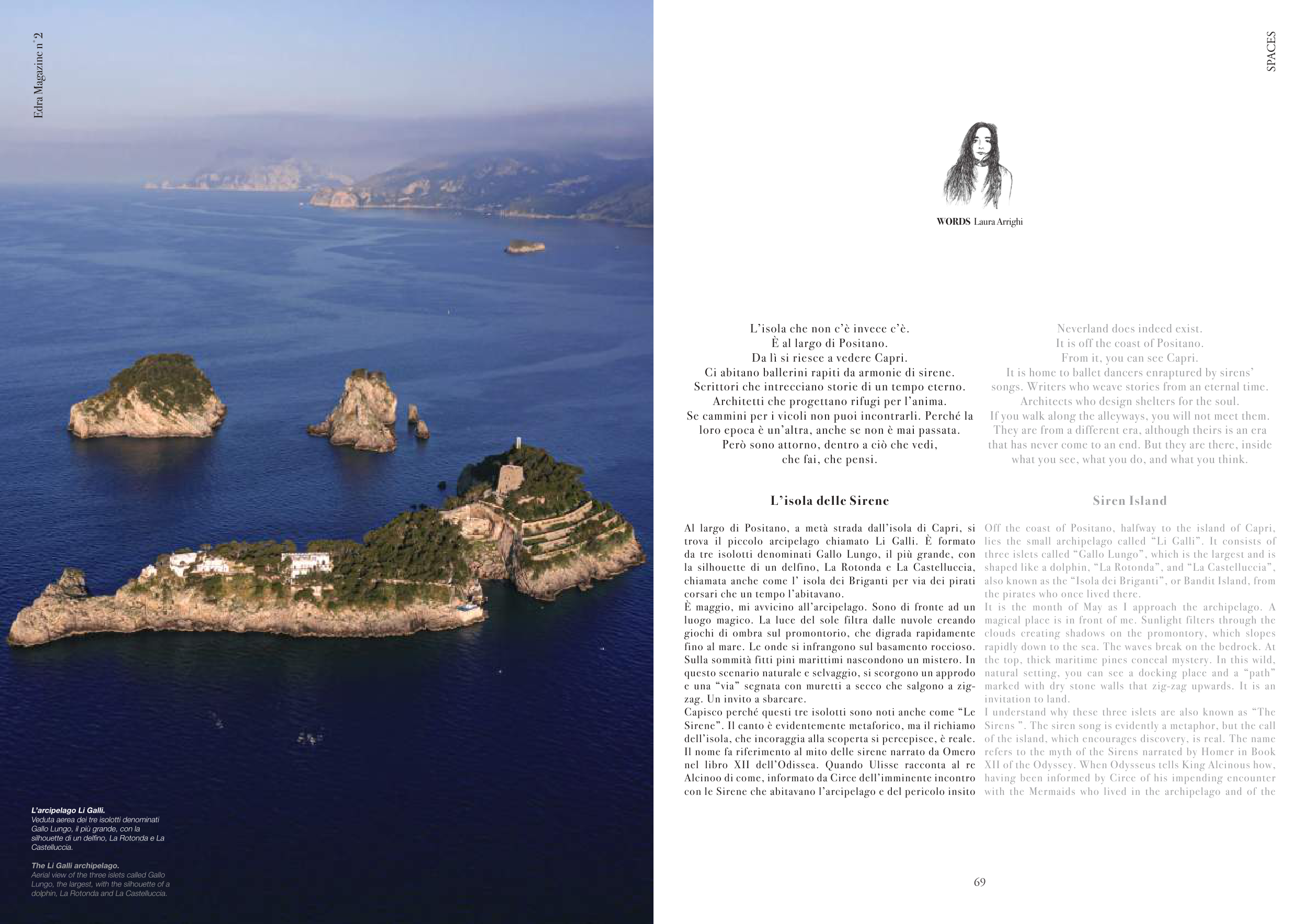
da tre isolotti denominati Gallo Lungo, il più grande, con
la silhouette di un delfino, La Rotonda e La Castelluccia,
chiamata anche come l’ isola dei Briganti per via dei pirati
corsari che un tempo l’abitavano.
È maggio, mi avvicino all’arcipelago. Sono di fronte ad un
luogo magico. La luce del sole filtra dalle nuvole creando
giochi di ombra sul promontorio, che digrada rapidamente
fino al mare. Le onde si infrangono sul basamento roccioso.
Sulla sommità fitti pini marittimi nascondono un mistero. In
questo scenario naturale e selvaggio, si scorgono un approdo
e una “via” segnata con muretti a secco che salgono a zig-
zag. Un invito a sbarcare.
Capisco perché questi tre isolotti sono noti anche come “Le
Sirene”. Il canto è evidentemente metaforico, ma il richiamo
dell’isola, che incoraggia alla scoperta si percepisce, è reale.
Il nome fa riferimento al mito delle sirene narrato da Omero
nel libro XII dell’Odissea. Quando Ulisse racconta al re
Alcinoo di come, informato da Circe dell’imminente incontro
con le Sirene che abitavano l’arcipelago e del pericolo insito
Neverland does indeed exist.
It is off the coast of Positano.
From it, you can see Capri.
It is home to ballet dancers enraptured by sirens’
songs. Writers who weave stories from an eternal time.
Architects who design shelters for the soul.
If you walk along the alleyways, you will not meet them.
They are from a different era, although theirs is an era
that has never come to an end. But they are there, inside
what you see, what you do, and what you think.
Siren Island
Off the coast of Positano, halfway to the island of Capri,
lies the small archipelago called “Li Galli”. It consists of
three islets called “Gallo Lungo”, which is the largest and is
shaped like a dolphin, “La Rotonda”, and “La Castelluccia”,
also known as the “Isola dei Briganti”, or Bandit Island, from
the pirates who once lived there.
It is the month of May as I approach the archipelago. A
magical place is in front of me. Sunlight filters through the
clouds creating shadows on the promontory, which slopes
rapidly down to the sea. The waves break on the bedrock. At
the top, thick maritime pines conceal mystery. In this wild,
natural setting, you can see a docking place and a “path”
marked with dry stone walls that zig-zag upwards. It is an
invitation to land.
I understand why these three islets are also known as “The
Sirens ”. The siren song is evidently a metaphor, but the call
of the island, which encourages discovery, is real. The name
refers to the myth of the Sirens narrated by Homer in Book
XII of the Odyssey. When Odysseus tells King Alcinous how,
having been informed by Circe of his impending encounter
with the Mermaids who lived in the archipelago and of the
L’arcipelago Li Galli.
Veduta aerea dei tre isolotti denominati
Gallo Lungo, il più grande, con la
silhouette di un delfino, La Rotonda e La
Castelluccia.
The Li Galli archipelago.
Aerial view of the three islets called Gallo
Lungo, the largest, with the silhouette of a
dolphin, La Rotonda and La Castelluccia.
SPACES
Edra Magazine n°2