Valentina Moretti.
Si laurea all’Accademia di Architettura di Mendrisio con maestri del calibro di Mario Botta, Peter Zumthor e Valerio Olgiati. A
New York affina la visione internazionale con Richard Meier e Anderson Architects. Nel 2009 è rientrata in Italia per dedicarsi
all’azienda di famiglia, Moretti Modular Contractor, storica impresa nell’edilizia industrializzata, introducendo la prefabbricazione
nel residenziale per avvicinare l’architettura alla vita quotidiana. Da quest’idea nasce MORE, società benefit che realizza abitazioni
su misura, lanciata con il supporto creativo di Oliviero Toscani. È Vicepresidente di Holding Terra Moretti, gruppo fondato nel
1967 dal padre Vittorio. Tra i progetti più recenti, ALTROVE: un laboratorio che esplora nuovi modelli abitativi fuori città. Numerosi
i premi ricevuti da MORE. La sua visione intreccia innovazione e patrimonio, con attenzione al paesaggio, alle comunità e alla
dignità umana.
A graduate of the Mendrisio Academy of Architecture, where she studied with masters such as Mario Botta, Valerio Olgiati and
Peter Zumtho, Moretti refined her international vision In New York with Richard Meier and Anderson Architects. Returning to Italy
in 2009, she dedicated her time to the family business Moretti Modular Contractor, a long-established industrialised construction
company, and introduced prefabrication into the residential sector to bring architecture closer to daily life. From this idea was born
MORE a benefit company creating made-to-measure homes, launched with creative support from Oliviero Toscani. Moretti is vice
president of Terra Moretti Holding, a group founded by her father Vittorio in 1967. Among her most recent projects is ALTROVE, a
laboratory exploring new models of inhabiting outside cities. MORE has received several awards. Its vision weaves innovation with
heritage, with attention for landscape, community and human dignity.
Laura Arrighi: Mi è molto chiara la direzione per quanto
riguarda l’architettura e la relazione con il paesaggio, ma non
riesco a definire uno stile per quanto riguarda gli interni. Forse
non è neppure quello che cerchi.
Valentina Moretti: La scelta di mobili, accessori e opere
d’arte è spesso legata a motivi affettivi. Non mi piacciono le
rigidità stilistiche. In casa mia convivono pezzi molto diversi,
come un mobile tirolese con uno moderno bianco in metallo.
Sopra c’è un quadro che mi ha dato mia madre con una
cornice ottocentesca ma, magari, tra due mesi quel quadro
finirà nella camera degli ospiti e sarà sostituito da una grande
foto. Prediligo pezzi unici e iconici. Scelgo aziende che
offrono un design senza tempo.
Laura Arrighi: Hai menzionato la tecnologia. Abbiamo parlato
tanto di natura. L’azienda MORE si distingue perché tiene
insieme queste identità: innovativa, industriale, tecnologica.
Ma è anche attentissima alla sostenibilità ambientale. Penso
alla Biennale Architettura di Venezia appena inaugurata,
curata da Carlo Ratti e intitolata Intelligens. Natural. Artificial.
Collective. Una riflessione sulla disciplina architettonica
come campo allargato capace di integrare diverse forme di
intelligenza.
Valentina Moretti: Non vedo contraddizione tra tecnologia e
natura, se la tecnologia è usata con intelligenza. MORE lavora
anche con materiali antichi, come terra cruda, paglia, canapa:
ma senza l’innovazione, questi materiali non durerebbero. E
poi c’è la domotica, che permette alla casa di capire quando
spegnere il raffrescamento, quando attivare una schermatura
solare. Anche l’intelligenza artificiale può essere utile se la
si usa per leggere e interpretare i dati in chiave ecologica.
Il problema non è la tecnologia, ma come decidiamo di
integrarla nella nostra vita.
Laura Arrighi: More ha ambizioni culturali che riguardano
l’abitare. All’interno del programma di ricerca ALTROVE,
curato da te, esplorate nuovi modelli, con particolare
attenzione alle aree rurali, valorizzando le comunità locali in
chiave innovativa e sostenibile. Possiamo leggerla come una
riflessione sull’intelligenza collettiva?
Valentina Moretti: ALTROVE è una ricerca che va oltre al
prodotto Casa, oltre la pura progettazione di architettura.
Ricerca un modo nuovo di abitare, più responsabile, per
un futuro circolare. Che per me non sarà più abitare in case
private, ma tornare al concetto di comunità che vive intorno a
uno stesso cortile, condividendo spazi e servizi.
Laura Arrighi: C’è qualcosa di questo ragionamento nella
tua casa?
Valentina Moretti: La mia è una casa viva, aperta, accogliente.
Mi piace dire che da noi c’è sempre una festa. I miei figli dicono
che è troppo grande per cinque persone, ma il fine settimana
ospitiamo amici, parenti, colleghi. C’è sempre qualcuno che
cucina, che porta qualcosa, che si muove liberamente. La
casa funziona davvero quando è abitata da più persone. Ho
sempre pensato che la vera bellezza dello spazio stia nella
sua capacità di generare relazioni.
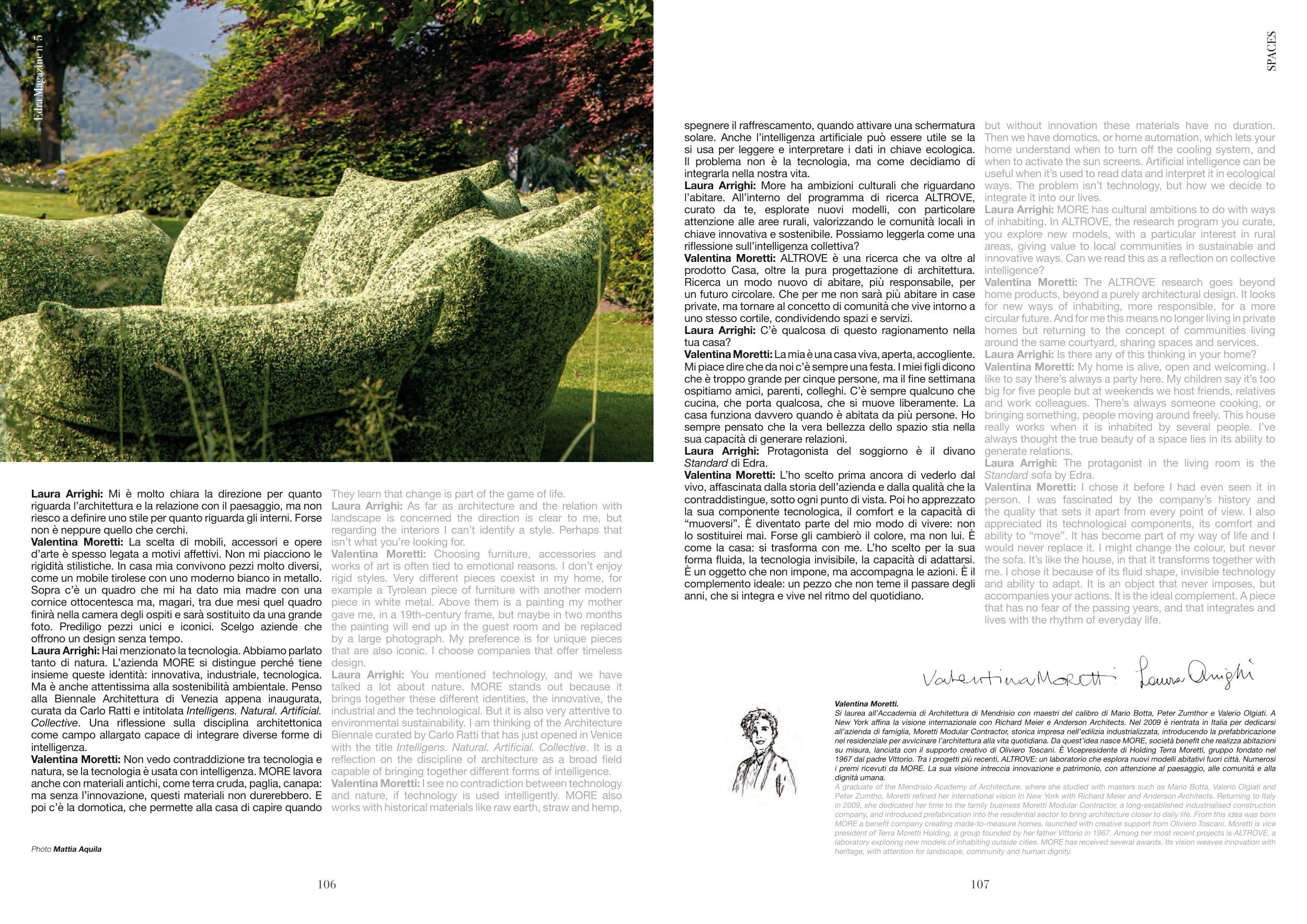
Laura Arrighi: Protagonista del soggiorno è il divano
Standard di Edra.
Valentina Moretti: L’ho scelto prima ancora di vederlo dal
vivo, affascinata dalla storia dell’azienda e dalla qualità che la
contraddistingue, sotto ogni punto di vista. Poi ho apprezzato
la sua componente tecnologica, il comfort e la capacità di
“muoversi”. È diventato parte del mio modo di vivere: non
lo sostituirei mai. Forse gli cambierò il colore, ma non lui. È
come la casa: si trasforma con me. L’ho scelto per la sua
forma fluida, la tecnologia invisibile, la capacità di adattarsi.
È un oggetto che non impone, ma accompagna le azioni. È il
complemento ideale: un pezzo che non teme il passare degli
anni, che si integra e vive nel ritmo del quotidiano.
Photo Mattia Aquila
They learn that change is part of the game of life.
Laura Arrighi: As far as architecture and the relation with
landscape is concerned the direction is clear to me, but
regarding the interiors I can’t identify a style. Perhaps that
isn’t what you’re looking for.
Valentina Moretti: Choosing furniture, accessories and
works of art is often tied to emotional reasons. I don’t enjoy
rigid styles. Very different pieces coexist in my home, for
example a Tyrolean piece of furniture with another modern
piece in white metal. Above them is a painting my mother
gave me, in a 19th-century frame, but maybe in two months
the painting will end up in the guest room and be replaced
by a large photograph. My preference is for unique pieces
that are also iconic. I choose companies that offer timeless
design.
Laura Arrighi: You mentioned technology, and we have
talked a lot about nature. MORE stands out because it
brings together these different identities, the innovative, the
industrial and the technological. But it is also very attentive to
environmental sustainability. I am thinking of the Architecture
Biennale curated by Carlo Ratti that has just opened in Venice
with the title Intelligens. Natural. Artificial. Collective. It is a
reflection on the discipline of architecture as a broad field
capable of bringing together different forms of intelligence.
Valentina Moretti: I see no contradiction between technology
and nature, if technology is used intelligently. MORE also
works with historical materials like raw earth, straw and hemp,
but without innovation these materials have no duration.
Then we have domotics, or home automation, which lets your
home understand when to turn off the cooling system, and
when to activate the sun screens. Artificial intelligence can be
useful when it’s used to read data and interpret it in ecological
ways. The problem isn’t technology, but how we decide to
integrate it into our lives.
Laura Arrighi: MORE has cultural ambitions to do with ways
of inhabiting. In ALTROVE, the research program you curate,
you explore new models, with a particular interest in rural
areas, giving value to local communities in sustainable and
innovative ways. Can we read this as a reflection on collective
intelligence?
Valentina Moretti: The ALTROVE research goes beyond
home products, beyond a purely architectural design. It looks
for new ways of inhabiting, more responsible, for a more
circular future. And for me this means no longer living in private
homes but returning to the concept of communities living
around the same courtyard, sharing spaces and services.
Laura Arrighi: Is there any of this thinking in your home?
Valentina Moretti: My home is alive, open and welcoming. I
like to say there’s always a party here. My children say it’s too
big for five people but at weekends we host friends, relatives
and work colleagues. There’s always someone cooking, or
bringing something, people moving around freely. This house
really works when it is inhabited by several people. I’ve
always thought the true beauty of a space lies in its ability to
generate relations.
Laura Arrighi: The protagonist in the living room is the
Standard sofa by Edra.
Valentina Moretti: I chose it before I had even seen it in
person. I was fascinated by the company’s history and
the quality that sets it apart from every point of view. I also
appreciated its technological components, its comfort and
ability to “move”. It has become part of my way of life and I
would never replace it. I might change the colour, but never
the sofa. It’s like the house, in that it transforms together with
me. I chose it because of its fluid shape, invisible technology
and ability to adapt. It is an object that never imposes, but
accompanies your actions. It is the ideal complement. A piece
that has no fear of the passing years, and that integrates and
lives with the rhythm of everyday life.
Edra Magazine n°5
106
107
SPACES