Cristiana Collu.
Direttrice di museo e curatrice indipendente, da settembre 2024 è la Direttrice della Fondazione Querini Stampalia di Venezia. Ha
diretto tra gli altri la Galleria Nazionale d’Arte Moderna e Contemporanea di Roma, il MART di Trento e Rovereto e il MAN di Nuoro.
Laureata in Storia dell’Arte all’Università di Cagliari, Phd all’Università Complutense di Madrid, ha insegnato presso l’Università
La Sapienza di Roma, l’Università di Sassari, l’Università di Cagliari, l’Università di Trento e la LUISS Business School di Roma.
Partecipa ad importanti commissioni, giurie e comitati scientifici come la Giuria Internazionale della Biennale di Venezia, 58a
edizione, la Commissione Farnesina, il Tuwaiq ISS e il Riyadh Art Program in Arabia Saudita, la Quadriennale di Roma, il Premio
Terna e molti altri. Ha curato e ideato oltre 200 mostre e ha dedicato molti dei suoi progetti, della sua ricerca e dei suoi interessi
alla sostenibilità, parità di genere, diversità e inclusione.
Museum director and independent curator, Cristiana Collu has been Director of the Querini Stampalia Foundation in Venice since
September 2024. She has also directed, among others, the National Gallery of Modern and Contemporary Arte in Rome, the MART
in Trento and Rovereto, and MAN in Nuoro. She holds a degree in Art History from the University of Cagliari and PhD from the
Complutense University of Madrid. Her teaching roles have included La Sapienza University of Rome, the University of Sassari, the
University of Cagliari, the University of Trento, and LUISS Business School in Rome. She has served on several key commissions,
juries, and scientific committees, including the International Jury of the 58th Venice Biennale, the Farnesina Commission, the
Tuwaiq ISS and Riyadh Art Program in Saudi Arabia, the Rome Quadriennale, and the Terna Prize, among many others. She has
conceived and curated more than 200 exhibitions, often dedicating her projects, research and interests to sustainability, gender
equality, diversity, and inclusion.
e la condivisione. Che dà la possibilità di abitare
pacificamente e transitoriamente i luoghi e di sentirsi
parte di un ambiente comune, temporaneamente ma in
modo significativo, in cui la prossimità non è vincolo ma
possibilità, e l’identità si costruisce nella differenza.
Il terzo movimento, la mostra inaugurale No Stone
Unturned. Conceptual Photography, dedicata a John
Baldessari, con oltre settanta opere che evidenziano il suo
ruolo pionieristico nell’arte concettuale e nella fotografia,
ma soprattutto il suo sguardo ironico e spensierato sulle
cose, l’attrazione fatale per ogni dettaglio, anche quello
apparentemente più insignificante, il gesto radicale a
partire da sé, il nuovo inizio, la tabula rasa del Cremation
project, da cui, come l’araba Fenice, è rinata ogni volta
la sua arte. John Baldessari amava Giotto, amava tutta la
storia dell’arte, anche quella che trovava noiosa. Per questo
ha sempre cercato di prenderla con filosofia e di stupirsi
per come sia sufficiente uno sguardo creativo e divergente
per fare spazio all’immaginazione, un ars combinatoria
che dà valore al mondo, una meraviglia che non ha niente
di eccezionale quando diventa pratica quotidiana che ci fa
stare al mondo e non evadere in un altrove che comunque,
almeno per ora, si trova ancora da queste parti.
Photo Pietro Savorelli
part of a common place where proximity is a possibility,
not a constraint, and where identities are constructed
through difference.
The third movement is the inaugural exhibition dedicated
to John Baldessari, No Stone Unturned. Conceptual
Photography, with more than seventy works that highlight
his pioneering role in conceptual art and photography,
above all his ironic carefree gaze on things, his fatal
attraction for even the most apparently insignificant
detail, his radical gestures that started with Self, and the
new beginnings, the tabula rasa of the Cremation project,
from which, like the Arabian Phoenix, his art was reborn
over and again. John Baldessari loved Giotto, loved all
history of art, even the things he found boring. For this
reason he always tried to be philosophical, to feel the
wonder of how a divergent creative gaze is enough to create
space for the imagination, an ars combinatoria that gives
value to the world, a marvelling that, when it becomes a
daily practice is nothing exceptional, and allows us to be
in the world and not escape to other worlds that, at least
for now, are still here, close by.
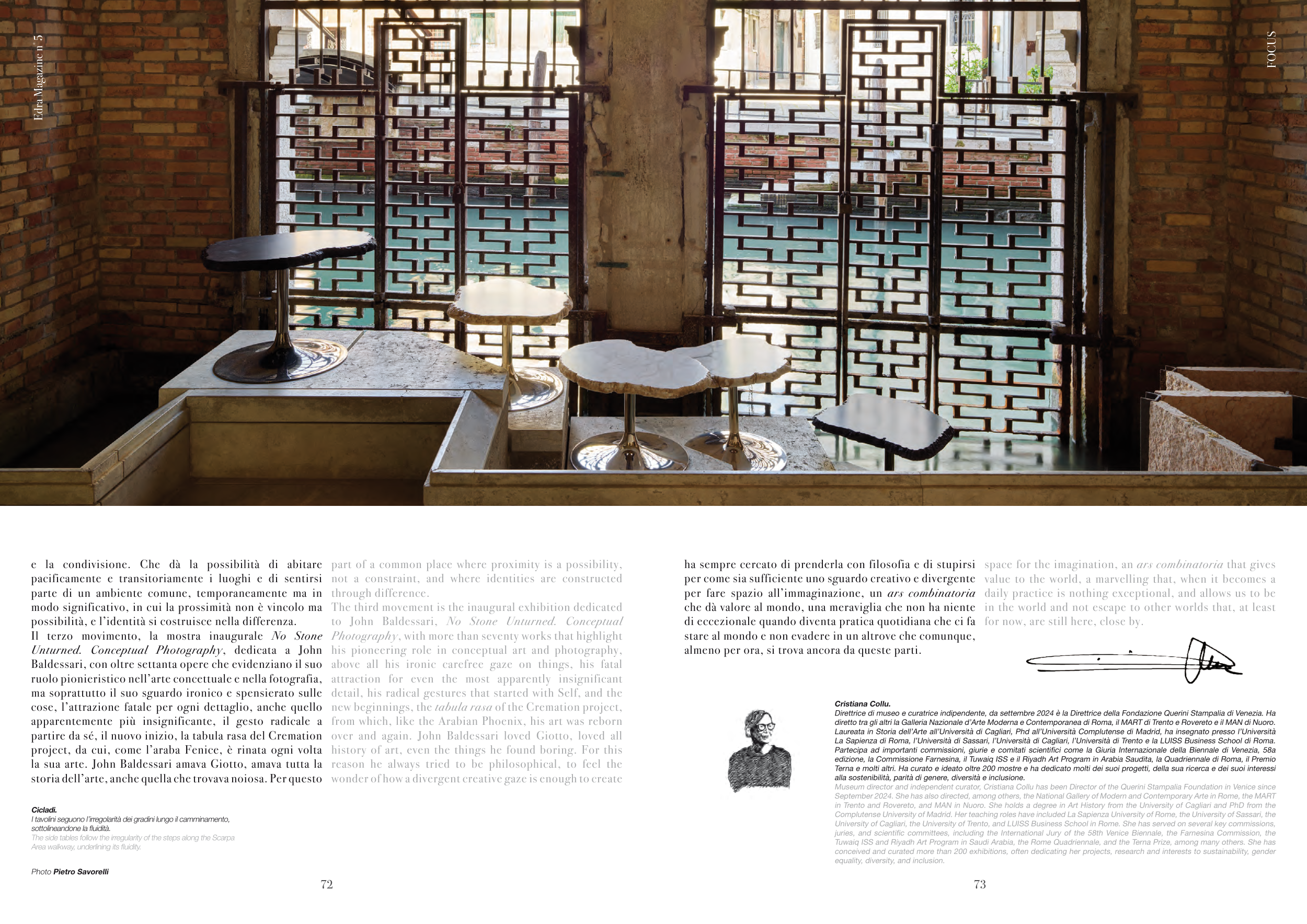
Cicladi.
I tavolini seguono l’irregolarità dei gradini lungo il camminamento,
sottolineandone la fluidità.
The side tables follow the irregularity of the steps along the Scarpa
Area walkway, underlining its fluidity.
Edra Magazine n°5
72
73
FOCUS