come ambiente che riaccoglie ciò che la modernità aveva
espulso: l’animale, l’organico, il naturale.
Nella storia dell’arredamento, la casa moderna è stata a
lungo pensata come rifugio dal mondo selvaggio, come
fortino razionale contro le minacce dell’esterno. I divani Edra
ribaltano questa logica. Non sono oggetti che disciplinano lo
spazio, ma organismi che lo invadono.
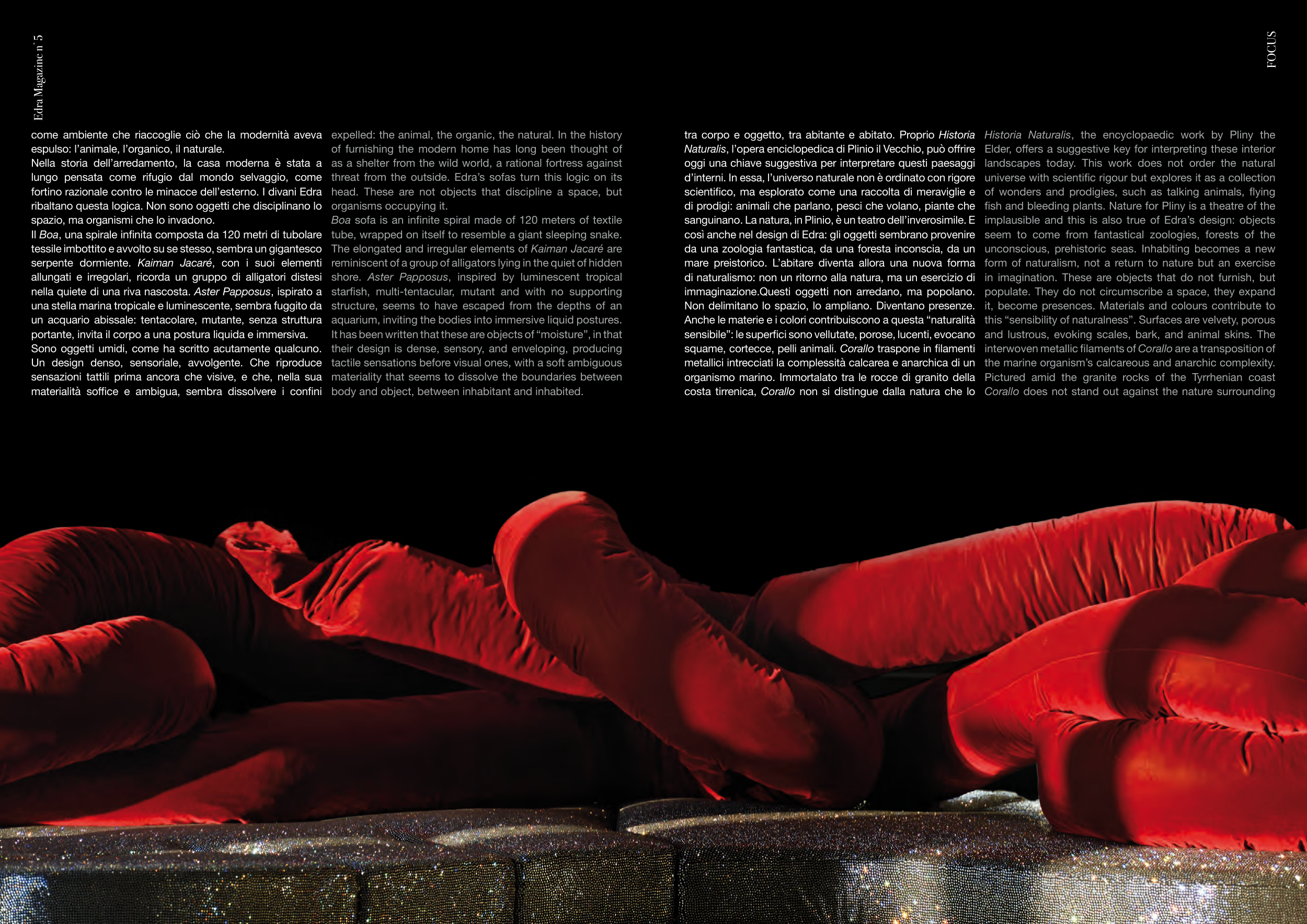
Il Boa, una spirale infinita composta da 120 metri di tubolare
tessile imbottito e avvolto su se stesso, sembra un gigantesco
serpente dormiente. Kaiman Jacaré, con i suoi elementi
allungati e irregolari, ricorda un gruppo di alligatori distesi
nella quiete di una riva nascosta. Aster Papposus, ispirato a
una stella marina tropicale e luminescente, sembra fuggito da
un acquario abissale: tentacolare, mutante, senza struttura
portante, invita il corpo a una postura liquida e immersiva.
Sono oggetti umidi, come ha scritto acutamente qualcuno.
Un design denso, sensoriale, avvolgente. Che riproduce
sensazioni tattili prima ancora che visive, e che, nella sua
materialità soffice e ambigua, sembra dissolvere i confini
tra corpo e oggetto, tra abitante e abitato. Proprio Historia
Naturalis, l’opera enciclopedica di Plinio il Vecchio, può offrire
oggi una chiave suggestiva per interpretare questi paesaggi
d’interni. In essa, l’universo naturale non è ordinato con rigore
scientifico, ma esplorato come una raccolta di meraviglie e
di prodigi: animali che parlano, pesci che volano, piante che
sanguinano. La natura, in Plinio, è un teatro dell’inverosimile. E
così anche nel design di Edra: gli oggetti sembrano provenire
da una zoologia fantastica, da una foresta inconscia, da un
mare preistorico. L’abitare diventa allora una nuova forma
di naturalismo: non un ritorno alla natura, ma un esercizio di
immaginazione.
Questi oggetti non arredano, ma popolano.
Non delimitano lo spazio, lo ampliano. Diventano presenze.
Anche le materie e i colori contribuiscono a questa “naturalità
sensibile”: le superfici sono vellutate, porose, lucenti, evocano
squame, cortecce, pelli animali. Corallo traspone in filamenti
metallici intrecciati la complessità calcarea e anarchica di un
organismo marino. Immortalato tra le rocce di granito della
costa tirrenica, Corallo non si distingue dalla natura che lo
expelled: the animal, the organic, the natural. In the history
of furnishing the modern home has long been thought of
as a shelter from the wild world, a rational fortress against
threat from the outside. Edra’s sofas turn this logic on its
head. These are not objects that discipline a space, but
organisms occupying it.
Boa sofa is an infinite spiral made of 120 meters of textile
tube, wrapped on itself to resemble a giant sleeping snake.
The elongated and irregular elements of Kaiman Jacaré are
reminiscent of a group of alligators lying in the quiet of hidden
shore. Aster Papposus, inspired by luminescent tropical
starfish, multi-tentacular, mutant and with no supporting
structure, seems to have escaped from the depths of an
aquarium, inviting the bodies into immersive liquid postures.
It has been written that these are objects of “moisture”, in that
their design is dense, sensory, and enveloping, producing
tactile sensations before visual ones, with a soft ambiguous
materiality that seems to dissolve the boundaries between
body and object, between inhabitant and inhabited.
Historia Naturalis, the encyclopaedic work by Pliny the
Elder, offers a suggestive key for interpreting these interior
landscapes today. This work does not order the natural
universe with scientific rigour but explores it as a collection
of wonders and prodigies, such as talking animals, flying
fish and bleeding plants. Nature for Pliny is a theatre of the
implausible and this is also true of Edra’s design: objects
seem to come from fantastical zoologies, forests of the
unconscious, prehistoric seas. Inhabiting becomes a new
form of naturalism, not a return to nature but an exercise
in imagination.
These are objects that do not furnish, but
populate. They do not circumscribe a space, they expand
it, become presences. Materials and colours contribute to
this “sensibility of naturalness”. Surfaces are velvety, porous
and lustrous, evoking scales, bark, and animal skins. The
interwoven metallic filaments of Corallo are a transposition of
the marine organism’s calcareous and anarchic complexity.
Pictured amid the granite rocks of the Tyrrhenian coast
Corallo does not stand out against the nature surrounding
Edra Magazine n°5
32
33
FOCUS