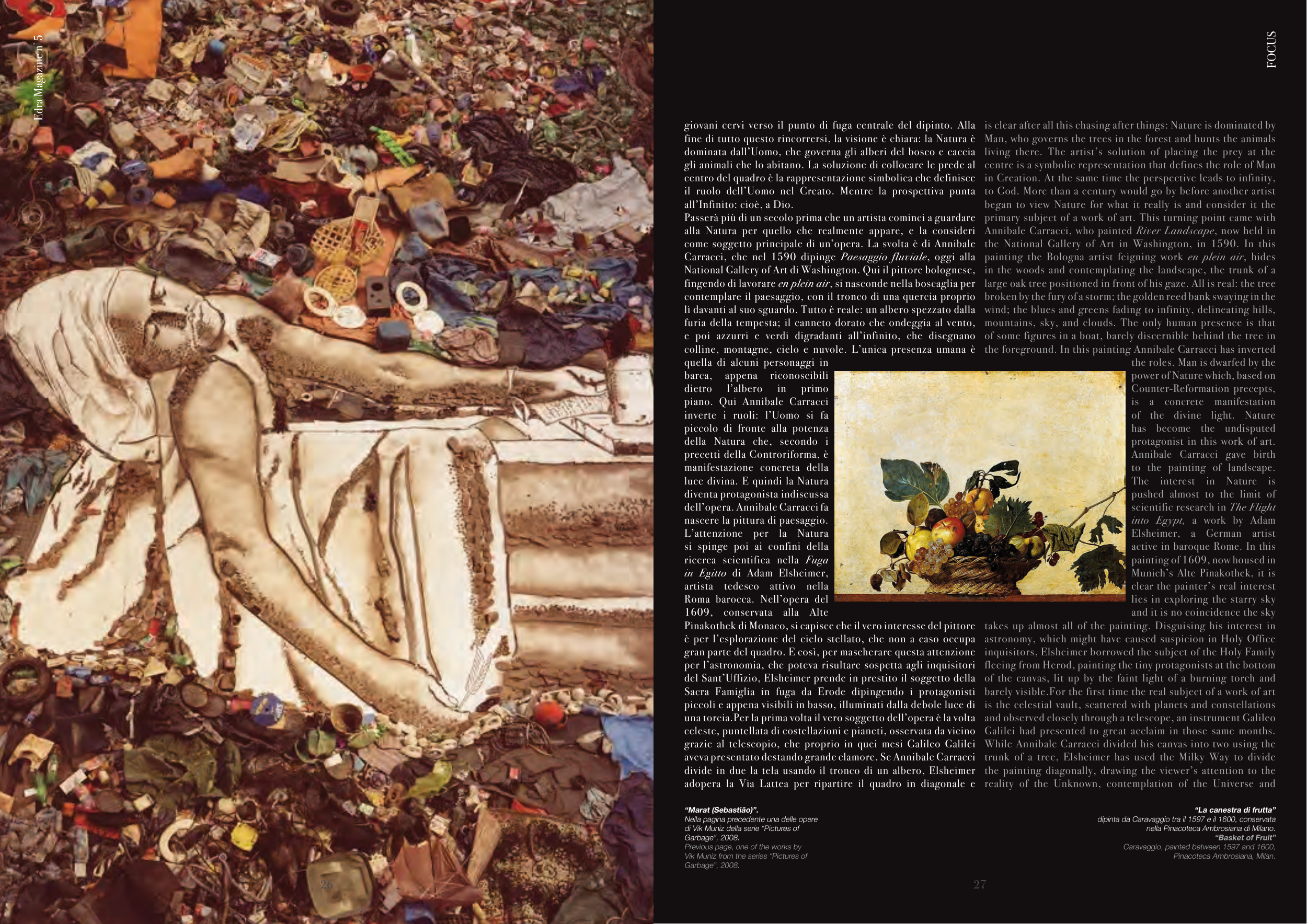
“La canestra di frutta”
dipinta da Caravaggio tra il 1597 e il 1600, conservata
nella Pinacoteca Ambrosiana di Milano.
“Basket of Fruit”
Caravaggio, painted between 1597 and 1600,
Pinacoteca Ambrosiana, Milan.
giovani cervi verso il punto di fuga centrale del dipinto. Alla
fine di tutto questo rincorrersi, la visione è chiara: la Natura è
dominata dall’Uomo, che governa gli alberi del bosco e caccia
gli animali che lo abitano. La soluzione di collocare le prede al
centro del quadro è la rappresentazione simbolica che definisce
il ruolo dell’Uomo nel Creato. Mentre la prospettiva punta
all’Infinito: cioè, a Dio.
Passerà più di un secolo prima che un artista cominci a guardare
alla Natura per quello che realmente appare, e la consideri
come soggetto principale di un’opera. La svolta è di Annibale
Carracci, che nel 1590 dipinge Paesaggio fluviale, oggi alla
National Gallery of Art di Washington. Qui il pittore bolognese,
fingendo di lavorare en plein air, si nasconde nella boscaglia per
contemplare il paesaggio, con il tronco di una quercia proprio
lì davanti al suo sguardo. Tutto è reale: un albero spezzato dalla
furia della tempesta; il canneto dorato che ondeggia al vento,
e poi azzurri e verdi digradanti all’infinito, che disegnano
colline, montagne, cielo e nuvole. L’unica presenza umana è
quella di alcuni personaggi in
barca,
appena
riconoscibili
dietro
l’albero
in
primo
piano. Qui Annibale Carracci
inverte i ruoli: l’Uomo si fa
piccolo di fronte alla potenza
della Natura che, secondo i
precetti della Controriforma, è
manifestazione concreta della
luce divina. E quindi la Natura
diventa protagonista indiscussa
dell’opera. Annibale Carracci fa
nascere la pittura di paesaggio.
L’attenzione per la Natura
si spinge poi ai confini della
ricerca scientifica nella Fuga
in Egitto di Adam Elsheimer,
artista tedesco attivo nella
Roma barocca. Nell’opera del
1609, conservata alla Alte
Pinakothek di Monaco, si capisce che il vero interesse del pittore
è per l’esplorazione del cielo stellato, che non a caso occupa
gran parte del quadro. E così, per mascherare questa attenzione
per l’astronomia, che poteva risultare sospetta agli inquisitori
del Sant’Uffizio, Elsheimer prende in prestito il soggetto della
Sacra Famiglia in fuga da Erode dipingendo i protagonisti
piccoli e appena visibili in basso, illuminati dalla debole luce di
una torcia.Per la prima volta il vero soggetto dell’opera è la volta
celeste, puntellata di costellazioni e pianeti, osservata da vicino
grazie al telescopio, che proprio in quei mesi Galileo Galilei
aveva presentato destando grande clamore. Se Annibale Carracci
divide in due la tela usando il tronco di un albero, Elsheimer
adopera la Via Lattea per ripartire il quadro in diagonale e
is clear after all this chasing after things: Nature is dominated by
Man, who governs the trees in the forest and hunts the animals
living there. The artist’s solution of placing the prey at the
centre is a symbolic representation that defines the role of Man
in Creation. At the same time the perspective leads to infinity,
to God. More than a century would go by before another artist
began to view Nature for what it really is and consider it the
primary subject of a work of art. This turning point came with
Annibale Carracci, who painted River Landscape, now held in
the National Gallery of Art in Washington, in 1590. In this
painting the Bologna artist feigning work en plein air, hides
in the woods and contemplating the landscape, the trunk of a
large oak tree positioned in front of his gaze. All is real: the tree
broken by the fury of a storm; the golden reed bank swaying in the
wind; the blues and greens fading to infinity, delineating hills,
mountains, sky, and clouds. The only human presence is that
of some figures in a boat, barely discernible behind the tree in
the foreground. In this painting Annibale Carracci has inverted
the roles. Man is dwarfed by the
power of Nature which, based on
Counter-Reformation precepts,
is a concrete manifestation
of the divine light. Nature
has become the undisputed
protagonist in this work of art.
Annibale Carracci gave birth
to the painting of landscape.
The
interest
in
Nature
is
pushed almost to the limit of
scientific research in The Flight
into Egypt, a work by Adam
Elsheimer, a German artist
active in baroque Rome. In this
painting of 1609, now housed in
Munich’s Alte Pinakothek, it is
clear the painter’s real interest
lies in exploring the starry sky
and it is no coincidence the sky
takes up almost all of the painting. Disguising his interest in
astronomy, which might have caused suspicion in Holy Office
inquisitors, Elsheimer borrowed the subject of the Holy Family
fleeing from Herod, painting the tiny protagonists at the bottom
of the canvas, lit up by the faint light of a burning torch and
barely visible.For the first time the real subject of a work of art
is the celestial vault, scattered with planets and constellations
and observed closely through a telescope, an instrument Galileo
Galilei had presented to great acclaim in those same months.
While Annibale Carracci divided his canvas into two using the
trunk of a tree, Elsheimer has used the Milky Way to divide
the painting diagonally, drawing the viewer’s attention to the
reality of the Unknown, contemplation of the Universe and
“Marat (Sebastião)”.
Nella pagina precedente una delle opere
di Vik Muniz della serie “Pictures of
Garbage”, 2008.
Previous page, one of the works by
Vik Muniz from the series “Pictures of
Garbage”, 2008.
Edra Magazine n°5
26
27
FOCUS