L
a Natura comunica con la forza dei suoi elementi.
Conosciamo bene la furia dell’acqua e del fuoco,
l’aumento della temperatura nell’atmosfera, le
condizioni dell’aria che respiriamo, i dissesti
del territorio. Il cambiamento climatico mi ha
fatto tornare alla mente la frase finale di Candide, il romanzo
filosofico di Voltaire: “Il faut cultiver notre jardin”, “bisogna
coltivare il nostro giardino”. A distanza di quasi tre secoli
quell’invito risuona come un imperativo disatteso. Perché non
c’è dubbio che il “nostro giardino” sia il mondo intero, quanto
mai bisognoso di cure.
L’idea del giardino evoca qualcosa di ordinato, pulito,
rigoglioso. Qualcosa di amato e costantemente lavorato. Il
giardiniere ha una sua incrollabile fede: sa che il meglio deve
ancora venire. Il suo ottimismo di fondo lo spinge a credere che
il lavoro costante assicurerà il benessere delle piante e che, anno
dopo anno, ci saranno fiori più belli e alberi più alti. In molte
culture, il giardino è la rappresentazione di un luogo ideale in
cui tutto è perfetto e che quindi, per sua stessa definizione,
non necessita di cure. È così, ad esempio, per il Giardino
dell’Eden della Bibbia, il Paradiso Terrestre da dove Adamo ed
Eva vengono cacciati; oppure per il mitologico Giardino delle
Esperidi, dove Eracle va a cogliere le tre mele d’oro; e anche per
l’isola di Ogigia descritta nell’Odissea, dove la ninfa Calipso
trattiene per sette anni Ulisse prima di tornare a Itaca.
Il mio ragionamento si colloca tra l’idea del giardino ideale e
la realtà del “nostro giardino” oggi, e poggia sul tema della
rappresentazione della Natura attraverso l’arte, un riferimento
Nature communicates through the force of its elements. We are
familiar with the fury of water and fire, the rising temperatures
of the atmosphere, the air conditions we are breathing and
the instability of our land. Climate change brings to mind the
final words of Candide, Voltaire’s philosophical novel; “Il
faut cultiver notre jardin”, “we need to cultivate our garden”.
Almost three centuries later his invitation resonates like an
unheeded imperative, because there is no doubt that “our
garden” is the whole world, and more in need of care than
ever.The idea of a garden evokes something orderly, clean,
and luxuriant, something we love and worked on constantly.
Gardeners have unshakable faith, and know the best is yet to
come. Their fundamental optimism drives them to believe that
their constant work will ensure the wellbeing of the plants and
that year on year the flowers will be more beautiful and the
trees taller. In many cultures gardens represent an ideal place
in which everything is perfect and therefore by definition does
not require maintenance. This is true of the biblical Garden of
Eden for example, the earthly paradise that Adam and Eve were
banished from; and for the mythological Garden of Hesperides,
where Heracles picked three golden apples, or the island of
Ogygia, described in the Odyssey, where the nymph Calypso
kept Odysseus for seven years before his return to Ithaca.My
reasoning is situated somewhere between the idea of this ideal
garden and the reality of “our garden” today, and uses the
theme of representing Nature through art, which has always
been a constant, up to our own time of the Anthropocene. This
is the era we live in. Works of art can help us to understand
WORDS Pierluigi Masini
costante fino ai giorni nostri, all’Antropocene. L’era che viviamo.
Le opere ci aiutano a comprendere il rapporto dell’Uomo con la
Natura perché, come dice il filosofo Georg Simmel, “solo all’arte
è dato di farci cogliere la vita reale attraverso l’apparenza che essa
ci offre”. La Natura ci ha sempre accompagnato nel corso della
storia, ricordandoci la nostra profonda appartenenza ad essa.
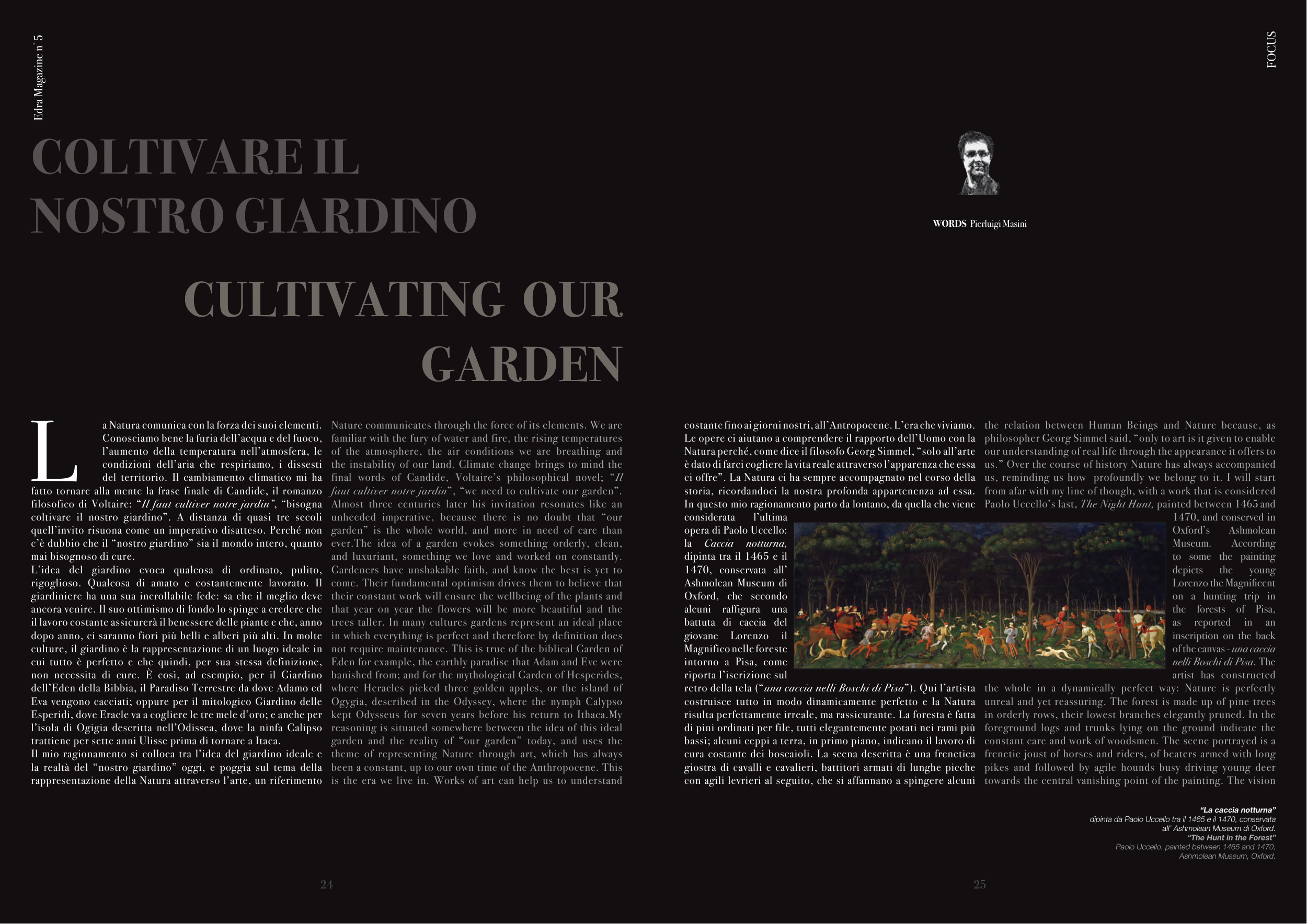
In questo mio ragionamento parto da lontano, da quella che viene
considerata
l’ultima
opera di Paolo Uccello:
la
Caccia
notturna,
dipinta tra il 1465 e il
1470, conservata all’
Ashmolean Museum di
Oxford, che secondo
alcuni
raffigura
una
battuta di caccia del
giovane
Lorenzo
il
Magnifico nelle foreste
intorno a Pisa, come
riporta l’iscrizione sul
retro della tela (“una caccia nelli Boschi di Pisa”). Qui l’artista
costruisce tutto in modo dinamicamente perfetto e la Natura
risulta perfettamente irreale, ma rassicurante. La foresta è fatta
di pini ordinati per file, tutti elegantemente potati nei rami più
bassi; alcuni ceppi a terra, in primo piano, indicano il lavoro di
cura costante dei boscaioli. La scena descritta è una frenetica
giostra di cavalli e cavalieri, battitori armati di lunghe picche
con agili levrieri al seguito, che si affannano a spingere alcuni
the relation between Human Beings and Nature because, as
philosopher Georg Simmel said, “only to art is it given to enable
our understanding of real life through the appearance it offers to
us.” Over the course of history Nature has always accompanied
us, reminding us how profoundly we belong to it. I will start
from afar with my line of though, with a work that is considered
Paolo Uccello’s last, The Night Hunt, painted between 1465 and
1470, and conserved in
Oxford’s
Ashmolean
Museum.
According
to some the painting
depicts
the
young
Lorenzo the Magnificent
on a hunting trip in
the
forests
of
Pisa,
as
reported
in
an
inscription on the back
of the canvas - una caccia
nelli Boschi di Pisa. The
artist has constructed
the whole in a dynamically perfect way: Nature is perfectly
unreal and yet reassuring. The forest is made up of pine trees
in orderly rows, their lowest branches elegantly pruned. In the
foreground logs and trunks lying on the ground indicate the
constant care and work of woodsmen. The scene portrayed is a
frenetic joust of horses and riders, of beaters armed with long
pikes and followed by agile hounds busy driving young deer
towards the central vanishing point of the painting. The vision
COLTIVARE IL
NOSTRO GIARDINO
“La caccia notturna”
dipinta da Paolo Uccello tra il 1465 e il 1470, conservata
all’ Ashmolean Museum di Oxford.
“The Hunt in the Forest”
Paolo Uccello, painted between 1465 and 1470,
Ashmolean Museum, Oxford.
CULTIVATING OUR
GARDEN
Edra Magazine n°5
24
25
FOCUS