On the Rocks & Cicladi.
Il divano di Francesco Binfaré e i tavolini di
Jacopo Foggini all’interno del salone.
Francesco Binfaré’s sofa and Jacopo
Foggini’s tables in the hall.
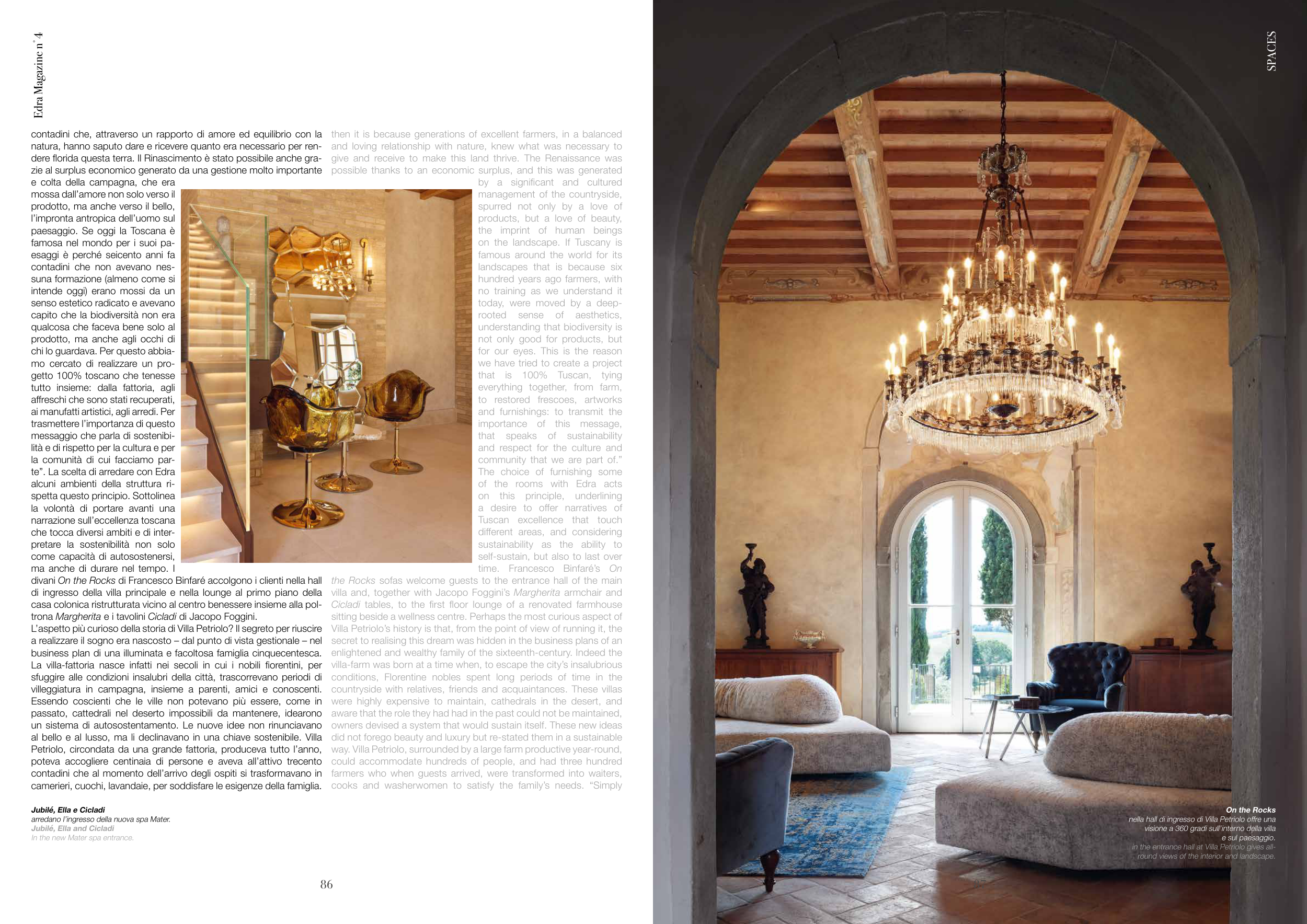
On the Rocks
nella hall di ingresso di Villa Petriolo offre una
visione a 360 gradi sull’interno della villa
e sul paesaggio.
in the entrance hall at Villa Petriolo gives all-
round views of the interior and landscape.
Jubilé, Ella e Cicladi
arredano l’ingresso della nuova spa Mater.
Jubilé, Ella and Cicladi
In the new Mater spa entrance.
contadini che, attraverso un rapporto di amore ed equilibrio con la
natura, hanno saputo dare e ricevere quanto era necessario per ren-
dere florida questa terra. Il Rinascimento è stato possibile anche gra-
zie al surplus economico generato da una gestione molto importante
e colta della campagna, che era
mossa dall’amore non solo verso il
prodotto, ma anche verso il bello,
l’impronta antropica dell’uomo sul
paesaggio. Se oggi la Toscana è
famosa nel mondo per i suoi pa-
esaggi è perché seicento anni fa
contadini che non avevano nes-
suna formazione (almeno come si
intende oggi) erano mossi da un
senso estetico radicato e avevano
capito che la biodiversità non era
qualcosa che faceva bene solo al
prodotto, ma anche agli occhi di
chi lo guardava. Per questo abbia-
mo cercato di realizzare un pro-
getto 100% toscano che tenesse
tutto insieme: dalla fattoria, agli
affreschi che sono stati recuperati,
ai manufatti artistici, agli arredi. Per
trasmettere l’importanza di questo
messaggio che parla di sostenibi-
lità e di rispetto per la cultura e per
la comunità di cui facciamo par-
te”. La scelta di arredare con Edra
alcuni ambienti della struttura ri-
spetta questo principio. Sottolinea
la volontà di portare avanti una
narrazione sull’eccellenza toscana
che tocca diversi ambiti e di inter-
pretare la sostenibilità non solo
come capacità di autosostenersi,
ma anche di durare nel tempo. I
divani On the Rocks di Francesco Binfaré accolgono i clienti nella hall
di ingresso della villa principale e nella lounge al primo piano della
casa colonica ristrutturata vicino al centro benessere insieme alla pol-
trona Margherita e i tavolini Cicladi di Jacopo Foggini.
L’aspetto più curioso della storia di Villa Petriolo? Il segreto per riuscire
a realizzare il sogno era nascosto – dal punto di vista gestionale – nel
business plan di una illuminata e facoltosa famiglia cinquecentesca.
La villa-fattoria nasce infatti nei secoli in cui i nobili fiorentini, per
sfuggire alle condizioni insalubri della città, trascorrevano periodi di
villeggiatura in campagna, insieme a parenti, amici e conoscenti.
Essendo coscienti che le ville non potevano più essere, come in
passato, cattedrali nel deserto impossibili da mantenere, idearono
un sistema di autosostentamento. Le nuove idee non rinunciavano
al bello e al lusso, ma li declinavano in una chiave sostenibile. Villa
Petriolo, circondata da una grande fattoria, produceva tutto l’anno,
poteva accogliere centinaia di persone e aveva all’attivo trecento
contadini che al momento dell’arrivo degli ospiti si trasformavano in
camerieri, cuochi, lavandaie, per soddisfare le esigenze della famiglia.
then it is because generations of excellent farmers, in a balanced
and loving relationship with nature, knew what was necessary to
give and receive to make this land thrive. The Renaissance was
possible thanks to an economic surplus, and this was generated
by a significant and cultured
management of the countryside,
spurred not only by a love of
products, but a love of beauty,
the imprint of human beings
on the landscape. If Tuscany is
famous around the world for its
landscapes that is because six
hundred years ago farmers, with
no training as we understand it
today, were moved by a deep-
rooted
sense
of
aesthetics,
understanding that biodiversity is
not only good for products, but
for our eyes. This is the reason
we have tried to create a project
that is 100% Tuscan, tying
everything together, from farm,
to restored frescoes, artworks
and furnishings: to transmit the
importance of this message,
that
speaks
of
sustainability
and respect for the culture and
community that we are part of.”
The choice of furnishing some
of the rooms with Edra acts
on this principle, underlining
a desire to offer narratives of
Tuscan excellence that touch
different areas, and considering
sustainability as the ability to
self-sustain, but also to last over
time. Francesco Binfaré’s On
the Rocks sofas welcome guests to the entrance hall of the main
villa and, together with Jacopo Foggini’s Margherita armchair and
Cicladi tables, to the first floor lounge of a renovated farmhouse
sitting beside a wellness centre. Perhaps the most curious aspect of
Villa Petriolo’s history is that, from the point of view of running it, the
secret to realising this dream was hidden in the business plans of an
enlightened and wealthy family of the sixteenth-century. Indeed the
villa-farm was born at a time when, to escape the city’s insalubrious
conditions, Florentine nobles spent long periods of time in the
countryside with relatives, friends and acquaintances. These villas
were highly expensive to maintain, cathedrals in the desert, and
aware that the role they had had in the past could not be maintained,
owners devised a system that would sustain itself. These new ideas
did not forego beauty and luxury but re-stated them in a sustainable
way. Villa Petriolo, surrounded by a large farm productive year-round,
could accommodate hundreds of people, and had three hundred
farmers who when guests arrived, were transformed into waiters,
cooks and washerwomen to satisfy the family’s needs. “Simply
87
SPACES
Edra Magazine n°4
86