quella che dopo cinque secoli abbiamo conservato noi. Una linea dirit-
ta con il passato a sinistra e il futuro a destra, in mezzo il punto in cui
siamo. Ma la raffigurazione del tempo non è sempre stata così. Dalla
nascita di Cristo, nell’anno zero, abbiamo cominciato a contare il tem-
po nel modo che conosciamo. Prima la sua raffigurazione era circolare,
era l’alternarsi rassicurante delle stagioni, un’energia che si autoali-
mentava, rappresentata spesso dall’Uroboro, il serpente che si morde
la coda, elemento iconografico che troviamo in civiltà lontanissime tra
loro, dal Centro-America all’India.
Fin qui i temi artistici. Abbiamo cominciato con il marketing, che
punta alla vendita, e stiamo ora per approdare alla scienza, che punta
all’oggettività. Ci spostiamo di livello. La rappresentazione lineare del
tempo mi ha fatto tornare in mente le riflessioni di un fisico teorico
e pensatore finissimo come Carlo Rovelli, che da decenni ha posto
questo elemento al centro della sua ricerca. Rovelli introduce alcuni
dati, ormai acclarati, che riguardano la natura mutevole del tempo. Per
esempio, che il tempo scorre più veloce in montagna e più lento in pia-
nura. Interstellar, il film premio Oscar 2015, mostra il padre che torna
sulla Terra dopo 124 anni e non è affatto cambiato. Ritrova sua figlia,
che ha 90 anni e li dimostra tutti. Al-
tro concetto ormai acclarato è che il
tempo varia in relazione alla velocità.
Quindi un orologio su un aereo che va
velocissimo segna un tempo più lento
di quello misurato da un medesimo
orologio rimasto a terra.
Ma la cosa più stupefacente del suo
ragionamento è che la dimensione del
tempo è soprattutto personale. Non
esiste un passato fissato oggettivamente, un presente hic et nunc e un
futuro tutto da esplorare. È falso. È l’approssimazione dell’approssi-
mazione di una realtà molto più complessa legata al concetto di entro-
pia. In realtà, spiega la fisica teorica, il tempo ha un ordine, ma non è
quello lineare, piuttosto è determinato da campi gravitazionali. E se
aggiungiamo lo spaziotempo della realtà quantistica, dobbiamo im-
maginare che le nostre esistenze siano immerse in una sorta di tempo
gelatina dell’Universo. Insomma, siamo piccolissime entità in balia di
forze che non conosciamo.
E allora, in conclusione, cos’è il tempo? Cito testualmente Rovelli:
“cominciamo a vedere che il tempo siamo noi. Siamo questo spazio,
questa radura aperta dalle tracce della memoria dentro le connessioni
dei nostri neuroni. Siamo memoria. Siamo nostalgia. Siamo anelito
verso un futuro che non verrà. Questo spazio che viene così aperto
dalla memoria e dall’anticipazione è il tempo, che forse talvolta ci an-
goscia, ma che alla fine è un dono”. Mi affascina questa definizione,
che riporta a galla il nostro essere in modo così delicato. E, lasciato
Rovelli, voglio inserirmi in questo spazio di riflessione sul tempo come
dimensione personale dove lui felicemente ci ha condotto. Ho recu-
perato un ricordo dei miei studi classici. Nella lingua greca il tempo
aveva più significati e veniva espresso con termini differenti. Esisteva
Chronos (Χρόνος), usato per indicare la dimensione quantitativa, la
sequenza e lo scorrere delle cose. Un dato misurabile e oggettivo. Ma
quando volevano fare riferimento a una dimensione personale, a un
tempo intimo, benevolo, piacevole, a un momento favorevole, oppor-
tuno, felice, allora i greci usavano la parola Kairòs (Kαιρός).
Chronos e Kairòs. Mi chiedo: ma perché abbiamo perso questa di-
stinzione, così importante, nella terminologia moderna? Perché non
abbiamo conservato la voglia di descrivere quel tempo sottratto alla
quotidianità delle cose che si ripetono, al lavoro d’ufficio, al ruolo che
abbiamo o che ci viene assegnato, per indicare un tempo per noi e ba-
sta? Un tempo per riflettere, per godere di quello che più ci piace, un
tempo davvero senza tempo che
scorre lento, senza nevrosi, senza
maschere, senza schemi. Un tem-
po che non opprime, non incalza
ma è dalla nostra parte, ci è favo-
revole, ci porta cose belle?
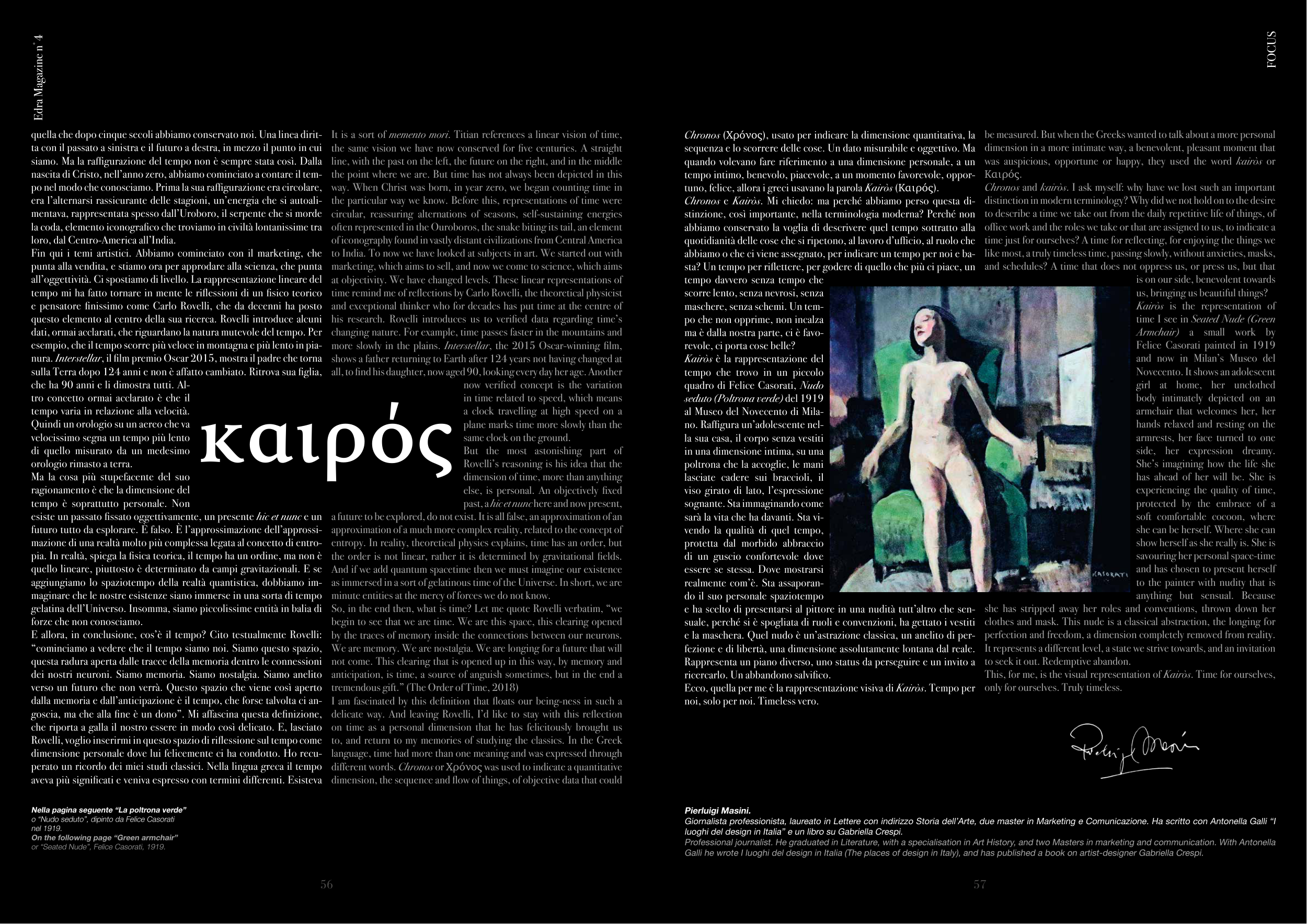
Kairòs è la rappresentazione del
tempo che trovo in un piccolo
quadro di Felice Casorati, Nudo
seduto (Poltrona verde) del 1919
al Museo del Novecento di Mila-
no. Raffigura un’adolescente nel-
la sua casa, il corpo senza vestiti
in una dimensione intima, su una
poltrona che la accoglie, le mani
lasciate cadere sui braccioli, il
viso girato di lato, l’espressione
sognante. Sta immaginando come
sarà la vita che ha davanti. Sta vi-
vendo la qualità di quel tempo,
protetta dal morbido abbraccio
di un guscio confortevole dove
essere se stessa. Dove mostrarsi
realmente com’è. Sta assaporan-
do il suo personale spaziotempo
e ha scelto di presentarsi al pittore in una nudità tutt’altro che sen-
suale, perché si è spogliata di ruoli e convenzioni, ha gettato i vestiti
e la maschera. Quel nudo è un’astrazione classica, un anelito di per-
fezione e di libertà, una dimensione assolutamente lontana dal reale.
Rappresenta un piano diverso, uno status da perseguire e un invito a
ricercarlo. Un abbandono salvifico.
Ecco, quella per me è la rappresentazione visiva di Kairòs. Tempo per
noi, solo per noi. Timeless vero.
Pierluigi Masini.
Giornalista professionista, laureato in Lettere con indirizzo Storia dell’Arte, due master in Marketing e Comunicazione. Ha scritto con Antonella Galli “I
luoghi del design in Italia” e un libro su Gabriella Crespi.
Professional journalist. He graduated in Literature, with a specialisation in Art History, and two Masters in marketing and communication. With Antonella
Galli he wrote I luoghi del design in Italia (The places of design in Italy), and has published a book on artist-designer Gabriella Crespi.
Nella pagina seguente “La poltrona verde”
o “Nudo seduto”, dipinto da Felice Casorati
nel 1919.
On the following page “Green armchair”
or “Seated Nude”, Felice Casorati, 1919.
It is a sort of memento mori. Titian references a linear vision of time,
the same vision we have now conserved for five centuries. A straight
line, with the past on the left, the future on the right, and in the middle
the point where we are. But time has not always been depicted in this
way. When Christ was born, in year zero, we began counting time in
the particular way we know. Before this, representations of time were
circular, reassuring alternations of seasons, self-sustaining energies
often represented in the Ouroboros, the snake biting its tail, an element
of iconography found in vastly distant civilizations from Central America
to India. To now we have looked at subjects in art. We started out with
marketing, which aims to sell, and now we come to science, which aims
at objectivity. We have changed levels. These linear representations of
time remind me of reflections by Carlo Rovelli, the theoretical physicist
and exceptional thinker who for decades has put time at the centre of
his research. Rovelli introduces us to verified data regarding time’s
changing nature. For example, time passes faster in the mountains and
more slowly in the plains. Interstellar, the 2015 Oscar-winning film,
shows a father returning to Earth after 124 years not having changed at
all, to find his daughter, now aged 90, looking every day her age. Another
now verified concept is the variation
in time related to speed, which means
a clock travelling at high speed on a
plane marks time more slowly than the
same clock on the ground.
But the most astonishing part of
Rovelli’s reasoning is his idea that the
dimension of time, more than anything
else, is personal. An objectively fixed
past, a hic et nunc here and now present,
a future to be explored, do not exist. It is all false, an approximation of an
approximation of a much more complex reality, related to the concept of
entropy. In reality, theoretical physics explains, time has an order, but
the order is not linear, rather it is determined by gravitational fields.
And if we add quantum spacetime then we must imagine our existence
as immersed in a sort of gelatinous time of the Universe. In short, we are
minute entities at the mercy of forces we do not know.
So, in the end then, what is time? Let me quote Rovelli verbatim, “we
begin to see that we are time. We are this space, this clearing opened
by the traces of memory inside the connections between our neurons.
We are memory. We are nostalgia. We are longing for a future that will
not come. This clearing that is opened up in this way, by memory and
anticipation, is time, a source of anguish sometimes, but in the end a
tremendous gift.” (The Order of Time, 2018)
I am fascinated by this definition that floats our being-ness in such a
delicate way. And leaving Rovelli, I’d like to stay with this reflection
on time as a personal dimension that he has felicitously brought us
to, and return to my memories of studying the classics. In the Greek
language, time had more than one meaning and was expressed through
different words. Chronos or Χρόνος was used to indicate a quantitative
dimension, the sequence and flow of things, of objective data that could
be measured. But when the Greeks wanted to talk about a more personal
dimension in a more intimate way, a benevolent, pleasant moment that
was auspicious, opportune or happy, they used the word kairòs or
Kαιρός.
Chronos and kairòs. I ask myself: why have we lost such an important
distinction in modern terminology? Why did we not hold on to the desire
to describe a time we take out from the daily repetitive life of things, of
office work and the roles we take or that are assigned to us, to indicate a
time just for ourselves? A time for reflecting, for enjoying the things we
like most, a truly timeless time, passing slowly, without anxieties, masks,
and schedules? A time that does not oppress us, or press us, but that
is on our side, benevolent towards
us, bringing us beautiful things?
Kairòs is the representation of
time I see in Seated Nude (Green
Armchair) a small work by
Felice Casorati painted in 1919
and now in Milan’s Museo del
Novecento. It shows an adolescent
girl at home, her unclothed
body intimately depicted on an
armchair that welcomes her, her
hands relaxed and resting on the
armrests, her face turned to one
side, her expression dreamy.
She’s imagining how the life she
has ahead of her will be. She is
experiencing the quality of time,
protected by the embrace of a
soft comfortable cocoon, where
she can be herself. Where she can
show herself as she really is. She is
savouring her personal space-time
and has chosen to present herself
to the painter with nudity that is
anything but sensual. Because
she has stripped away her roles and conventions, thrown down her
clothes and mask. This nude is a classical abstraction, the longing for
perfection and freedom, a dimension completely removed from reality.
It represents a different level, a state we strive towards, and an invitation
to seek it out. Redemptive abandon.
This, for me, is the visual representation of Kairòs. Time for ourselves,
only for ourselves. Truly timeless.
καιρός
Edra Magazine n°4
56
57
FOCUS