Laura Arrighi
Architetto, dottore di ricerca, web writer ed editor freelance. Si dedica a: scrittura, ricerca, didattica e progetto collaborando con le istituzioni e con alcuni importanti studi di
architettura italiani. Assegnista di ricerca all’Università Iuav di Venezia dal 2020 al 2022, ha scritto diverse pubblicazioni. Insegna Design dell’Evento e Design degli Interni presso
l’Università degli Studi di Genova ed è guest professor presso l’Università BUCT di Beijing per il corso di Interior Design.
Arrighi is an architect with PhD, a web writer and freelance editor. She dedicates her time to writing, research, teaching and design, collaborating with institutions and important
Italian architectural studios. She was research fellow at the Iuav University of Venice from 2020 to 2022 and has written several publications. She teaches Event Design and Interior
Design at the University of Genoa and is guest professor at BUCT University of Beijing on the Interior Design course.
L’armonia che regna nel paesaggio toscano ha origini rinascimentali
e non è possibile spiegarla facendo esclusivo riferimento alla tecnica
agraria in uso, da sempre, nel territorio”.
Con questo spirito rinascimentale di coltivare e custodire la bellezza
in ogni sua forma, Castello di Ama per l’Arte contemporanea ha
proseguito il suo percorso e con sempre maggior consapevolezza
del significato del progetto si è reso autonomo da Galleria Continua.
“Abbiamo chiamato un solo artista all’anno. Come abbiamo fatto per
la produzione di vino, la nostra ambizione è sempre stata quella di
fare qualcosa di unico per il luogo, che non fosse né di marketing né
di comunicazione rispetto alla nostra azienda, ma che avesse il solo
scopo di far bene a noi, al territorio e ai nostri ospiti. L’arte è vitale.
Il tempo che passo con gli artisti per me è il tempo giusto, che mi
nutre” spiega Lorenza. Dopo le prime due, altre sedici opere hanno
contribuito a legare sempre di più i mondi dell’ospitalità e del vino a
quello dell’arte. Topiary di Louise Bourgeois, una scultura in marmo
rosa di una dolcissima figura femminile trasformata in fallo, in boccio
che si autofeconda seduta in un una vecchia cisterna di raccolta di
acqua. Revolution / love di Kendell Geers: la scritta in neon rosso la
scritta revolution al contrario che compare in una stanza, evoca una
cripta romanica e si fa portavoce del racconto del vino del Castello
di Ama; un racconto rivoluzionario rispetto a uno status quo e a
una tradizione. Che è poi quello che succede in natura con la sua
continua pulsione di rinnovamento. E ancora Aima di Anish Kapoor,
un cerchio luminoso, una piccola voragine rossa, ingannevole,
aperta al centro del pavimento della cappellina del Castello di
Ama. Paradigma di Giulio Paolini, La lumiere interieure du corps
humain di Chen Zhen, Yo no quiero ver mas a mis vecinos di Carlos
Garaicoa, Towards the ground di Cristina Iglesias, Amadoodles di
Nedko Solakov, The observer di Ilya ed Emilia Kabakov, Le chemin
du bonheur di Pascal Martine Tayou, Confession of zero di Hiroshi
Sugimoto, Topos (excavated) di Lee Ufan, red nerve di Miroslaw
Balka e Untitled di Roni Horn. E appena ultimata l’opera Tana di
Giorgio Andreotta Calò. Philip Larratt-Smith scrive: “Con la sua
miscela unica di arte, cibo, vino, architettura e paesaggio, Ama si
rivela un’opera d’arte di per sé. Trascorrere del tempo qui significa
regolarsi su un altro ritmo, un altro modo di stare al mondo, via
via che un senso di pace si accompagna al senso di sé. Stando qui
sentiamo crescere la consapevolezza di noi stessi, la nostra esistenza
ci pare arricchirsi e farsi più profonda, la nostra mente si inebria di
natura e proviamo una eccitante sensazione di autenticità e di verità
interiore”.
Photo Alessandro Moggi
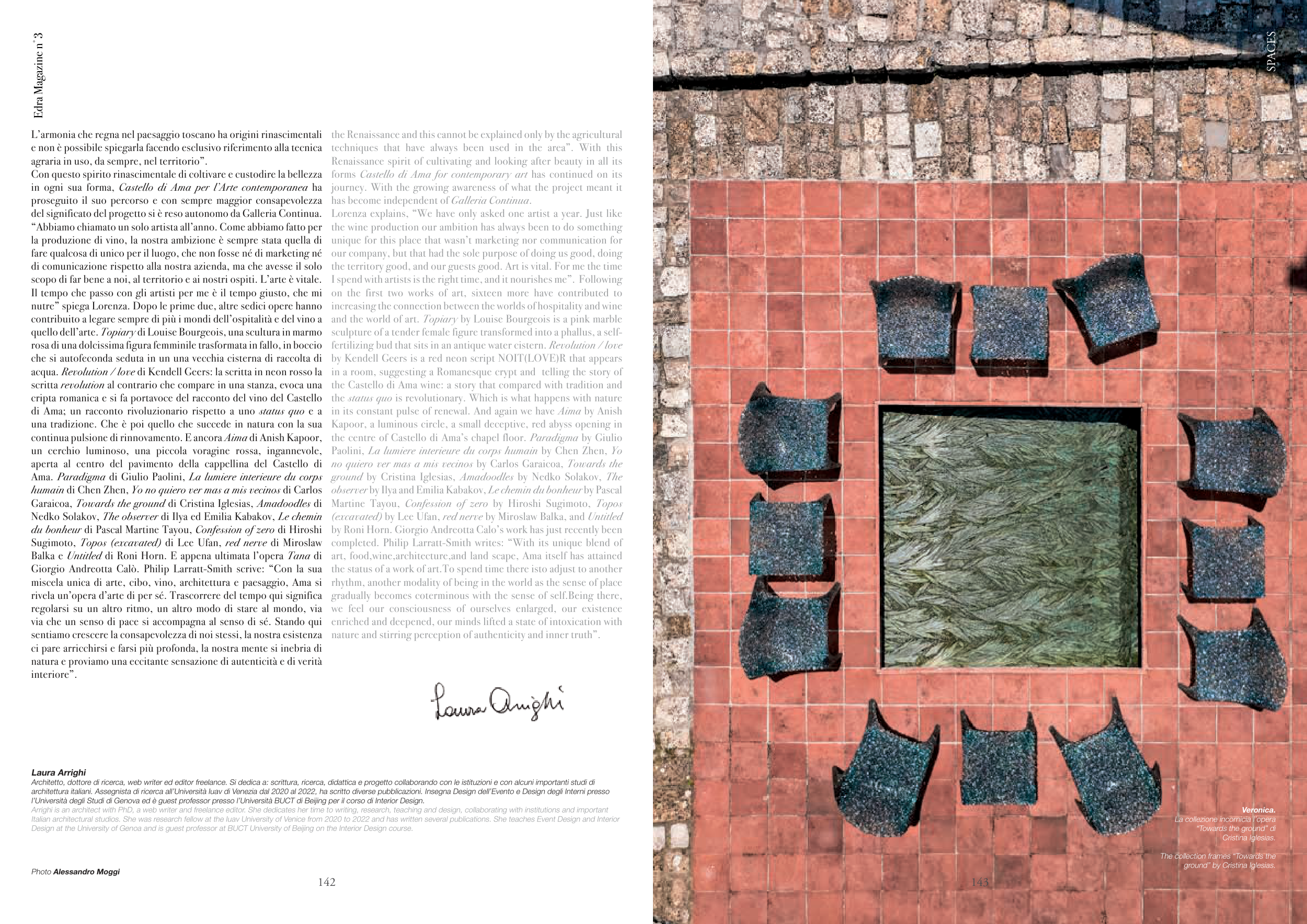
Veronica.
La collezione incornicia l’opera
“Towards the ground” di
Cristina Iglesias.
The collection frames “Towards the
ground” by Cristina Iglesias.
the Renaissance and this cannot be explained only by the agricultural
techniques that have always been used in the area”. With this
Renaissance spirit of cultivating and looking after beauty in all its
forms Castello di Ama for contemporary art has continued on its
journey. With the growing awareness of what the project meant it
has become independent of Galleria Continua.
Lorenza explains, “We have only asked one artist a year. Just like
the wine production our ambition has always been to do something
unique for this place that wasn’t marketing nor communication for
our company, but that had the sole purpose of doing us good, doing
the territory good, and our guests good. Art is vital. For me the time
I spend with artists is the right time, and it nourishes me”. Following
on the first two works of art, sixteen more have contributed to
increasing the connection between the worlds of hospitality and wine
and the world of art. Topiary by Louise Bourgeois is a pink marble
sculpture of a tender female figure transformed into a phallus, a self-
fertilizing bud that sits in an antique water cistern. Revolution / love
by Kendell Geers is a red neon script NOIT(LOVE)R that appears
in a room, suggesting a Romanesque crypt and telling the story of
the Castello di Ama wine: a story that compared with tradition and
the status quo is revolutionary. Which is what happens with nature
in its constant pulse of renewal. And again we have Aima by Anish
Kapoor, a luminous circle, a small deceptive, red abyss opening in
the centre of Castello di Ama’s chapel floor. Paradigma by Giulio
Paolini, La lumiere interieure du corps humain by Chen Zhen, Yo
no quiero ver mas a mis vecinos by Carlos Garaicoa, Towards the
ground by Cristina Iglesias, Amadoodles by Nedko Solakov, The
observer by Ilya and Emilia Kabakov, Le chemin du bonheur by Pascal
Martine Tayou, Confession of zero by Hiroshi Sugimoto, Topos
(excavated) by Lee Ufan, red nerve by Miroslaw Balka, and Untitled
by Roni Horn. Giorgio Andreotta Calo’s work has just recently been
completed. Philip Larratt-Smith writes: “With its unique blend of
art, food,wine,architecture,and land scape, Ama itself has attained
the status of a work of art.To spend time there isto adjust to another
rhythm, another modality of being in the world as the sense of place
gradually becomes coterminous with the sense of self.Being there,
we feel our consciousness of ourselves enlarged, our existence
enriched and deepened, our minds lifted a state of intoxication with
nature and stirring perception of authenticity and inner truth”.
143
SPACES
Edra Magazine n°3
142