Personalmente non conosco altro modo di fare
il nostro tempo che stare sul presente, non solo
stare al passo ma segnare il passo.
Personally, I know of no other way to do
our time than to stay in the present, not just
keeping up, but marking time.
“
“
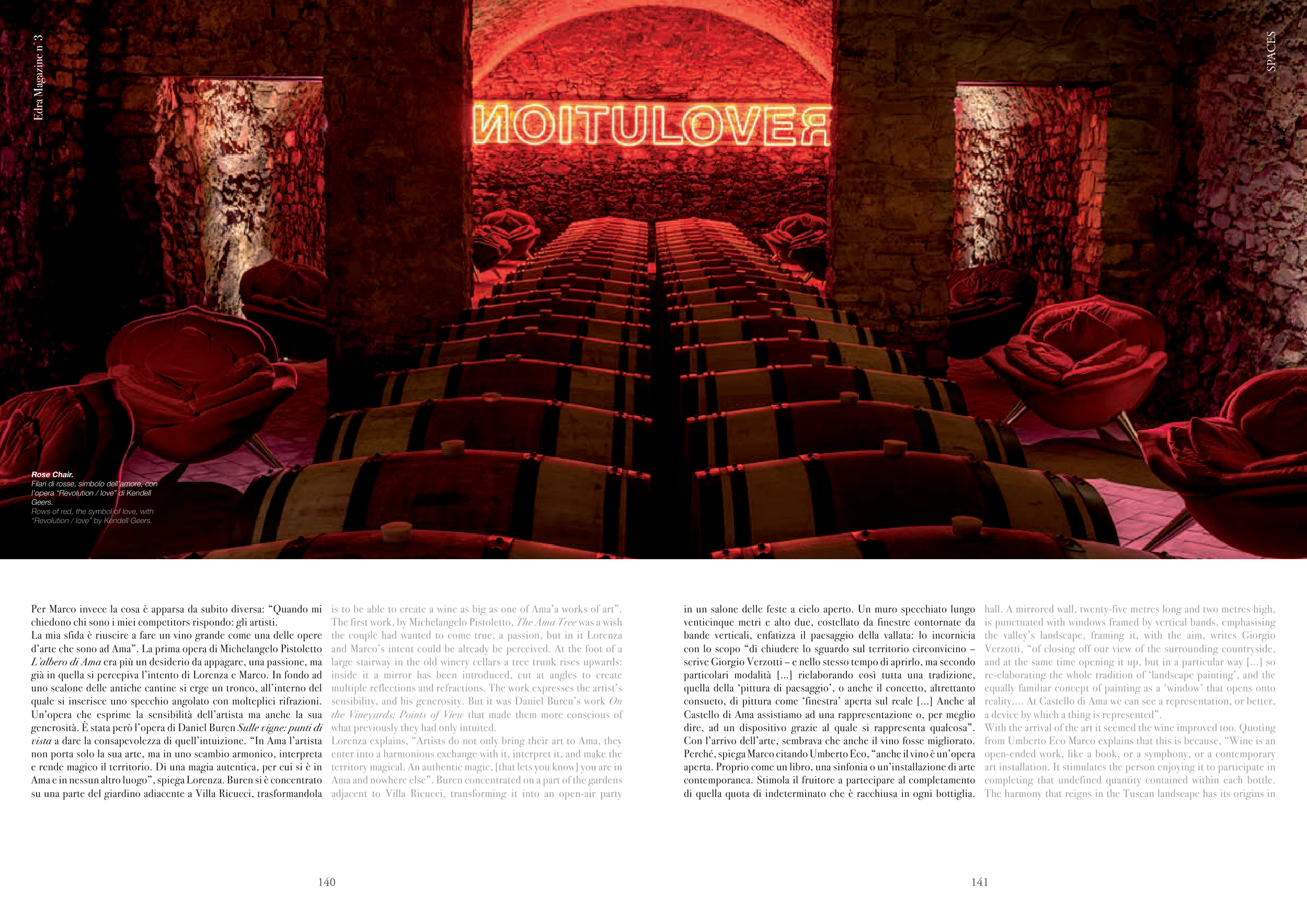
Rose Chair.
Filari di rosse, simbolo dell’amore, con
l’opera “Revolution / love” di Kendell
Geers.
Rows of red, the symbol of love, with
“Revolution / love” by Kendell Geers.
Per Marco invece la cosa è apparsa da subito diversa: “Quando mi
chiedono chi sono i miei competitors rispondo: gli artisti.
La mia sfida è riuscire a fare un vino grande come una delle opere
d’arte che sono ad Ama”. La prima opera di Michelangelo Pistoletto
L’albero di Ama era più un desiderio da appagare, una passione, ma
già in quella si percepiva l’intento di Lorenza e Marco. In fondo ad
uno scalone delle antiche cantine si erge un tronco, all’interno del
quale si inserisce uno specchio angolato con molteplici rifrazioni.
Un’opera che esprime la sensibilità dell’artista ma anche la sua
generosità. È stata però l’opera di Daniel Buren Sulle vigne: punti di
vista a dare la consapevolezza di quell’intuizione. “In Ama l’artista
non porta solo la sua arte, ma in uno scambio armonico, interpreta
e rende magico il territorio. Di una magia autentica, per cui si è in
Ama e in nessun altro luogo”, spiega Lorenza. Buren si è concentrato
su una parte del giardino adiacente a Villa Ricucci, trasformandola
in un salone delle feste a cielo aperto. Un muro specchiato lungo
venticinque metri e alto due, costellato da finestre contornate da
bande verticali, enfatizza il paesaggio della vallata: lo incornicia
con lo scopo “di chiudere lo sguardo sul territorio circonvicino –
scrive Giorgio Verzotti – e nello stesso tempo di aprirlo, ma secondo
particolari modalità […] rielaborando così tutta una tradizione,
quella della ‘pittura di paesaggio’, o anche il concetto, altrettanto
consueto, di pittura come ‘finestra’ aperta sul reale [...] Anche al
Castello di Ama assistiamo ad una rappresentazione o, per meglio
dire, ad un dispositivo grazie al quale si rappresenta qualcosa”.
Con l’arrivo dell’arte, sembrava che anche il vino fosse migliorato.
Perché, spiega Marco citando Umberto Eco, “anche il vino è un’opera
aperta. Proprio come un libro, una sinfonia o un’installazione di arte
contemporanea. Stimola il fruitore a partecipare al completamento
di quella quota di indeterminato che è racchiusa in ogni bottiglia.
is to be able to create a wine as big as one of Ama’a works of art”.
The first work, by Michelangelo Pistoletto, The Ama Tree was a wish
the couple had wanted to come true, a passion, but in it Lorenza
and Marco’s intent could be already be perceived. At the foot of a
large stairway in the old winery cellars a tree trunk rises upwards:
inside it a mirror has been introduced, cut at angles to create
multiple reflections and refractions. The work expresses the artist’s
sensibility, and his generosity. But it was Daniel Buren’s work On
the Vineyards: Points of View that made them more conscious of
what previously they had only intuited.
Lorenza explains, “Artists do not only bring their art to Ama, they
enter into a harmonious exchange with it, interpret it, and make the
territory magical. An authentic magic, [that lets you know] you are in
Ama and nowhere else”. Buren concentrated on a part of the gardens
adjacent to Villa Ricucci, transforming it into an open-air party
hall. A mirrored wall, twenty-five metres long and two metres high,
is punctuated with windows framed by vertical bands, emphasising
the valley’s landscape, framing it, with the aim, writes Giorgio
Verzotti, “of closing off our view of the surrounding countryside,
and at the same time opening it up, but in a particular way [...] so
re-elaborating the whole tradition of ‘landscape painting’, and the
equally familiar concept of painting as a ‘window’ that opens onto
reality.... At Castello di Ama we can see a representation, or better,
a device by which a thing is represented”.
With the arrival of the art it seemed the wine improved too. Quoting
from Umberto Eco Marco explains that this is because, “Wine is an
open-ended work, like a book, or a symphony, or a contemporary
art installation. It stimulates the person enjoying it to participate in
completing that undefined quantity contained within each bottle.
The harmony that reigns in the Tuscan landscape has its origins in
Edra Magazine n°3
140
141
SPACES