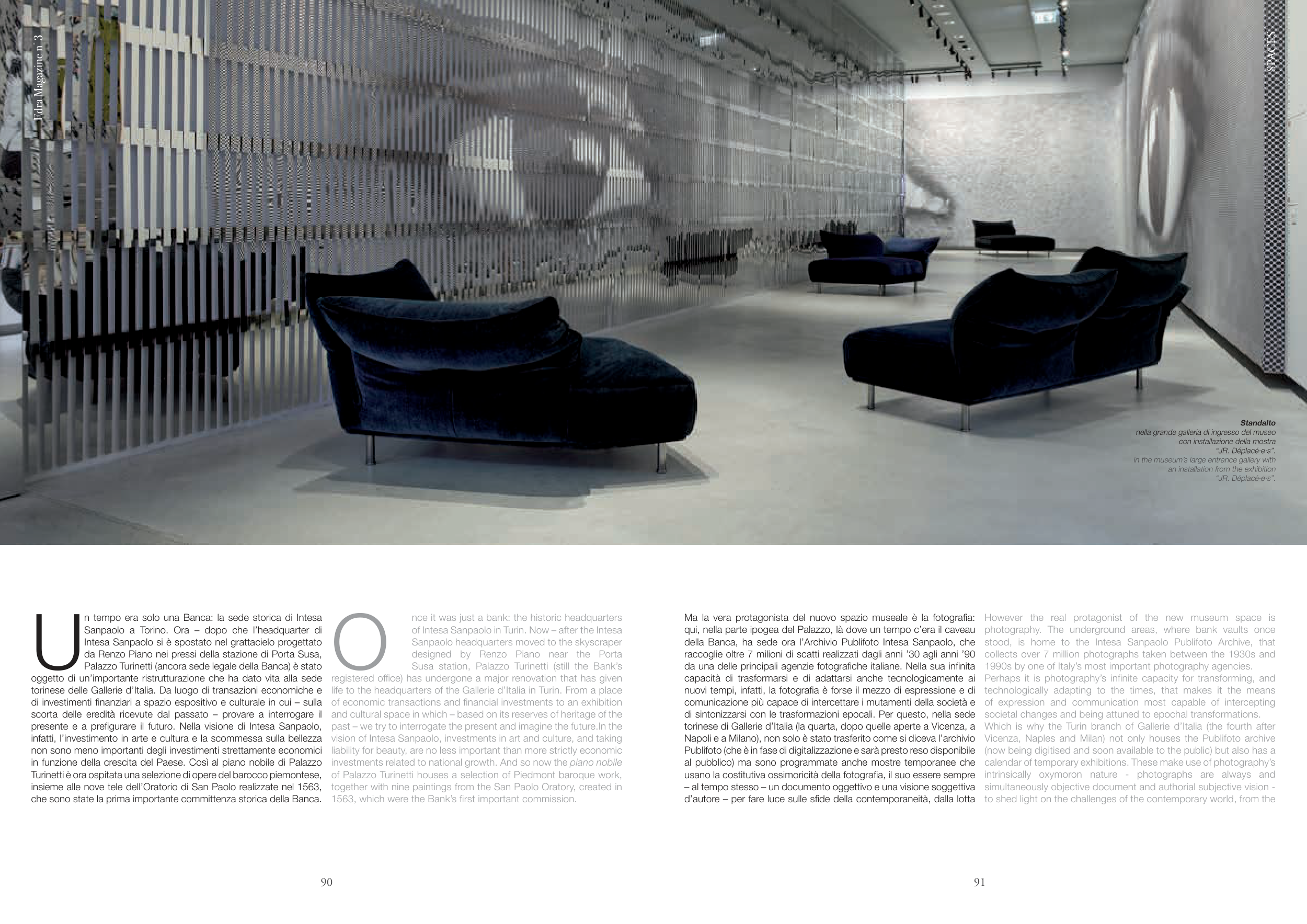
Standalto
nella grande galleria di ingresso del museo
con installazione della mostra
“JR. Déplacé·e·s”.
in the museum’s large entrance gallery with
an installation from the exhibition
“JR. Déplacé·e·s”.
U
n tempo era solo una Banca: la sede storica di Intesa
Sanpaolo a Torino. Ora – dopo che l’headquarter di
Intesa Sanpaolo si è spostato nel grattacielo progettato
da Renzo Piano nei pressi della stazione di Porta Susa,
Palazzo Turinetti (ancora sede legale della Banca) è stato
oggetto di un’importante ristrutturazione che ha dato vita alla sede
torinese delle Gallerie d’Italia. Da luogo di transazioni economiche e
di investimenti finanziari a spazio espositivo e culturale in cui – sulla
scorta delle eredità ricevute dal passato – provare a interrogare il
presente e a prefigurare il futuro. Nella visione di Intesa Sanpaolo,
infatti, l’investimento in arte e cultura e la scommessa sulla bellezza
non sono meno importanti degli investimenti strettamente economici
in funzione della crescita del Paese. Così al piano nobile di Palazzo
Turinetti è ora ospitata una selezione di opere del barocco piemontese,
insieme alle nove tele dell’Oratorio di San Paolo realizzate nel 1563,
che sono state la prima importante committenza storica della Banca.
O
nce it was just a bank: the historic headquarters
of Intesa Sanpaolo in Turin. Now – after the Intesa
Sanpaolo headquarters moved to the skyscraper
designed by Renzo Piano near the Porta
Susa station, Palazzo Turinetti (still the Bank’s
registered office) has undergone a major renovation that has given
life to the headquarters of the Gallerie d’Italia in Turin. From a place
of economic transactions and financial investments to an exhibition
and cultural space in which – based on its reserves of heritage of the
past – we try to interrogate the present and imagine the future.In the
vision of Intesa Sanpaolo, investments in art and culture, and taking
liability for beauty, are no less important than more strictly economic
investments related to national growth. And so now the piano nobile
of Palazzo Turinetti houses a selection of Piedmont baroque work,
together with nine paintings from the San Paolo Oratory, created in
1563, which were the Bank’s first important commission.
Ma la vera protagonista del nuovo spazio museale è la fotografia:
qui, nella parte ipogea del Palazzo, là dove un tempo c’era il caveau
della Banca, ha sede ora l’Archivio Publifoto Intesa Sanpaolo, che
raccoglie oltre 7 milioni di scatti realizzati dagli anni ’30 agli anni ’90
da una delle principali agenzie fotografiche italiane. Nella sua infinita
capacità di trasformarsi e di adattarsi anche tecnologicamente ai
nuovi tempi, infatti, la fotografia è forse il mezzo di espressione e di
comunicazione più capace di intercettare i mutamenti della società e
di sintonizzarsi con le trasformazioni epocali. Per questo, nella sede
torinese di Gallerie d’Italia (la quarta, dopo quelle aperte a Vicenza, a
Napoli e a Milano), non solo è stato trasferito come si diceva l’archivio
Publifoto (che è in fase di digitalizzazione e sarà presto reso disponibile
al pubblico) ma sono programmate anche mostre temporanee che
usano la costitutiva ossimoricità della fotografia, il suo essere sempre
– al tempo stesso – un documento oggettivo e una visione soggettiva
d’autore – per fare luce sulle sfide della contemporaneità, dalla lotta
However the real protagonist of the new museum space is
photography. The underground areas, where bank vaults once
stood, is home to the Intesa Sanpaolo Publifoto Archive, that
collects over 7 million photographs taken between the 1930s and
1990s by one of Italy’s most important photography agencies.
Perhaps it is photography’s infinite capacity for transforming, and
technologically adapting to the times, that makes it the means
of expression and communication most capable of intercepting
societal changes and being attuned to epochal transformations.
Which is why the Turin branch of Gallerie d’Italia (the fourth after
Vicenza, Naples and Milan) not only houses the Publifoto archive
(now being digitised and soon available to the public) but also has a
calendar of temporary exhibitions. These make use of photography’s
intrinsically oxymoron nature - photographs are always and
simultaneously objective document and authorial subjective vision -
to shed light on the challenges of the contemporary world, from the
Edra Magazine n°3
90
91
SPACES