velocità, con riferimento al panorama padano che ha visto nascere
Enzo Ferrari e Ferruccio Lamborghini. O sul rapporto del vetro
di Murano, così pulsante e vivo, con la trasparenza e i riflessi can-
gianti dell’acqua della laguna veneziana. Il genius loci è in fondo
qualcosa che ci portiamo dentro, quello spiritello antico alber-
ga in noi e ci regala il senso del bello e delle proporzioni, delle
forme e dei colori. Scivolando dall’estetica all’etica, ci rivela il
confine tra ciò che è giusto e sbagliato.
Torniamo alla visione, che dall’essere intuizione personale di-
venta oggi prospettiva aziendale, quello che l’impresa vuole ar-
rivare ad essere. Il suo sogno. La visione si ottiene solo attraver-
so l’execution, il lavoro quotidiano per raggiungere passo dopo
passo quell’obiettivo immaginato. Da sola non basta se non è ac-
compagnata da una caparbia ostinazione che trasforma il sogno in
realtà. È il motto “If you can dream
it, you can do it” di Walt Disney,
che ci fa ritornare bambini, e quin-
di puri. La purezza d’animo del ca-
valiere.
Ora, visto che scriviamo sulle pagi-
ne patinate del suo magazine, viene
naturale avanzare qualche conside-
razione su Edra. Qual è la visione
che propone? Cosa è impegnata a
realizzare da quando è nata 36 anni
fa? Possiamo pensare che anche in
questo caso il genius loci abbia un
ruolo? Per me la visione di Edra si
riassume in queste poche parole:
realizzare divani e arredi che sfi-
dano il tempo. Prodotti che non
guardano alla moda del momento
ma sono in grado di conservare il
loro carattere, e la loro bellezza, in un ciclo di vita molto lun-
go. Un grande azzardo, tutto il contrario dell’obsolescenza, più
o meno programmata, a cui la società dei consumi mass-market
ci ha abituato.
Edra propone soluzioni per l’abitare che assumono anche un
carattere sentimentale, prodotti destinati ad accompagnarci e a
essere tramandati di padre in figlio. Come si fa con i gioielli di
famiglia, gli orologi, i mobili antichi: le cose, in fin dei conti, a
cui teniamo di più, di cui ci siamo circondati e che vogliamo ci
sopravvivano. Se le cose hanno un’anima – e per me, in qualche
modo, ce l’hanno – questa deve puntare all’immortalità, proprio
come insegna il Sogno del cavaliere.
Per mettere in pratica una visione del genere occorre una forte
dose di innovazione. Dino Gavina, uno dei padri del Bel Design,
diceva che “veramente moderno è ciò che è degno di diventare
antico”. Sulla strada dell’execution, Edra sta portando avanti di-
verse linee di sviluppo coerenti. La prima è quella di tenere in
collezione a lungo prodotti dal concept fortemente innovativo
che ha realizzato nella sua storia con i fratelli Fernando e Hum-
berto Campana, con Masanori Umeda, con Francesco Binfaré e
Jacopo Foggini. Con i suoi autori, come li chiama. Autori e non
designer. Fermiamoci un attimo su questi termini.
La parola design è stata cancellata dal lessico Edra, e anche que-
sta è una bella sfida. In una società dell’apparire, in cui l’etichet-
ta “design” viene applicata spesso a sproposito, Edra la elimina
– pur avendo pieno titolo per rivendicare l’appartenenza a quel
mondo. E chiama autori i suoi progettisti, qualcosa che li avvicina
alla sfera degli artisti, riconoscendo loro forti connotati di liber-
tà creativa, liberandoli dai condi-
zionamenti, altrove imperanti, del
marketing (altra parola cancellata
dall’organigramma aziendale). Si
punta al ruolo dell’autore che so-
gna, disegna e poi, con le diverse
figure aziendali, trasforma l’idea
in prodotto. Come in un’opera di
Emilio Isgrò, cancellare dal testo
le parole che non servono lascia
scorgere verità sottese. E tra que-
ste, in Edra, la scelta di avvalersi
di una tecnologia proprietaria per
tutelare alcuni asset unici, come
il Cuscino Intelligente e il Gel-
lyfoam®. Invenzioni brevettate,
segreti aziendali custoditi con
cura. In conclusione, Edra vuole
affermare la sua visione basata su
un’idea di innovazione e bellezza che forse – e qui torna il genius
loci – poteva realizzarsi solo in Toscana. In una terra che ancor
prima del Rinascimento ha messo al centro l’Uomo, l’Arte e le In-
venzioni. Dove si perpetua da secoli il saper fare artigiano secon-
do la migliore tradizione nella scelta e nella lavorazione dei tes-
suti e delle pelli. Avere visione per Edra vuol dire sfidare il tempo
puntando all’anima delle cose, costruendo oggetti per la vita e
oltre. Che significa non smettere mai di sognare, di fare e, perché
no, anche di volare. Perché, come scriveva Leonardo: “Una volta
che abbiate conosciuto il volo, camminerete sulla terra guardan-
do il cielo, perché là siete stati e là desidererete tornare”.
Pierluigi Masini
Giornalista professionista, laureato in Lettere con indirizzo Storia dell’Arte, due master in Marketing e Comunicazione. Insegna Storia del Design alla Raffl es
Milano e Fenomenologia delle arti contemporanee alla LABA di Brescia. Ha scritto con Antonella Galli “I luoghi del design in Italia” e un libro su Gabriella Crespi.
Professional journalist, a graduate of Literature with a specialization in Art History, and two masters in Marketing and Communication, Masini teaches History
of Design at Raffl es Milano and Phenomenology of Contemporary Arts at LABA in Brescia. Together with Antonella Galli he wrote “I luoghi del design in Italia”
(The places of design in Italy) and has written a book on Gabriella Crespi.
Giornalista professionista, laureato in Lettere con indirizzo Storia dell’Arte, due master in Marketing e Comunicazione. Insegna Storia del Design alla Raffl es
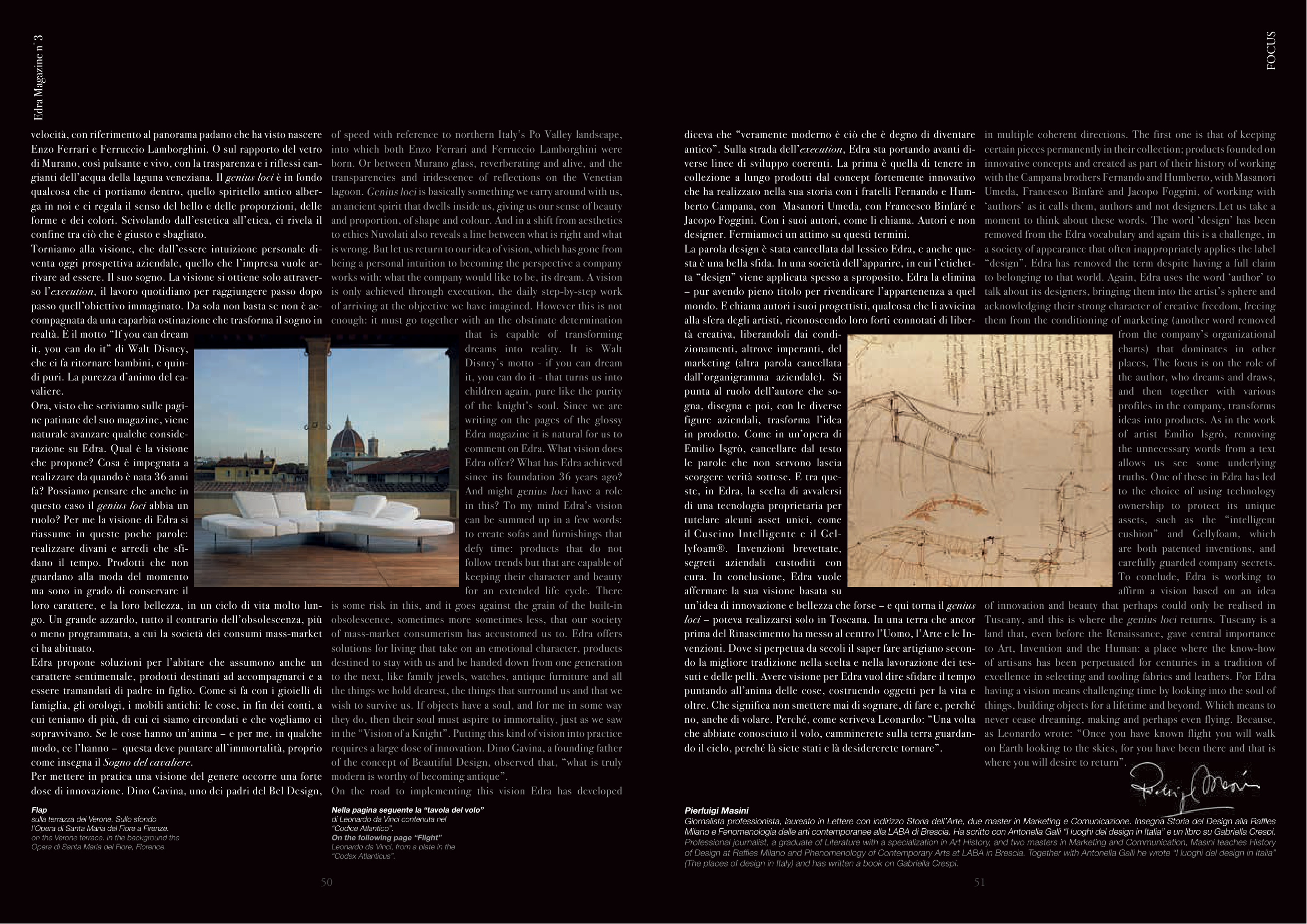
Flap
sulla terrazza del Verone. Sullo sfondo
l’Opera di Santa Maria del Fiore a Firenze.
on the Verone terrace. In the background the
Opera di Santa Maria del Fiore, Florence.
Nella pagina seguente la “tavola del volo”
di Leonardo da Vinci contenuta nel
“Codice Atlantico”.
On the following page “Flight”
Leonardo da Vinci, from a plate in the
“Codex Atlanticus”.
of speed with reference to northern Italy’s Po Valley landscape,
into which both Enzo Ferrari and Ferruccio Lamborghini were
born. Or between Murano glass, reverberating and alive, and the
transparencies and iridescence of reflections on the Venetian
lagoon. Genius loci is basically something we carry around with us,
an ancient spirit that dwells inside us, giving us our sense of beauty
and proportion, of shape and colour. And in a shift from aesthetics
to ethics Nuvolati also reveals a line between what is right and what
is wrong. But let us return to our idea of vision, which has gone from
being a personal intuition to becoming the perspective a company
works with: what the company would like to be, its dream. A vision
is only achieved through execution, the daily step-by-step work
of arriving at the objective we have imagined. However this is not
enough: it must go together with an the obstinate determination
that is capable of transforming
dreams into reality. It is Walt
Disney’s motto - if you can dream
it, you can do it - that turns us into
children again, pure like the purity
of the knight’s soul. Since we are
writing on the pages of the glossy
Edra magazine it is natural for us to
comment on Edra. What vision does
Edra offer? What has Edra achieved
since its foundation 36 years ago?
And might genius loci have a role
in this? To my mind Edra’s vision
can be summed up in a few words:
to create sofas and furnishings that
defy time: products that do not
follow trends but that are capable of
keeping their character and beauty
for an extended life cycle. There
is some risk in this, and it goes against the grain of the built-in
obsolescence, sometimes more sometimes less, that our society
of mass-market consumerism has accustomed us to. Edra offers
solutions for living that take on an emotional character, products
destined to stay with us and be handed down from one generation
to the next, like family jewels, watches, antique furniture and all
the things we hold dearest, the things that surround us and that we
wish to survive us. If objects have a soul, and for me in some way
they do, then their soul must aspire to immortality, just as we saw
in the “Vision of a Knight”. Putting this kind of vision into practice
requires a large dose of innovation. Dino Gavina, a founding father
of the concept of Beautiful Design, observed that, “what is truly
modern is worthy of becoming antique”.
On the road to implementing this vision Edra has developed
in multiple coherent directions. The first one is that of keeping
certain pieces permanently in their collection; products founded on
innovative concepts and created as part of their history of working
with the Campana brothers Fernando and Humberto, with Masanori
Umeda, Francesco Binfarè and Jacopo Foggini, of working with
‘authors’ as it calls them, authors and not designers.Let us take a
moment to think about these words. The word ‘design’ has been
removed from the Edra vocabulary and again this is a challenge, in
a society of appearance that often inappropriately applies the label
“design”. Edra has removed the term despite having a full claim
to belonging to that world. Again, Edra uses the word ‘author’ to
talk about its designers, bringing them into the artist’s sphere and
acknowledging their strong character of creative freedom, freeing
them from the conditioning of marketing (another word removed
from the company’s organizational
charts) that dominates in other
places, The focus is on the role of
the author, who dreams and draws,
and then together with various
profiles in the company, transforms
ideas into products. As in the work
of artist Emilio Isgrò, removing
the unnecessary words from a text
allows us see some underlying
truths. One of these in Edra has led
to the choice of using technology
ownership to protect its unique
assets, such as the “intelligent
cushion” and Gellyfoam, which
are both patented inventions, and
carefully guarded company secrets.
To conclude, Edra is working to
affirm a vision based on an idea
of innovation and beauty that perhaps could only be realised in
Tuscany, and this is where the genius loci returns. Tuscany is a
land that, even before the Renaissance, gave central importance
to Art, Invention and the Human: a place where the know-how
of artisans has been perpetuated for centuries in a tradition of
excellence in selecting and tooling fabrics and leathers. For Edra
having a vision means challenging time by looking into the soul of
things, building objects for a lifetime and beyond. Which means to
never cease dreaming, making and perhaps even flying. Because,
as Leonardo wrote: “Once you have known flight you will walk
on Earth looking to the skies, for you have been there and that is
where you will desire to return”.
Edra Magazine n°3
50
51
FOCUS