62
63
gli arredi. Una sorta di metaverso al contrario, costruito nella
realtà invece che in un mondo immaginario. Questa tendenza
di fatto tradisce lo spirito del progetto di arredo, che – come
insegna Andrea Branzi – nasce con l’uomo, come risposta
ai suoi bisogni. Basti pensare che la maggior parte degli
oggetti che usiamo da tempo immemorabile non hanno una
paternità accertata. Sappiamo chi ha inventato la forchetta?
Il pettine? La sedia? No. E l’elenco
è sterminato. Achille Castiglioni
amava collezionare oggetti di
design anonimo che mostrava con
orgoglio ai suoi studenti, parlava
più di questi che dei suoi.
Di certo, quando la funzionalità
del segno supera quella dell’uso,
quando non si lavora più con
attenzione
quasi
spasmodica
al prodotto ma ancor prima
agli elementi comunicativi che
esprime, torna utile l’avvertimento
di cinquant’anni fa del fi losofo e
critico d’arte Dino Formaggio,
che scriveva che “l’arte è tutto ciò
che gli uomini chiamano arte”.
Così facendo metteva in guardia
dal rischio che, perdendo la
sua piena funzionalità estetica,
l’arte si staccasse anche dalla
vita delle persone e dalla società.
Parafrasando
questo
assunto,
viene da chiedersi a questo punto:
cosa è allora tutto ciò gli uomini
chiamano design?
In conclusione, lavorando su un piano di riconoscimento
inverso, Edra sa bene cosa signifi ca progetto di arredo. E
nella sua scelta di campo sembra piuttosto voler recuperare
quel clima rinascimentale di totale armonia tra arte e alto
artigianato in cui è bello immergersi, guardando al tempo
lungo della storia.
Pierluigi Masini
Giornalista professionista, laureato in Lettere con indirizzo Storia dell’Arte, due master in Marketing e Comunicazione. Insegna Storia del Design alla Raffl es
Milano, Interior Design and Sustainability alla Yacademy e Fenomenologia delle arti contemporanee alla LABA di Brescia. Ha scritto un libro su Gabriella Crespi.
Professional journalist, with a degree in Literature and specialization in History of Art, two masters‘ degrees in Marketing and Communication. He teaches
History of Design at Raffl es Milan, Interior Design and Sustainability at the Yacademy and Phenomenology of Contemporary Arts at LABA in Brescia. He wrote
a book about Gabriella Crespi.
Standard.
Dettaglio del divano pubblicato sul volume
Edra Shades di Stefano Pasqualetti.
Detail of the sofa published in the book
Edra Shades by Stefano Pasqualetti.
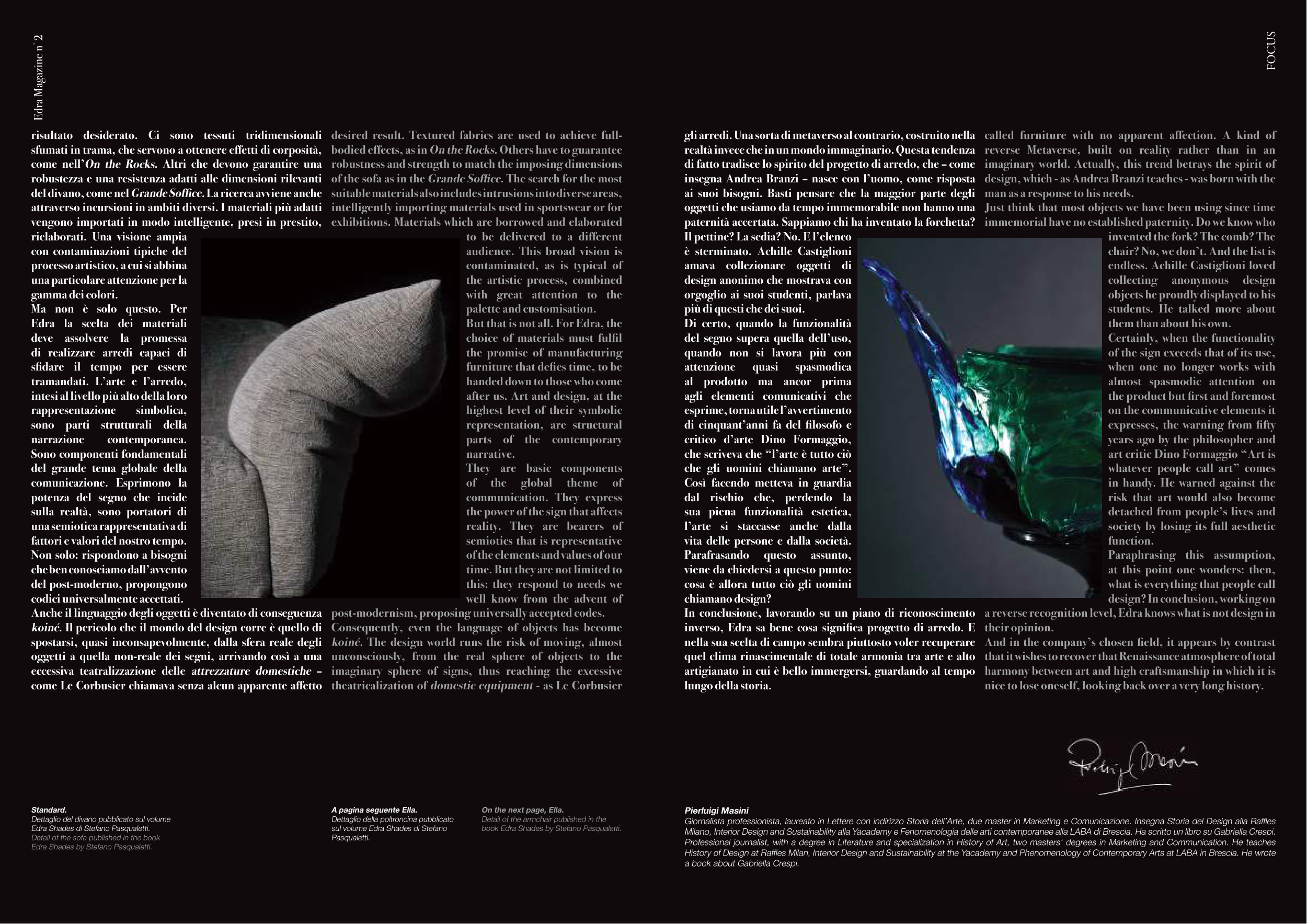
A pagina seguente Ella.
Dettaglio della poltroncina pubblicato
sul volume Edra Shades di Stefano
Pasqualetti.
On the next page, Ella.
Detail of the armchair published in the
book Edra Shades by Stefano Pasqualetti.
risultato desiderato. Ci sono tessuti tridimensionali
sfumati in trama, che servono a ottenere effetti di corposità,
come nell’On the Rocks. Altri che devono garantire una
robustezza e una resistenza adatti alle dimensioni rilevanti
del divano, come nel Grande Soffi ce. La ricerca avviene anche
attraverso incursioni in ambiti diversi. I materiali più adatti
vengono importati in modo intelligente, presi in prestito,
rielaborati. Una visione ampia
con contaminazioni tipiche del
processo artistico, a cui si abbina
una particolare attenzione per la
gamma dei colori.
Ma non è solo questo. Per
Edra la scelta dei materiali
deve
assolvere
la
promessa
di realizzare arredi capaci di
sfi dare il tempo per essere
tramandati. L’arte e l’arredo,
intesi al livello più alto della loro
rappresentazione
simbolica,
sono parti strutturali della
narrazione
contemporanea.
Sono componenti fondamentali
del grande tema globale della
comunicazione. Esprimono la
potenza del segno che incide
sulla realtà, sono portatori di
una semiotica rappresentativa di
fattori e valori del nostro tempo.
Non solo: rispondono a bisogni
che ben conosciamo dall’avvento
del post-moderno, propongono
codici universalmente accettati.
Anche il linguaggio degli oggetti è diventato di conseguenza
koiné. Il pericolo che il mondo del design corre è quello di
spostarsi, quasi inconsapevolmente, dalla sfera reale degli
oggetti a quella non-reale dei segni, arrivando così a una
eccessiva teatralizzazione delle attrezzature domestiche –
come Le Corbusier chiamava senza alcun apparente affetto
desired result. Textured fabrics are used to achieve full-
bodied effects, as in On the Rocks. Others have to guarantee
robustness and strength to match the imposing dimensions
of the sofa as in the Grande Soffi ce. The search for the most
suitable materials also includes intrusions into diverse areas,
intelligently importing materials used in sportswear or for
exhibitions. Materials which are borrowed and elaborated
to be delivered to a different
audience. This broad vision is
contaminated, as is typical of
the artistic process, combined
with great attention to the
palette and customisation.
But that is not all. For Edra, the
choice of materials must fulfi l
the promise of manufacturing
furniture that defi es time, to be
handed down to those who come
after us. Art and design, at the
highest level of their symbolic
representation, are structural
parts
of
the
contemporary
narrative.
They are basic components
of
the
global
theme
of
communication. They express
the power of the sign that affects
reality. They are bearers of
semiotics that is representative
of the elements and values of our
time. But they are not limited to
this: they respond to needs we
well know from the advent of
post-modernism, proposing universally accepted codes.
Consequently, even the language of objects has become
koiné. The design world runs the risk of moving, almost
unconsciously, from the real sphere of objects to the
imaginary sphere of signs, thus reaching the excessive
theatricalization of domestic equipment - as Le Corbusier
called furniture with no apparent affection. A kind of
reverse Metaverse, built on reality rather than in an
imaginary world. Actually, this trend betrays the spirit of
design, which - as Andrea Branzi teaches - was born with the
man as a response to his needs.
Just think that most objects we have been using since time
immemorial have no established paternity. Do we know who
invented the fork? The comb? The
chair? No, we don’t. And the list is
endless. Achille Castiglioni loved
collecting
anonymous
design
objects he proudly displayed to his
students. He talked more about
them than about his own.
Certainly, when the functionality
of the sign exceeds that of its use,
when one no longer works with
almost spasmodic attention on
the product but fi rst and foremost
on the communicative elements it
expresses, the warning from fi fty
years ago by the philosopher and
art critic Dino Formaggio “Art is
whatever people call art” comes
in handy. He warned against the
risk that art would also become
detached from people’s lives and
society by losing its full aesthetic
function.
Paraphrasing this assumption,
at this point one wonders: then,
what is everything that people call
design? In conclusion, working on
a reverse recognition level, Edra knows what is not design in
their opinion.
And in the company’s chosen fi eld, it appears by contrast
that it wishes to recover that Renaissance atmosphere of total
harmony between art and high craftsmanship in which it is
nice to lose oneself, looking back over a very long history.
Edra Magazine n°2
FOCUS