42
43
N
el numero 30 di “Wallpaper” del 2000, in un articolo
firmato da Edward Peacock, Monica Mazzei – che da
sempre in Edra si occupa della ricerca sui tessuti e
materiali – veniva definita “Materials Girl”. Utilizzando
una metafora cinematografica, Peacock la descriveva
come una “costumista […] alla continua ricerca di tutto ciò che è nuovo
e originale”. Raccontava come Monica traesse ispirazione anche dalle
passerelle, dalle fiere del tessile per l’abbigliamento o per calzatura, dai
musei e dai viaggi. Da ogni esperienza. Una volta guardando un corpo in
trasparenza si mise alla ricerca di un tessuto che permettesse di vedere
l’imbottitura interna. Trovò una finitura trasparente e opaca – il latex –
che venne associata ad una imbottitura vegetale naturale.
Sempre all’epoca, per il progetto Monster di AB Rogers, una scultura
appoggiata a terra con cuscino sagomato, Monica prese a prestito il
tessuto altamente performante, elastico e super resistente delle tute da
bob su ghiaccio, aggiungendo poi una finitura rosso fluo. Il risultato fu
chiamato Hi-Speed.
Per il Salone del Mobile 2001, in una collezione dedicata alle finiture
“metalliche”, venne presentata una versione di Flap argentato, insieme
a mobili e tavoli. Venne inventato un tessuto con un filo di metallo che
caratterizzava le finiture oro argento e bronzo.
Questa attitudine a ricercare, sperimentare, inventare materiali – anche
se derivati da settori diversi – e adattarli all’arredo è cresciuta e si è
rafforzata negli anni, per definire i progetti e accompagnare l’evoluzione
dei modelli. Molto spesso, infatti, i tessuti non esistono né in collezione,
né presso i produttori di tessuti d’arredamento e non si trovano neanche
nelle fiere. Edra ha quindi progettato e creato dal nulla materiali adatti
alla struttura delle proprie sedute e che raccontassero il progetto. Che
garantissero performance e resa tecnica in grado di rispondere a tutte le
sollecitazioni di uso. Il materiale deve resistere nel tempo, mantenendo
il più a lungo possibile tutte le sue qualità.
Nel processo di ricerca e invenzione, per prima cosa Edra ascolta il
racconto dei suoi autori. È questo il passaggio forse più importante,
quando c’è un’idea che forse diventerà prima progetto e poi prodotto.
Edra immagina o, meglio, cerca di immaginare quale tipo di filato,
I
n the 2000 issue 30 “Wallpaper”, in an article by Edward
Peacock, Monica Mazzei - who has always been involved in
researching textiles and materials at Edra - was described
as “Materials Girl”. Using a cinematic metaphor, Peacock
described her as a “costume designer [...] constantly searching
for everything new and original.” He described how Monica drew
inspiration from catwalks, clothing and shoe textile fairs, museums and
travel. From every experience.
Even from pregnancy. In 1998, after the excitement of seeing her
son for the first time during an ultrasound scan, Monica set out to
find a fabric that would allow her to look through objects. She found a
transparent, opaque finish - latex - which was combined with a natural
vegetable filling.
In the same timeframe, for AB Rogers’ Monster project, a floor-standing
sculpture with a contoured cushion, Monica borrowed the high-
performance, elastic and super-strong fabric of ice bobsleigh suits and
added a neon red finish. The result was called Hi-Speed.
For the Salone del Mobile 2001, a silver-plated version of Flap was
presented in a collection dedicated to ‘metallic’ finishes, together with
furniture and tables. It had gold silver and bronze finishes. For the
occasion, a fabric with a metal thread was invented.
This aptitude for researching, experimenting, and inventing materials
- even if derived from different market sectors - and adapting them to
furniture has grown and strengthened over the years to define designs
and accompany the evolution of models. Very often, in fact, fabrics
do not exist either in collections or at manufacturers of furnishing
fabrics, nor are they even to be found at trade fairs. Edra found itself in
the position of having to design and create from scratch materials that
would adapt to the structure and tell the story of the project, supporting
the performance and guaranteeing a technical performance capable of
responding to all the stress of use. A material must stand the test of time,
retaining all its qualities for as long as possible.
In the process of research and invention, Edra first listens to its artists’
stories. This is perhaps the most important step when there is an idea
that, perhaps, will first become a project and then a product. Edra
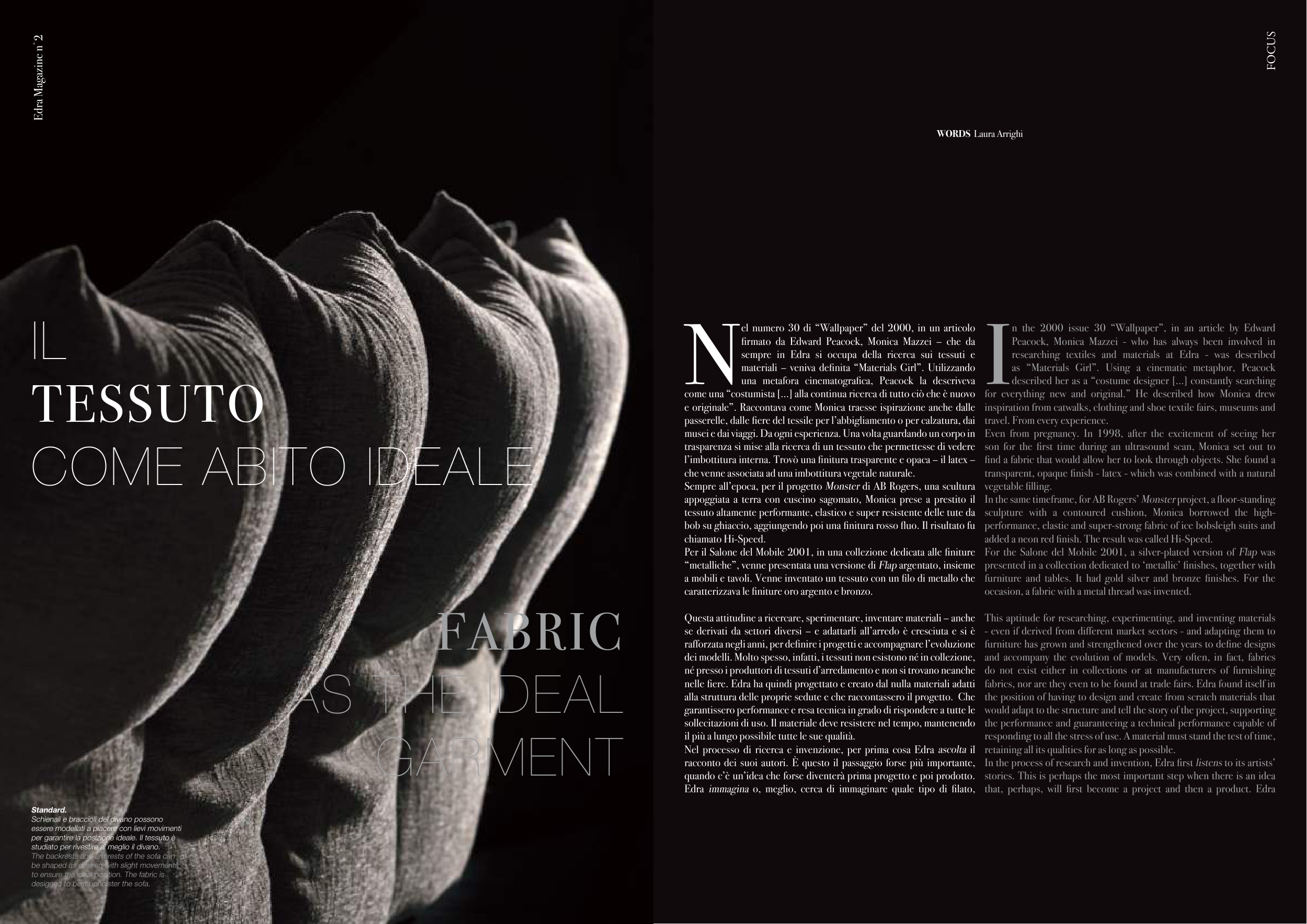
Standard.
Schienali e braccioli del divano possono
essere modellati a piacere con lievi movimenti
per garantire la posizione ideale. Il tessuto è
studiato per rivestire al meglio il divano.
The backrests and armrests of the sofa can
be shaped as desired with slight movements
to ensure the ideal position. The fabric is
designed to best upholster the sofa.
IL
TESSUTO
COME ABITO IDEALE
FABRIC
AS THE IDEAL
GARMENT
WORDS Laura Arrighi
Edra Magazine n°2
FOCUS