38
39
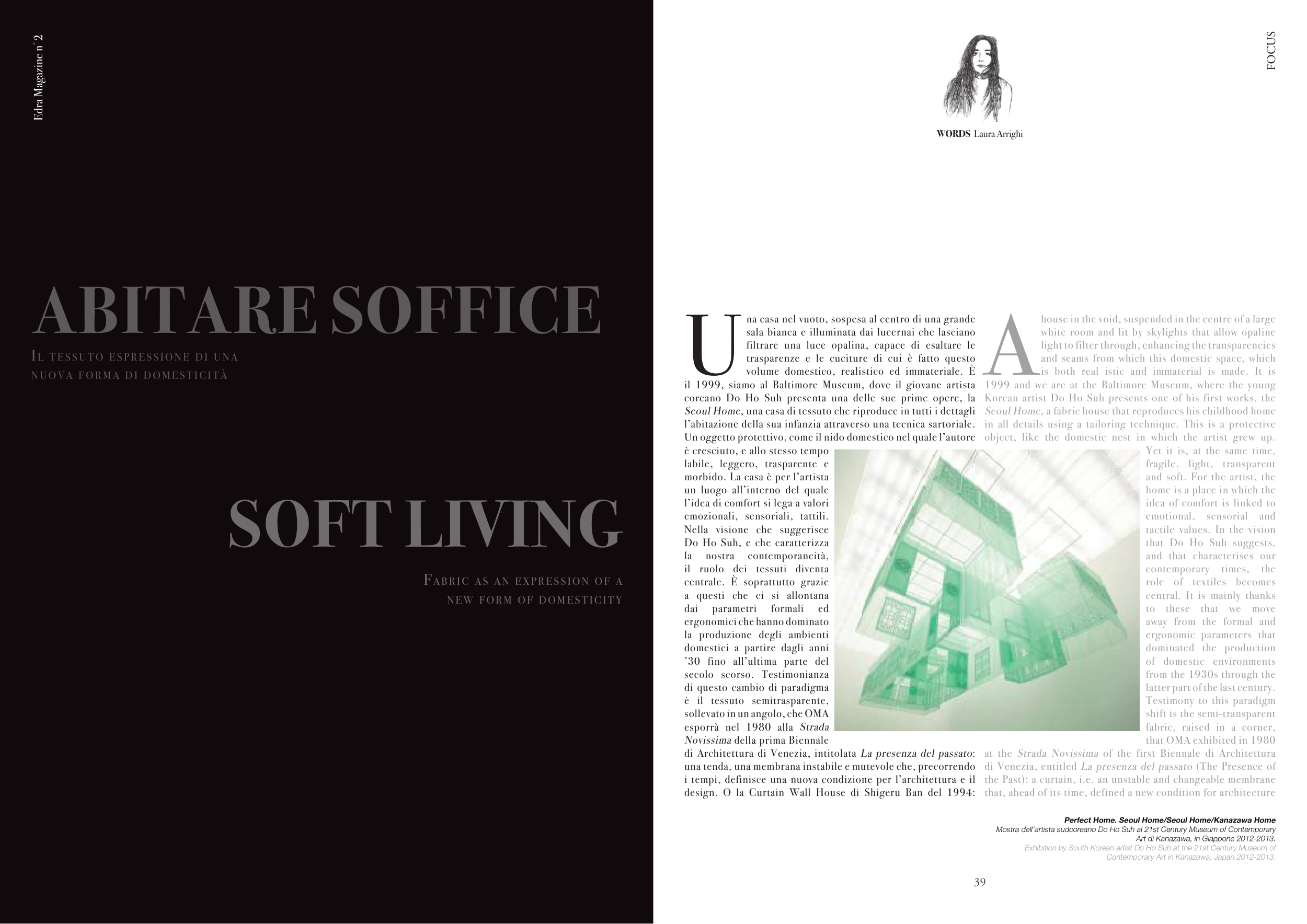
Perfect Home. Seoul Home/Seoul Home/Kanazawa Home
Mostra dell’artista sudcoreano Do Ho Suh al 21st Century Museum of Contemporary
Art di Kanazawa, in Giappone 2012-2013.
Exhibition by South Korean artist Do Ho Suh at the 21st Century Museum of
Contemporary Art in Kanazawa, Japan 2012-2013.
ABITARE SOFFICE
SOFT LIVING
il tEssuto EsprEssionE di una
nuova ForMa di doMEsticità
FaBric as an EXprEssion oF a
nEw ForM oF doMEsticity
U
na casa nel vuoto, sospesa al centro di una grande
sala bianca e illuminata dai lucernai che lasciano
filtrare una luce opalina, capace di esaltare le
trasparenze e le cuciture di cui è fatto questo
volume domestico, realistico ed immateriale. È
il 1999, siamo al Baltimore Museum, dove il giovane artista
coreano Do Ho Suh presenta una delle sue prime opere, la
Seoul Home, una casa di tessuto che riproduce in tutti i dettagli
l’abitazione della sua infanzia attraverso una tecnica sartoriale.
Un oggetto protettivo, come il nido domestico nel quale l’autore
è cresciuto, e allo stesso tempo
labile, leggero, trasparente e
morbido. La casa è per l’artista
un luogo all’interno del quale
l’idea di comfort si lega a valori
emozionali, sensoriali, tattili.
Nella visione che suggerisce
Do Ho Suh, e che caratterizza
la
nostra
contemporaneità,
il ruolo dei tessuti diventa
centrale. È soprattutto grazie
a questi che ci si allontana
dai
parametri
formali
ed
ergonomici che hanno dominato
la produzione degli ambienti
domestici a partire dagli anni
’30 fino all’ultima parte del
secolo scorso. Testimonianza
di questo cambio di paradigma
è il tessuto semitrasparente,
sollevato in un angolo, che OMA
esporrà nel 1980 alla Strada
Novissima della prima Biennale
di Architettura di Venezia, intitolata La presenza del passato:
una tenda, una membrana instabile e mutevole che, precorrendo
i tempi, definisce una nuova condizione per l’architettura e il
design. O la Curtain Wall House di Shigeru Ban del 1994:
A
house in the void, suspended in the centre of a large
white room and lit by skylights that allow opaline
light to filter through, enhancing the transparencies
and seams from which this domestic space, which
is both real istic and immaterial is made. It is
1999 and we are at the Baltimore Museum, where the young
Korean artist Do Ho Suh presents one of his first works, the
Seoul Home, a fabric house that reproduces his childhood home
in all details using a tailoring technique. This is a protective
object, like the domestic nest in which the artist grew up.
Yet it is, at the same time,
fragile, light, transparent
and soft. For the artist, the
home is a place in which the
idea of comfort is linked to
emotional,
sensorial
and
tactile values. In the vision
that Do Ho Suh suggests,
and that characterises our
contemporary
times,
the
role of textiles becomes
central. It is mainly thanks
to these that we move
away from the formal and
ergonomic parameters that
dominated the production
of domestic environments
from the 1930s through the
latter part of the last century.
Testimony to this paradigm
shift is the semi-transparent
fabric, raised in a corner,
that OMA exhibited in 1980
at the Strada Novissima of the first Biennale di Architettura
di Venezia, entitled La presenza del passato (The Presence of
the Past): a curtain, i.e. an unstable and changeable membrane
that, ahead of its time, defined a new condition for architecture
WORDS Laura Arrighi
Edra Magazine n°2
FOCUS