26
27
approfondito e illuminante pubblicato da Electa, propone di leggere il suo
lavoro alla luce della lezione di Marcel Duchamp e di Mircea Eliade. Proposta
suggestiva, a patto di non dimenticare mai che nel disegnare i suoi divani
Binfaré è sempre stato prima di tutto un visionario: lo era quando negli anni
’70 dirigeva il Centro Ricerca per Cassina e lo è ancora di più ora, quando
riesce a coinvolgere un’azienda coraggiosa come Edra nelle sue avventure e
nelle sue sperimentazioni creative. “Io penso che nel creare una cosa che
non c’è – mi ha detto con tono appassionato – si sprigiona una tensione
erotica fortissima. Devi dar vita a qualcosa che non esiste, devi infonderle
l’anima”. Questa tensione si sente in tutte le sue “creature”. Così come si
sente l’erotismo del progetto. Erede della lezione di Vico Magistretti, con
cui ha collaborato quando lavorava per Cassina, ma anche sodale di una
visione eterodossa come quella di Gaetano Pesce, Binfaré è convinto che
progettare significhi prima di tutto saper comunicare un’idea. Saper
dedicated an in-depth and illuminating study to him - published by Electa
- proposes reading his work in the light of the lessons of Marcel Duchamp
and Mircea Eliade. A suggestive proposal, as long as we don’t forget that, in
designing his sofas, Binfaré has always been first and foremost a visionary.
That was true when he directed the Cassina Research Centre in the 1970s,
and even more so now, when he succeeds in involving a courageous company
like Edra in his unprejudiced adventures and creative experiments. “I think
that a very strong erotic tension is released in creating something that is not
there,” he told me in a passionate tone. “You have to give life to something
that does not exist; you have to infuse it with soul.” This tension is felt in all
his “creations”. Just as one can feel the erotism of the project. Heir to the
lesson of Vico Magistretti, with whom he collaborated when he worked for
Cassina, but also a supporter of a heterodox vision such as that of Gaetano
Pesce, Binfaré is convinced that designing means first and foremost knowing
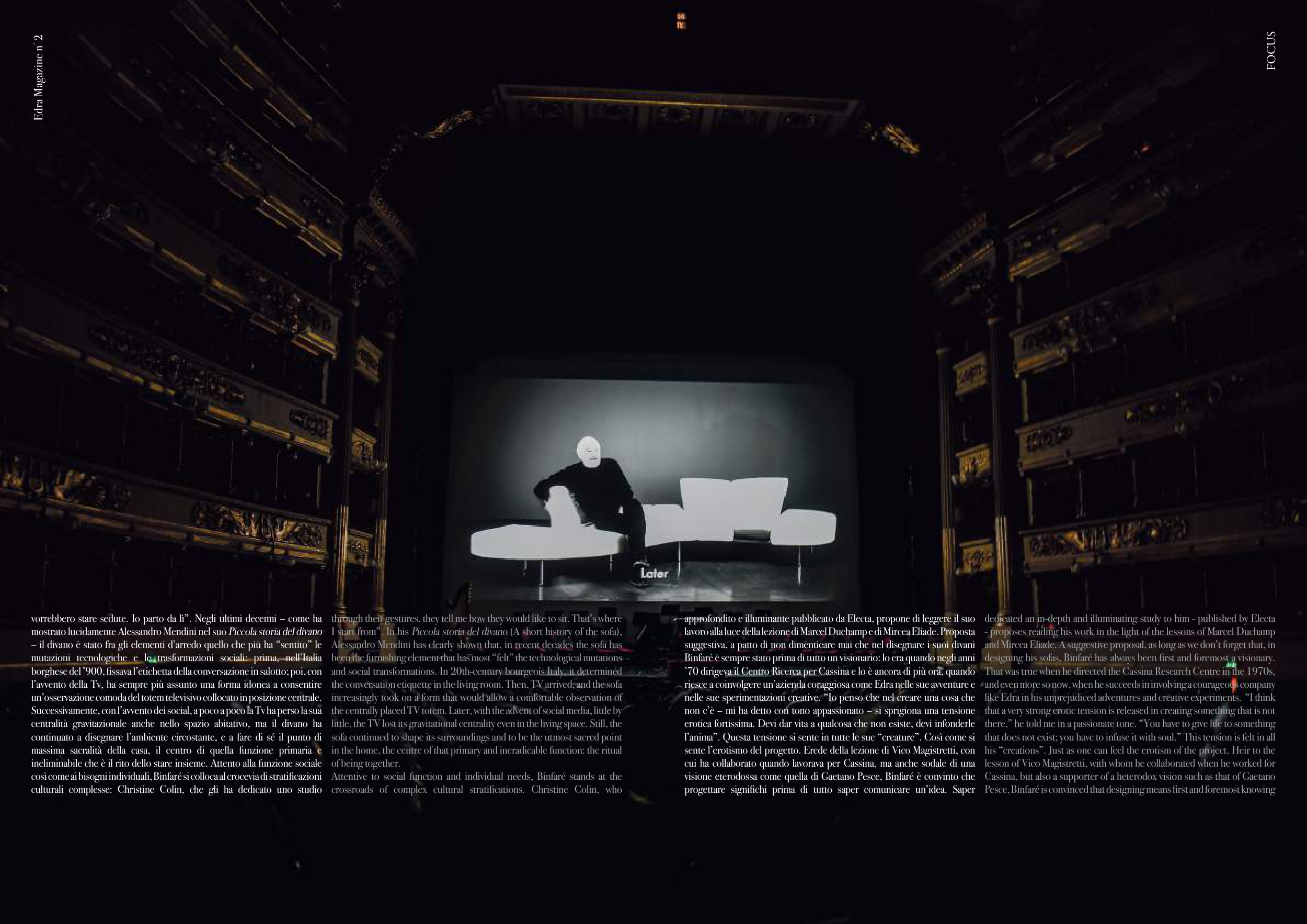
vorrebbero stare sedute. Io parto da lì”. Negli ultimi decenni – come ha
mostrato lucidamente Alessandro Mendini nel suo Piccola storia del divano
– il divano è stato fra gli elementi d’arredo quello che più ha “sentito” le
mutazioni tecnologiche e le trasformazioni sociali: prima, nell’Italia
borghese del ’900, fissava l’etichetta della conversazione in salotto; poi, con
l’avvento della Tv, ha sempre più assunto una forma idonea a consentire
un’osservazione comoda del totem televisivo collocato in posizione centrale.
Successivamente, con l’avvento dei social, a poco a poco la Tv ha perso la sua
centralità gravitazionale anche nello spazio abitativo, ma il divano ha
continuato a disegnare l’ambiente circostante, e a fare di sé il punto di
massima sacralità della casa, il centro di quella funzione primaria e
ineliminabile che è il rito dello stare insieme. Attento alla funzione sociale
così come ai bisogni individuali, Binfaré si colloca al crocevia di stratificazioni
culturali complesse: Christine Colin, che gli ha dedicato uno studio
through their gestures, they tell me how they would like to sit. That’s where
I start from”. In his Piccola storia del divano (A short history of the sofa),
Alessandro Mendini has clearly shown that, in recent decades the sofa has
been the furnishing element that has most “felt” the technological mutations
and social transformations. In 20th-century bourgeois Italy, it determined
the conversation etiquette in the living room. Then, TV arrived, and the sofa
increasingly took on a form that would allow a comfortable observation of
the centrally placed TV totem. Later, with the advent of social media, little by
little, the TV lost its gravitational centrality even in the living space. Still, the
sofa continued to shape its surroundings and to be the utmost sacred point
in the home, the centre of that primary and ineradicable function: the ritual
of being together.
Attentive to social function and individual needs, Binfaré stands at the
crossroads of complex cultural stratifications. Christine Colin, who
Edra Magazine n°2
FOCUS