424
Measurement precision +/-10% for all flux data and 12% for efficacy data is generally to be observed for all data mentioned in this catalog. Measurement precision for CRI +/-1.5.
Measurements have been carried out with white luminaires. efficiency of drivers has been calculated with a reference efficiency of 89%.
LED Technology and efficiëncy improves rapidly. For the latest technical info please visit www.doxis.be.
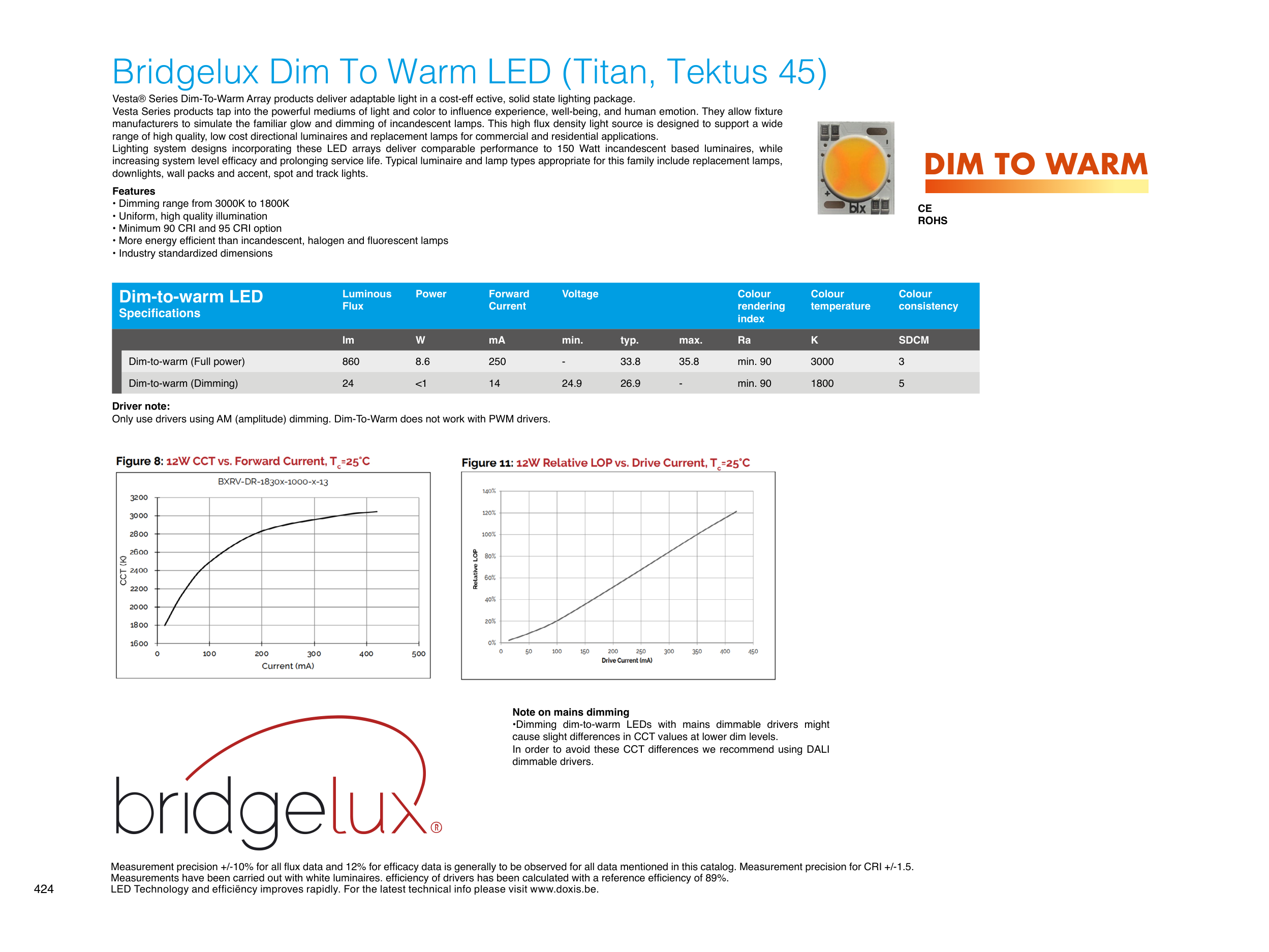
Bridgelux Dim To Warm LED (Titan, Tektus 45)
Driver note:
Only use drivers using AM (amplitude) dimming. Dim-To-Warm does not work with PWM drivers.
Dim-to-warm LED
Specifications
Luminous
Flux
Power
Forward
Current
Voltage
Colour
rendering
index
Colour
temperature
Colour
consistency
lm
W
mA
min.
typ.
max.
Ra
K
SDCM
Dim-to-warm (Full power)
860
8.6
250
-
33.8
35.8
min. 90
3000
3
Dim-to-warm (Dimming)
24
<1
14
24.9
26.9
-
min. 90
1800
5
DIM TO
WARM
DIM TO WARM
3100K
1850K
3100K
1850K
DIM TO WARM
3100K
1850K
Vesta® Series Dim-To-Warm Array products deliver adaptable light in a cost-eff ective, solid state lighting package.
Vesta Series products tap into the powerful mediums of light and color to influence experience, well-being, and human emotion. They allow fixture
manufacturers to simulate the familiar glow and dimming of incandescent lamps. This high flux density light source is designed to support a wide
range of high quality, low cost directional luminaires and replacement lamps for commercial and residential applications.
Lighting system designs incorporating these LED arrays deliver comparable performance to 150 Watt incandescent based luminaires, while
increasing system level efficacy and prolonging service life. Typical luminaire and lamp types appropriate for this family include replacement lamps,
downlights, wall packs and accent, spot and track lights.
Features
• Dimming range from 3000K to 1800K
• Uniform, high quality illumination
• Minimum 90 CRI and 95 CRI option
• More energy efficient than incandescent, halogen and fluorescent lamps
• Industry standardized dimensions
Note on mains dimming
•Dimming dim-to-warm LEDs with mains dimmable drivers might
cause slight differences in CCT values at lower dim levels.
In order to avoid these CCT differences we recommend using DALI
dimmable drivers.
CE
ROHS