16
17
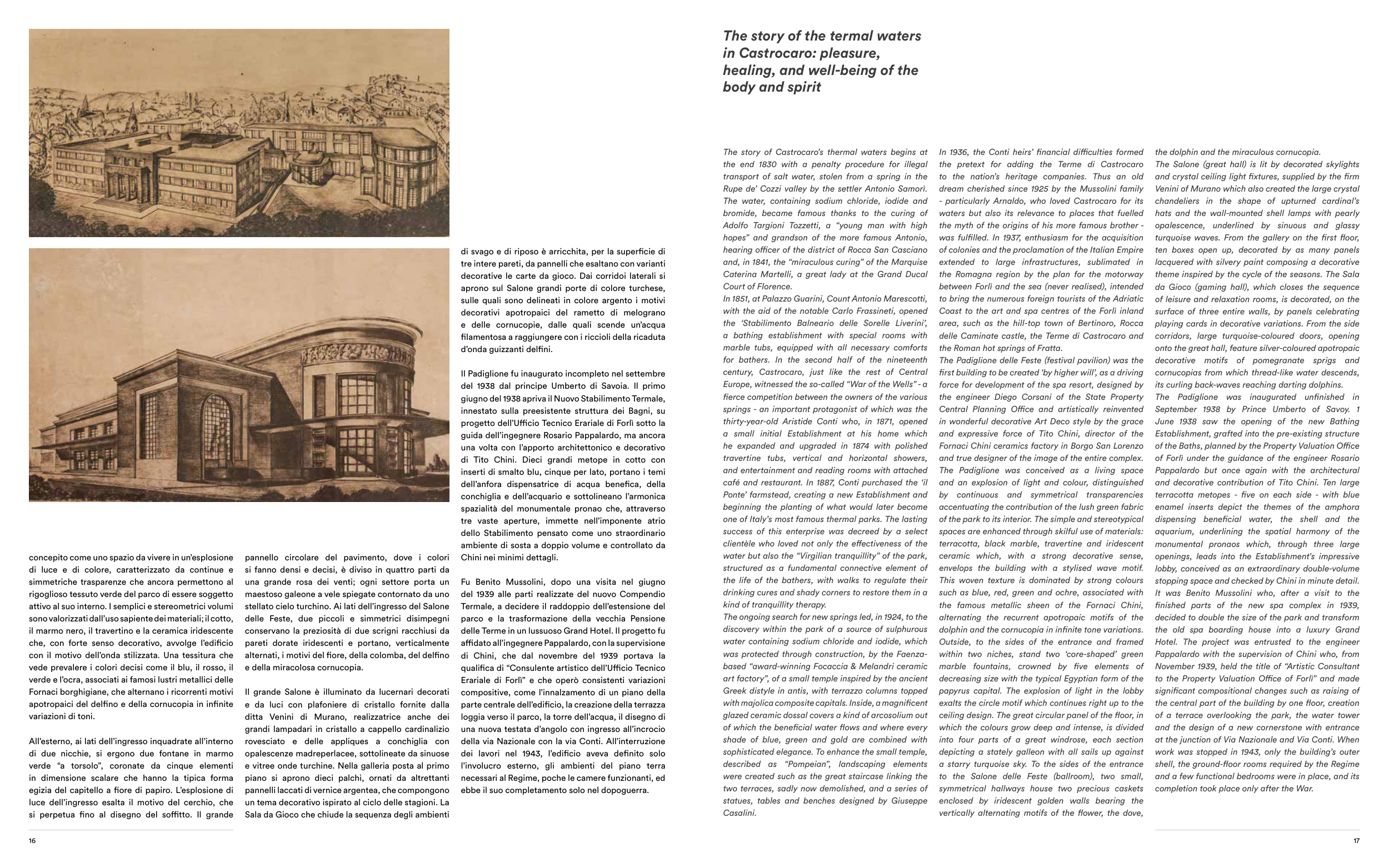
concepito come uno spazio da vivere in un’esplosione
di luce e di colore, caratterizzato da continue e
simmetriche trasparenze che ancora permettono al
rigoglioso tessuto verde del parco di essere soggetto
attivo al suo interno. I semplici e stereometrici volumi
sono valorizzati dall’uso sapiente dei materiali; il cotto,
il marmo nero, il travertino e la ceramica iridescente
che, con forte senso decorativo, avvolge l’edificio
con il motivo dell’onda stilizzata. Una tessitura che
vede prevalere i colori decisi come il blu, il rosso, il
verde e l’ocra, associati ai famosi lustri metallici delle
Fornaci borghigiane, che alternano i ricorrenti motivi
apotropaici del delfino e della cornucopia in infinite
variazioni di toni.
All’esterno, ai lati dell’ingresso inquadrate all’interno
di due nicchie, si ergono due fontane in marmo
verde “a torsolo”, coronate da cinque elementi
in dimensione scalare che hanno la tipica forma
egizia del capitello a fiore di papiro. L’esplosione di
luce dell’ingresso esalta il motivo del cerchio, che
si perpetua fino al disegno del soffitto. Il grande
pannello circolare del pavimento, dove i colori
si fanno densi e decisi, è diviso in quattro parti da
una grande rosa dei venti; ogni settore porta un
maestoso galeone a vele spiegate contornato da uno
stellato cielo turchino. Ai lati dell’ingresso del Salone
delle Feste, due piccoli e simmetrici disimpegni
conservano la preziosità di due scrigni racchiusi da
pareti dorate iridescenti e portano, verticalmente
alternati, i motivi del fiore, della colomba, del delfino
e della miracolosa cornucopia.
Il grande Salone è illuminato da lucernari decorati
e da luci con plafoniere di cristallo fornite dalla
ditta Venini di Murano, realizzatrice anche dei
grandi lampadari in cristallo a cappello cardinalizio
rovesciato e delle appliques a conchiglia con
opalescenze madreperlacee, sottolineate da sinuose
e vitree onde turchine. Nella galleria posta al primo
piano si aprono dieci palchi, ornati da altrettanti
pannelli laccati di vernice argentea, che compongono
un tema decorativo ispirato al ciclo delle stagioni. La
Sala da Gioco che chiude la sequenza degli ambienti
di svago e di riposo è arricchita, per la superficie di
tre intere pareti, da pannelli che esaltano con varianti
decorative le carte da gioco. Dai corridoi laterali si
aprono sul Salone grandi porte di colore turchese,
sulle quali sono delineati in colore argento i motivi
decorativi apotropaici del rametto di melograno
e delle cornucopie, dalle quali scende un’acqua
filamentosa a raggiungere con i riccioli della ricaduta
d’onda guizzanti delfini.
Il Padiglione fu inaugurato incompleto nel settembre
del 1938 dal principe Umberto di Savoia. Il primo
giugno del 1938 apriva il Nuovo Stabilimento Termale,
innestato sulla preesistente struttura dei Bagni, su
progetto dell’Ufficio Tecnico Erariale di Forlì sotto la
guida dell’ingegnere Rosario Pappalardo, ma ancora
una volta con l’apporto architettonico e decorativo
di Tito Chini. Dieci grandi metope in cotto con
inserti di smalto blu, cinque per lato, portano i temi
dell’anfora dispensatrice di acqua benefica, della
conchiglia e dell’acquario e sottolineano l’armonica
spazialità del monumentale pronao che, attraverso
tre vaste aperture, immette nell’imponente atrio
dello Stabilimento pensato come uno straordinario
ambiente di sosta a doppio volume e controllato da
Chini nei minimi dettagli.
Fu Benito Mussolini, dopo una visita nel giugno
del 1939 alle parti realizzate del nuovo Compendio
Termale, a decidere il raddoppio dell’estensione del
parco e la trasformazione della vecchia Pensione
delle Terme in un lussuoso Grand Hotel. Il progetto fu
affidato all’ingegnere Pappalardo, con la supervisione
di Chini, che dal novembre del 1939 portava la
qualifica di “Consulente artistico dell’Ufficio Tecnico
Erariale di Forlì” e che operò consistenti variazioni
compositive, come l’innalzamento di un piano della
parte centrale dell’edificio, la creazione della terrazza
loggia verso il parco, la torre dell’acqua, il disegno di
una nuova testata d’angolo con ingresso all’incrocio
della via Nazionale con la via Conti. All’interruzione
dei lavori nel 1943, l’edificio aveva definito solo
l’involucro esterno, gli ambienti del piano terra
necessari al Regime, poche le camere funzionanti, ed
ebbe il suo completamento solo nel dopoguerra.
The story of the termal waters
in Castrocaro: pleasure,
healing, and well-being of the
body and spirit
The story of Castrocaro’s thermal waters begins at
the end 1830 with a penalty procedure for illegal
transport of salt water, stolen from a spring in the
Rupe de’ Cozzi valley by the settler Antonio Samorì.
The water, containing sodium chloride, iodide and
bromide, became famous thanks to the curing of
Adolfo Targioni Tozzetti, a “young man with high
hopes” and grandson of the more famous Antonio,
hearing officer of the district of Rocca San Casciano
and, in 1841, the “miraculous curing” of the Marquise
Caterina Martelli, a great lady at the Grand Ducal
Court of Florence.
In 1851, at Palazzo Guarini, Count Antonio Marescotti,
with the aid of the notable Carlo Frassineti, opened
the ‘Stabilimento Balneario delle Sorelle Liverini’,
a bathing establishment with special rooms with
marble tubs, equipped with all necessary comforts
for bathers. In the second half of the nineteenth
century, Castrocaro, just like the rest of Central
Europe, witnessed the so-called “War of the Wells” - a
fierce competition between the owners of the various
springs - an important protagonist of which was the
thirty-year-old Aristide Conti who, in 1871, opened
a small initial Establishment at his home which
he expanded and upgraded in 1874 with polished
travertine tubs, vertical and horizontal showers,
and entertainment and reading rooms with attached
café and restaurant. In 1887, Conti purchased the ‘il
Ponte’ farmstead, creating a new Establishment and
beginning the planting of what would later become
one of Italy’s most famous thermal parks. The lasting
success of this enterprise was decreed by a select
clientèle who loved not only the effectiveness of the
water but also the “Virgilian tranquillity” of the park,
structured as a fundamental connective element of
the life of the bathers, with walks to regulate their
drinking cures and shady corners to restore them in a
kind of tranquillity therapy.
The ongoing search for new springs led, in 1924, to the
discovery within the park of a source of sulphurous
water containing sodium chloride and iodide, which
was protected through construction, by the Faenza-
based “award-winning Focaccia & Melandri ceramic
art factory”, of a small temple inspired by the ancient
Greek distyle in antis, with terrazzo columns topped
with majolica composite capitals. Inside, a magnificent
glazed ceramic dossal covers a kind of arcosolium out
of which the beneficial water flows and where every
shade of blue, green and gold are combined with
sophisticated elegance. To enhance the small temple,
described as “Pompeian”, landscaping elements
were created such as the great staircase linking the
two terraces, sadly now demolished, and a series of
statues, tables and benches designed by Giuseppe
Casalini.
In 1936, the Conti heirs’ financial difficulties formed
the pretext for adding the Terme di Castrocaro
to the nation’s heritage companies. Thus an old
dream cherished since 1925 by the Mussolini family
- particularly Arnaldo, who loved Castrocaro for its
waters but also its relevance to places that fuelled
the myth of the origins of his more famous brother -
was fulfilled. In 1937, enthusiasm for the acquisition
of colonies and the proclamation of the Italian Empire
extended to large infrastructures, sublimated in
the Romagna region by the plan for the motorway
between Forlì and the sea (never realised), intended
to bring the numerous foreign tourists of the Adriatic
Coast to the art and spa centres of the Forlì inland
area, such as the hill-top town of Bertinoro, Rocca
delle Caminate castle, the Terme di Castrocaro and
the Roman hot springs of Fratta.
The Padiglione delle Feste (festival pavilion) was the
first building to be created ‘by higher will’, as a driving
force for development of the spa resort, designed by
the engineer Diego Corsani of the State Property
Central Planning Office and artistically reinvented
in wonderful decorative Art Deco style by the grace
and expressive force of Tito Chini, director of the
Fornaci Chini ceramics factory in Borgo San Lorenzo
and true designer of the image of the entire complex.
The Padiglione was conceived as a living space
and an explosion of light and colour, distinguished
by continuous and symmetrical transparencies
accentuating the contribution of the lush green fabric
of the park to its interior. The simple and stereotypical
spaces are enhanced through skilful use of materials:
terracotta, black marble, travertine and iridescent
ceramic which, with a strong decorative sense,
envelops the building with a stylised wave motif.
This woven texture is dominated by strong colours
such as blue, red, green and ochre, associated with
the famous metallic sheen of the Fornaci Chini,
alternating the recurrent apotropaic motifs of the
dolphin and the cornucopia in infinite tone variations.
Outside, to the sides of the entrance and framed
within two niches, stand two ‘core-shaped’ green
marble fountains, crowned by five elements of
decreasing size with the typical Egyptian form of the
papyrus capital. The explosion of light in the lobby
exalts the circle motif which continues right up to the
ceiling design. The great circular panel of the floor, in
which the colours grow deep and intense, is divided
into four parts of a great windrose, each section
depicting a stately galleon with all sails up against
a starry turquoise sky. To the sides of the entrance
to the Salone delle Feste (ballroom), two small,
symmetrical hallways house two precious caskets
enclosed by iridescent golden walls bearing the
vertically alternating motifs of the flower, the dove,
the dolphin and the miraculous cornucopia.
The Salone (great hall) is lit by decorated skylights
and crystal ceiling light fixtures, supplied by the firm
Venini of Murano which also created the large crystal
chandeliers in the shape of upturned cardinal’s
hats and the wall-mounted shell lamps with pearly
opalescence, underlined by sinuous and glassy
turquoise waves. From the gallery on the first floor,
ten boxes open up, decorated by as many panels
lacquered with silvery paint composing a decorative
theme inspired by the cycle of the seasons. The Sala
da Gioco (gaming hall), which closes the sequence
of leisure and relaxation rooms, is decorated, on the
surface of three entire walls, by panels celebrating
playing cards in decorative variations. From the side
corridors, large turquoise-coloured doors, opening
onto the great hall, feature silver-coloured apotropaic
decorative motifs of pomegranate sprigs and
cornucopias from which thread-like water descends,
its curling back-waves reaching darting dolphins.
The Padiglione was inaugurated unfinished in
September 1938 by Prince Umberto of Savoy. 1
June 1938 saw the opening of the new Bathing
Establishment, grafted into the pre-existing structure
of the Baths, planned by the Property Valuation Office
of Forlì under the guidance of the engineer Rosario
Pappalardo but once again with the architectural
and decorative contribution of Tito Chini. Ten large
terracotta metopes - five on each side - with blue
enamel inserts depict the themes of the amphora
dispensing beneficial water, the shell and the
aquarium, underlining the spatial harmony of the
monumental pronaos which, through three large
openings, leads into the Establishment’s impressive
lobby, conceived as an extraordinary double-volume
stopping space and checked by Chini in minute detail.
It was Benito Mussolini who, after a visit to the
finished parts of the new spa complex in 1939,
decided to double the size of the park and transform
the old spa boarding house into a luxury Grand
Hotel. The project was entrusted to the engineer
Pappalardo with the supervision of Chini who, from
November 1939, held the title of “Artistic Consultant
to the Property Valuation Office of Forlì” and made
significant compositional changes such as raising of
the central part of the building by one floor, creation
of a terrace overlooking the park, the water tower
and the design of a new cornerstone with entrance
at the junction of Via Nazionale and Via Conti. When
work was stopped in 1943, only the building’s outer
shell, the ground-floor rooms required by the Regime
and a few functional bedrooms were in place, and its
completion took place only after the War.