32
33
vita futura, perché li farà progredire nel pensiero e
nelle azioni. Così è stato quella sera dopo la visita alla
mostra in Fondazione e dopo il laboratorio creativo, i
bambini erano felici e contenti delle loro realizzazioni
che avevano creato in sinergia anche con le tematiche
ambientali del riuso e riciclo, perché i tessuti tagliati
e impiegati per gli acchiappasogni erano sfridi di
lavorazione.
Il rispetto per l’ambiente e la natura è un tema molto
importante da insegnare ai più piccoli. Trasferire loro
la giusta consapevolezza dei propri atteggiamenti
e comportamenti, oltre a insegnare loro i gesti
quotidiani e le strategie per assumere uno stile di
vita ecosostenibile, è fondamentale per garantire un
futuro migliore alla nostra terra e a loro stessi prima
di tutto.
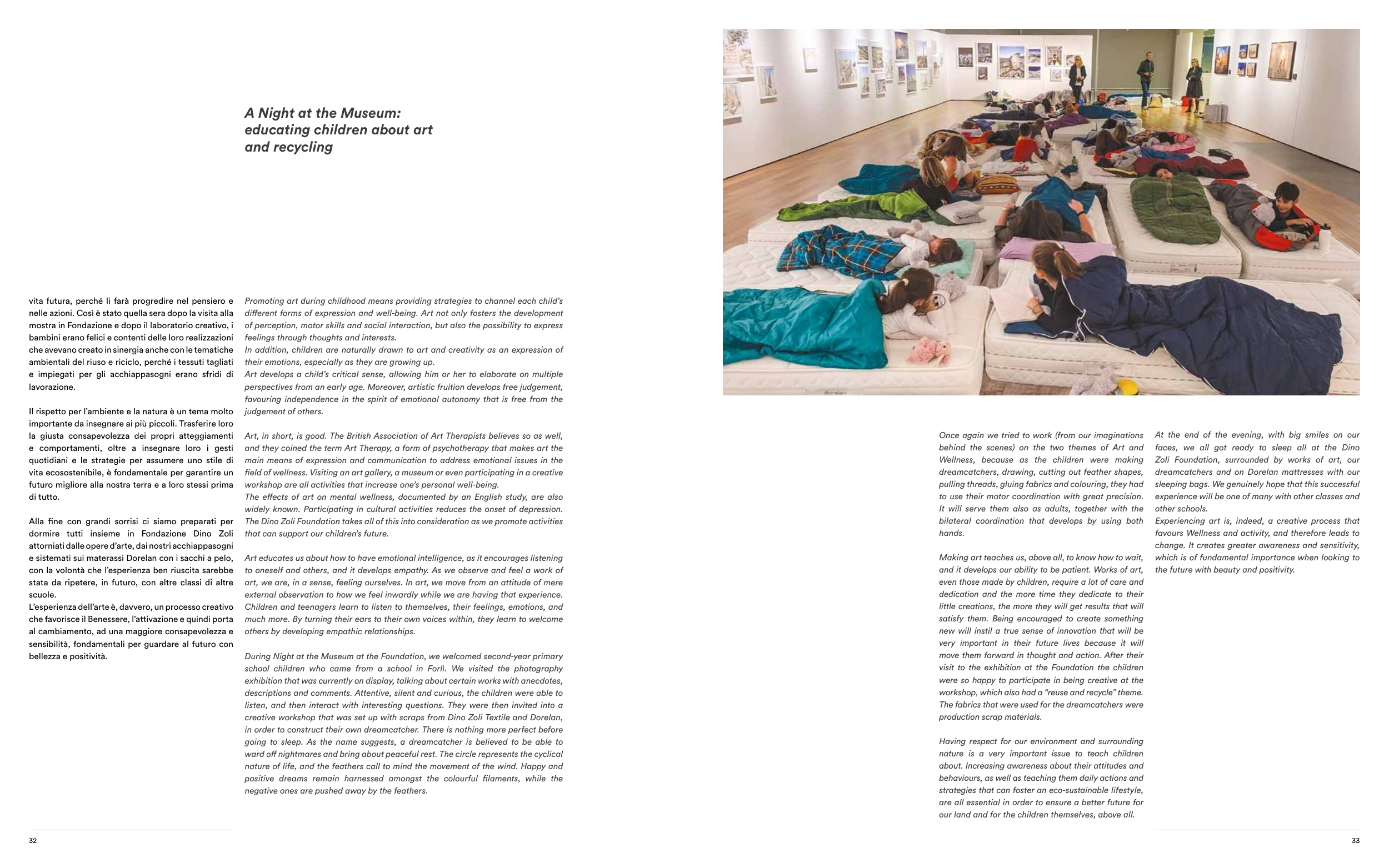
Alla fine con grandi sorrisi ci siamo preparati per
dormire tutti insieme in Fondazione Dino Zoli
attorniati dalle opere d’arte, dai nostri acchiappasogni
e sistemati sui materassi Dorelan con i sacchi a pelo,
con la volontà che l’esperienza ben riuscita sarebbe
stata da ripetere, in futuro, con altre classi di altre
scuole.
L’esperienza dell’arte è, davvero, un processo creativo
che favorisce il Benessere, l’attivazione e quindi porta
al cambiamento, ad una maggiore consapevolezza e
sensibilità, fondamentali per guardare al futuro con
bellezza e positività.
A Night at the Museum:
educating children about art
and recycling
Promoting art during childhood means providing strategies to channel each child’s
different forms of expression and well-being. Art not only fosters the development
of perception, motor skills and social interaction, but also the possibility to express
feelings through thoughts and interests.
In addition, children are naturally drawn to art and creativity as an expression of
their emotions, especially as they are growing up.
Art develops a child’s critical sense, allowing him or her to elaborate on multiple
perspectives from an early age. Moreover, artistic fruition develops free judgement,
favouring independence in the spirit of emotional autonomy that is free from the
judgement of others.
Art, in short, is good. The British Association of Art Therapists believes so as well,
and they coined the term Art Therapy, a form of psychotherapy that makes art the
main means of expression and communication to address emotional issues in the
field of wellness. Visiting an art gallery, a museum or even participating in a creative
workshop are all activities that increase one’s personal well-being.
The effects of art on mental wellness, documented by an English study, are also
widely known. Participating in cultural activities reduces the onset of depression.
The Dino Zoli Foundation takes all of this into consideration as we promote activities
that can support our children’s future.
Art educates us about how to have emotional intelligence, as it encourages listening
to oneself and others, and it develops empathy. As we observe and feel a work of
art, we are, in a sense, feeling ourselves. In art, we move from an attitude of mere
external observation to how we feel inwardly while we are having that experience.
Children and teenagers learn to listen to themselves, their feelings, emotions, and
much more. By turning their ears to their own voices within, they learn to welcome
others by developing empathic relationships.
During Night at the Museum at the Foundation, we welcomed second-year primary
school children who came from a school in Forlì. We visited the photography
exhibition that was currently on display, talking about certain works with anecdotes,
descriptions and comments. Attentive, silent and curious, the children were able to
listen, and then interact with interesting questions. They were then invited into a
creative workshop that was set up with scraps from Dino Zoli Textile and Dorelan,
in order to construct their own dreamcatcher. There is nothing more perfect before
going to sleep. As the name suggests, a dreamcatcher is believed to be able to
ward off nightmares and bring about peaceful rest. The circle represents the cyclical
nature of life, and the feathers call to mind the movement of the wind. Happy and
positive dreams remain harnessed amongst the colourful filaments, while the
negative ones are pushed away by the feathers.
Once again we tried to work (from our imaginations
behind the scenes) on the two themes of Art and
Wellness, because as the children were making
dreamcatchers, drawing, cutting out feather shapes,
pulling threads, gluing fabrics and colouring, they had
to use their motor coordination with great precision.
It will serve them also as adults, together with the
bilateral coordination that develops by using both
hands.
Making art teaches us, above all, to know how to wait,
and it develops our ability to be patient. Works of art,
even those made by children, require a lot of care and
dedication and the more time they dedicate to their
little creations, the more they will get results that will
satisfy them. Being encouraged to create something
new will instil a true sense of innovation that will be
very important in their future lives because it will
move them forward in thought and action. After their
visit to the exhibition at the Foundation the children
were so happy to participate in being creative at the
workshop, which also had a “reuse and recycle” theme.
The fabrics that were used for the dreamcatchers were
production scrap materials.
Having respect for our environment and surrounding
nature is a very important issue to teach children
about. Increasing awareness about their attitudes and
behaviours, as well as teaching them daily actions and
strategies that can foster an eco-sustainable lifestyle,
are all essential in order to ensure a better future for
our land and for the children themselves, above all.
At the end of the evening, with big smiles on our
faces, we all got ready to sleep all at the Dino
Zoli Foundation, surrounded by works of art, our
dreamcatchers and on Dorelan mattresses with our
sleeping bags. We genuinely hope that this successful
experience will be one of many with other classes and
other schools.
Experiencing art is, indeed, a creative process that
favours Wellness and activity, and therefore leads to
change. It creates greater awareness and sensitivity,
which is of fundamental importance when looking to
the future with beauty and positivity.