26
27
palio e la doverosa partecipazione di tutte le Autorità
cittadine. In seguito, specialmente a partire dal
Seicento, Forlì divenne città mariana, col prevalere
del patrocinio della Madonna del fuoco. Si sa che la
mamma è sempre la mamma, ma, in questo caso, a
detrimento del culto del Santo Protovescovo incise
anche il contrasto tra l’Abate e il Vescovo diocesano.
In tempi recenti, la memoria liturgica del Santo è
stata trasferita al 26 ottobre, giorno in cui agli inizi del
XVII secolo le reliquie furono collocate nella cappella
Mercuriali, dove tuttora si trovano, dopo essere
state deposte, due anni fa, in un’urna marmorea
commissionata a tal fine. Desidero ricordare, di
sfuggita, che la ricognizione canonico-scientifica
delle suddette reliquie, voluta tre anni or sono, ha
dato esiti che confermano in modo sorprendente la
tradizione circa la provenienza di Mercuriale dalla
lontana Armenia. E le analisi non sono ancora finite.
Tutto questo porrebbe la città di Forlì in un orizzonte
molto più ampio, collegandola al più antico regno
cristiano del mondo, quello dell’Armenia appunto.
Da ultimo, ma non per importanza e valore, occorre
fare un doveroso riferimento alla bella facciata della
basilica, nella quale è incastonato il prezioso portale
romanico con la stupenda lunetta dei Magi. Si tratta
di ciò che resta della facciata, rimaneggiata più volte
lungo i secoli, e restaurata nel primo quarto del
secolo scorso con l’aggiunta del rosone. La lunetta,
in particolare, dovuta a un maestro attivo nella prima
metà del XIII secolo, è una delle maggiori opere
scultoree romaniche della Romagna. Se Mercuriale
ci collega all’Oriente, a maggior ragione i Magi
della lunetta ci aprono al mondo intero, poiché
rappresentano, secondo il Vangelo di Matteo, tutti i
popoli, chiamati a entrare, attraverso Gesù il Cristo,
nella famiglia dei figli di Dio. La lunetta contiene due
scene tratte da Matteo: l’adorazione dei Magi, da cui
si comincia con lettura sinistrorsa, e il sogno dei Magi.
Il recente intervento di ripulitura e consolidamento
della facciata ha permesso a tanti, non solo Forlivesi,
di riscoprire questo tesoro della nostra città. Qui mi si
lasci dire che un tale tesoro c’ispira a trarre vantaggio
anche dal riposo notturno, non solo perché occorre
alternare il riposo alla veglia operosa, ma perché
il sogno di chi ha il cuore aperto a Dio e agli altri
diventa indicazione per un nuovo inizio, per un nuovo
cammino. E quanto vi sia bisogno, soprattutto ora, di
nuovi inizi, è superfluo sottolinearlo.
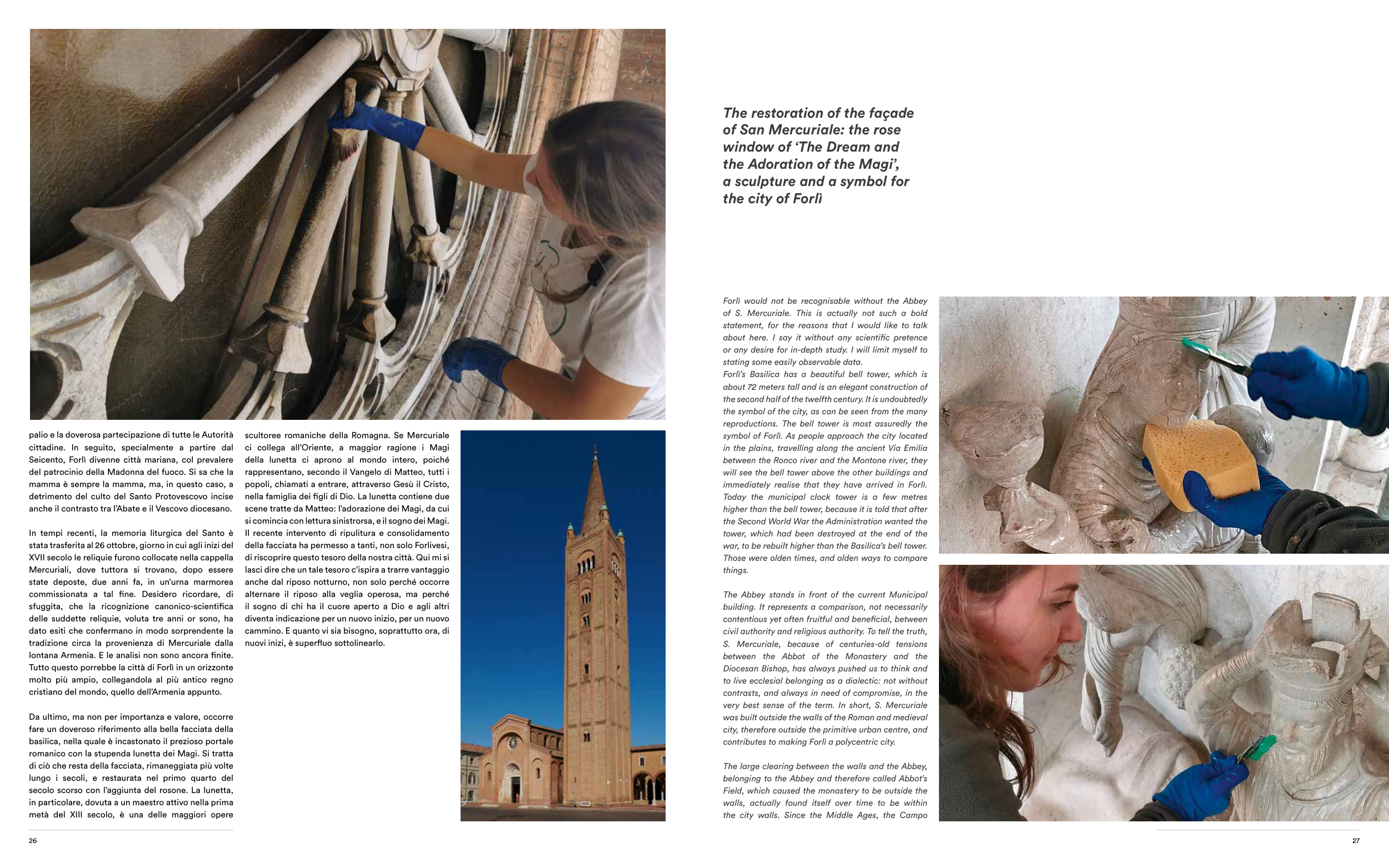
The restoration of the façade
of San Mercuriale: the rose
window of ‘The Dream and
the Adoration of the Magi’,
a sculpture and a symbol for
the city of Forlì
Forlì would not be recognisable without the Abbey
of S. Mercuriale. This is actually not such a bold
statement, for the reasons that I would like to talk
about here. I say it without any scientific pretence
or any desire for in-depth study. I will limit myself to
stating some easily observable data.
Forlì’s Basilica has a beautiful bell tower, which is
about 72 meters tall and is an elegant construction of
the second half of the twelfth century. It is undoubtedly
the symbol of the city, as can be seen from the many
reproductions. The bell tower is most assuredly the
symbol of Forlì. As people approach the city located
in the plains, travelling along the ancient Via Emilia
between the Ronco river and the Montone river, they
will see the bell tower above the other buildings and
immediately realise that they have arrived in Forlì.
Today the municipal clock tower is a few metres
higher than the bell tower, because it is told that after
the Second World War the Administration wanted the
tower, which had been destroyed at the end of the
war, to be rebuilt higher than the Basilica’s bell tower.
Those were olden times, and olden ways to compare
things.
The Abbey stands in front of the current Municipal
building. It represents a comparison, not necessarily
contentious yet often fruitful and beneficial, between
civil authority and religious authority. To tell the truth,
S. Mercuriale, because of centuries-old tensions
between the Abbot of the Monastery and the
Diocesan Bishop, has always pushed us to think and
to live ecclesial belonging as a dialectic: not without
contrasts, and always in need of compromise, in the
very best sense of the term. In short, S. Mercuriale
was built outside the walls of the Roman and medieval
city, therefore outside the primitive urban centre, and
contributes to making Forlì a polycentric city.
The large clearing between the walls and the Abbey,
belonging to the Abbey and therefore called Abbot’s
Field, which caused the monastery to be outside the
walls, actually found itself over time to be within
the city walls. Since the Middle Ages, the Campo