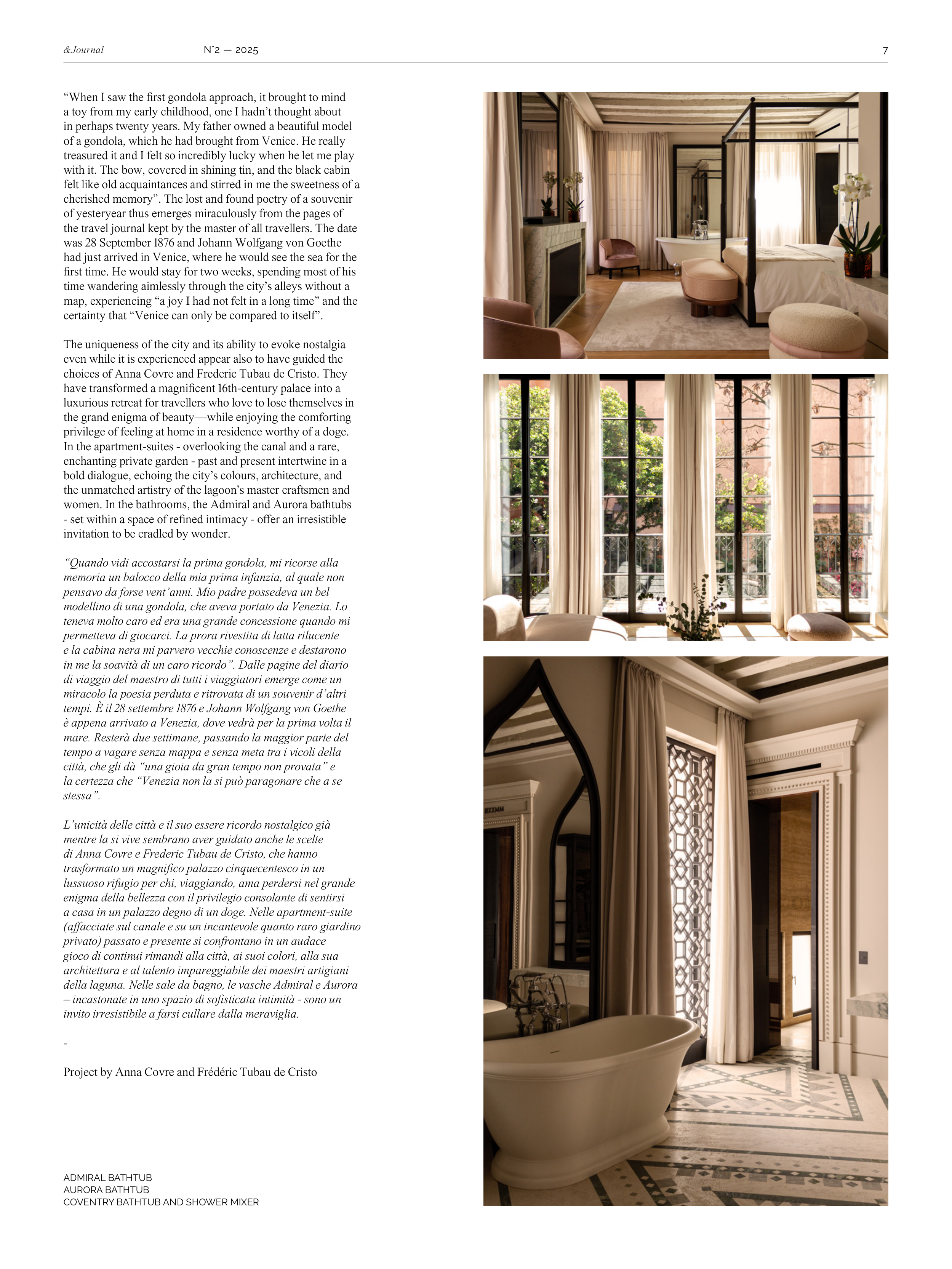
ADMIRAL BATHTUB
AURORA BATHTUB
COVENTRY BATHTUB AND SHOWER MIXER
“When I saw the first gondola approach, it brought to mind
a toy from my early childhood, one I hadn’t thought about
in perhaps twenty years. My father owned a beautiful model
of a gondola, which he had brought from Venice. He really
treasured it and I felt so incredibly lucky when he let me play
with it. The bow, covered in shining tin, and the black cabin
felt like old acquaintances and stirred in me the sweetness of a
cherished memory”. The lost and found poetry of a souvenir
of yesteryear thus emerges miraculously from the pages of
the travel journal kept by the master of all travellers. The date
was 28 September 1876 and Johann Wolfgang von Goethe
had just arrived in Venice, where he would see the sea for the
first time. He would stay for two weeks, spending most of his
time wandering aimlessly through the city’s alleys without a
map, experiencing “a joy I had not felt in a long time” and the
certainty that “Venice can only be compared to itself”.
The uniqueness of the city and its ability to evoke nostalgia
even while it is experienced appear also to have guided the
choices of Anna Covre and Frederic Tubau de Cristo. They
have transformed a magnificent 16th-century palace into a
luxurious retreat for travellers who love to lose themselves in
the grand enigma of beauty—while enjoying the comforting
privilege of feeling at home in a residence worthy of a doge.
In the apartment-suites - overlooking the canal and a rare,
enchanting private garden - past and present intertwine in a
bold dialogue, echoing the city’s colours, architecture, and
the unmatched artistry of the lagoon’s master craftsmen and
women. In the bathrooms, the Admiral and Aurora bathtubs
- set within a space of refined intimacy - offer an irresistible
invitation to be cradled by wonder.
“Quando vidi accostarsi la prima gondola, mi ricorse alla
memoria un balocco della mia prima infanzia, al quale non
pensavo da forse vent’anni. Mio padre possedeva un bel
modellino di una gondola, che aveva portato da Venezia. Lo
teneva molto caro ed era una grande concessione quando mi
permetteva di giocarci. La prora rivestita di latta rilucente
e la cabina nera mi parvero vecchie conoscenze e destarono
in me la soavità di un caro ricordo”. Dalle pagine del diario
di viaggio del maestro di tutti i viaggiatori emerge come un
miracolo la poesia perduta e ritrovata di un souvenir d’altri
tempi. È il 28 settembre 1876 e Johann Wolfgang von Goethe
è appena arrivato a Venezia, dove vedrà per la prima volta il
mare. Resterà due settimane, passando la maggior parte del
tempo a vagare senza mappa e senza meta tra i vicoli della
città, che gli dà “una gioia da gran tempo non provata” e
la certezza che “Venezia non la si può paragonare che a se
stessa”.
L’unicità delle città e il suo essere ricordo nostalgico già
mentre la si vive sembrano aver guidato anche le scelte
di Anna Covre e Frederic Tubau de Cristo, che hanno
trasformato un magnifico palazzo cinquecentesco in un
lussuoso rifugio per chi, viaggiando, ama perdersi nel grande
enigma della bellezza con il privilegio consolante di sentirsi
a casa in un palazzo degno di un doge. Nelle apartment-suite
(affacciate sul canale e su un incantevole quanto raro giardino
privato) passato e presente si confrontano in un audace
gioco di continui rimandi alla città, ai suoi colori, alla sua
architettura e al talento impareggiabile dei maestri artigiani
della laguna. Nelle sale da bagno, le vasche Admiral e Aurora
– incastonate in uno spazio di sofisticata intimità - sono un
invito irresistibile a farsi cullare dalla meraviglia.
-
Project by Anna Covre and Frédéric Tubau de Cristo
7
&Journal
N°2 — 2025