DE ROTTERDAM DS-21
17
DE ROTTERDAM DS-21
16
De Rotterdam
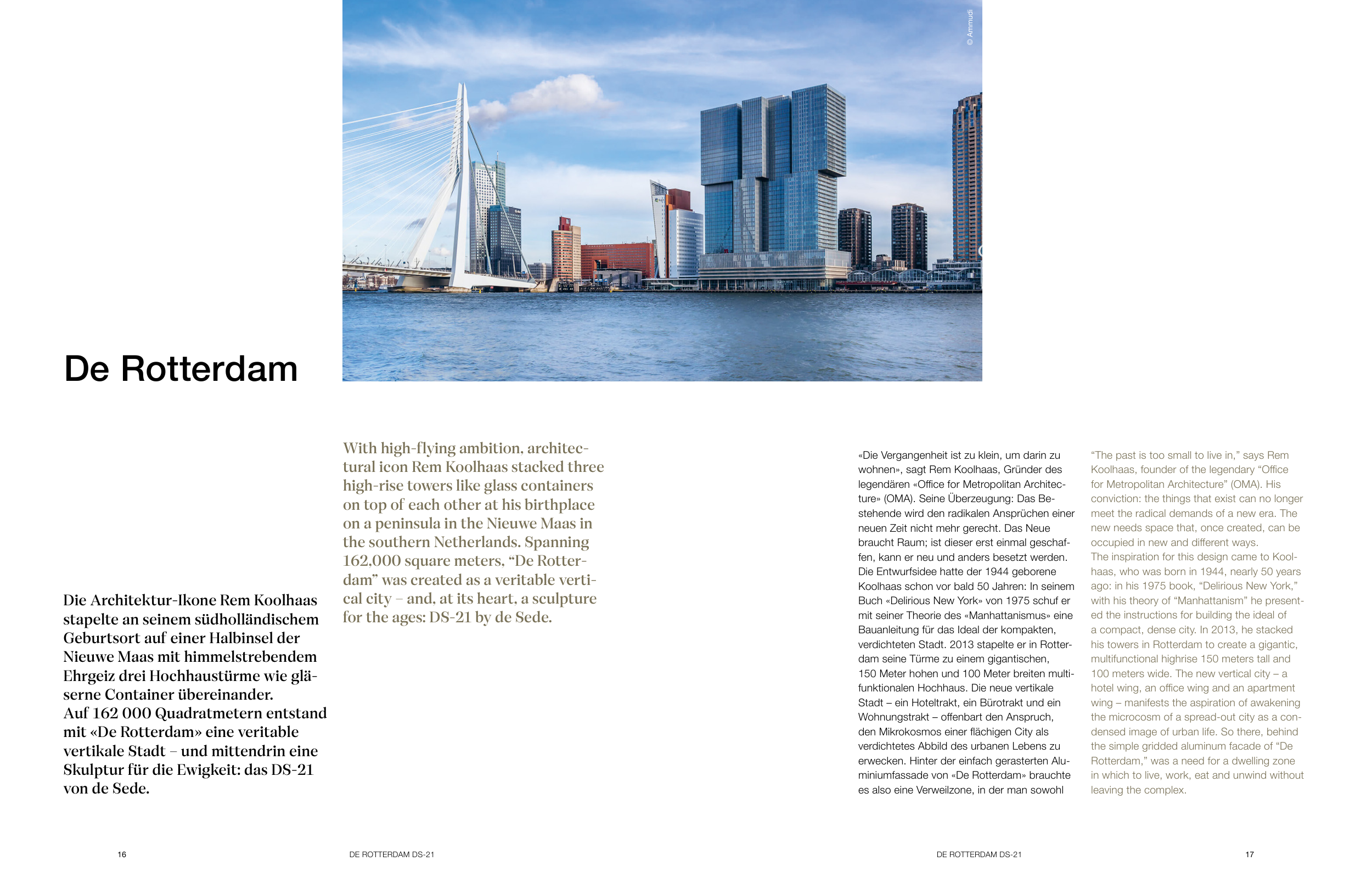
With high-flying ambition, architec-
tural icon Rem Koolhaas stacked three
high-rise towers like glass containers
on top of each other at his birthplace
on a peninsula in the Nieuwe Maas in
the southern Netherlands. Spanning
162,000 square meters, “De Rotter-
dam” was created as a veritable verti-
cal city – and, at its heart, a sculpture
for the ages: DS-21 by de Sede.
Die Architektur-Ikone Rem Koolhaas
stapelte an seinem südholländischem
Geburtsort auf einer Halbinsel der
Nieuwe Maas mit himmelstrebendem
Ehrgeiz drei Hochhaustürme wie glä-
serne Container übereinander.
Auf 162 000 Quadratmetern entstand
mit «De Rotterdam» eine veritable
vertikale Stadt – und mittendrin eine
Skulptur für die Ewigkeit: das DS-21
von de Sede.
«Die Vergangenheit ist zu klein, um darin zu
wohnen», sagt Rem Koolhaas, Gründer des
legendären «Office for Metropolitan Architec-
ture» (OMA). Seine Überzeugung: Das Be-
stehende wird den radikalen Ansprüchen einer
neuen Zeit nicht mehr gerecht. Das Neue
braucht Raum; ist dieser erst einmal geschaf-
fen, kann er neu und anders besetzt werden.
Die Entwurfsidee hatte der 1944 geborene
Koolhaas schon vor bald 50 Jahren: In seinem
Buch «Delirious New York» von 1975 schuf er
mit seiner Theorie des «Manhattanismus» eine
Bauanleitung für das Ideal der kompakten,
verdichteten Stadt. 2013 stapelte er in Rotter-
dam seine Türme zu einem gigantischen,
150 Meter hohen und 100 Meter breiten multi-
funktionalen Hochhaus. Die neue vertikale
Stadt – ein Hoteltrakt, ein Bürotrakt und ein
Wohnungstrakt – offenbart den Anspruch,
den Mikrokosmos einer flächigen City als
verdichtetes Abbild des urbanen Lebens zu
erwecken. Hinter der einfach gerasterten Alu-
miniumfassade von «De Rotterdam» brauchte
es also eine Verweilzone, in der man sowohl
“The past is too small to live in,” says Rem
Koolhaas, founder of the legendary “Office
for Metropolitan Architecture” (OMA). His
conviction: the things that exist can no longer
meet the radical demands of a new era. The
new needs space that, once created, can be
occupied in new and different ways.
The inspiration for this design came to Kool-
haas, who was born in 1944, nearly 50 years
ago: in his 1975 book, “Delirious New York,”
with his theory of “Manhattanism” he present-
ed the instructions for building the ideal of
a compact, dense city. In 2013, he stacked
his towers in Rotterdam to create a gigantic,
multifunctional highrise 150 meters tall and
100 meters wide. The new vertical city – a
hotel wing, an office wing and an apartment
wing – manifests the aspiration of awakening
the microcosm of a spread-out city as a con-
densed image of urban life. So there, behind
the simple gridded aluminum facade of “De
Rotterdam,” was a need for a dwelling zone
in which to live, work, eat and unwind without
leaving the complex.
© Ammudi