Komorebi
Japan is known for its humidity and rain, and the roofs are
generally extended to create deep eaves to protect buildings
from the severe winds and rains. Wooden shrines and temples,
which were built using techniques imported from the Asian
Continent, have roofs with even longer eaves than the original,
as they adapted to the harsher climate in Japan. Such compo-
nents have become the characteristics of Japanese architec-
ture.
Until recently, Japanese homes had a garden no matter how
small the home or plot was. Trees were planted, large and
small rocks were arranged, and ponds were placed for koi carp
to swim. They were not solely to provide scenery. In fact,
Japanese people preferred to avoid inviting direct sunlight
into the room. Homes were built to draw in indirect light
reflected off of the garden. Inside the home, shoji screens,
sliding partitions made of thin Japanese paper pasted onto
delicate latticed wooden frames, were commonly used to
divide rooms. When the weather is mild, only one layer of
shoji was needed to separate the interior space from the
exterior. Sunlight reflected off of the garden is filtered through
the paper screens, and gently diffused light is drawn in, whilst
sunlight passing through the trees in the garden flickers as it
shines on the shoji, creating a dream-like scene inside the
room. Shoji’s wooden framework is made using coniferous
trees with delicate grain such as cedar and cypress. Various
types of design were made across the era, ranging from those
with decorative wooden latticework to plain designs. They can
be found in historical buildings as well as residential homes all
over Japan.
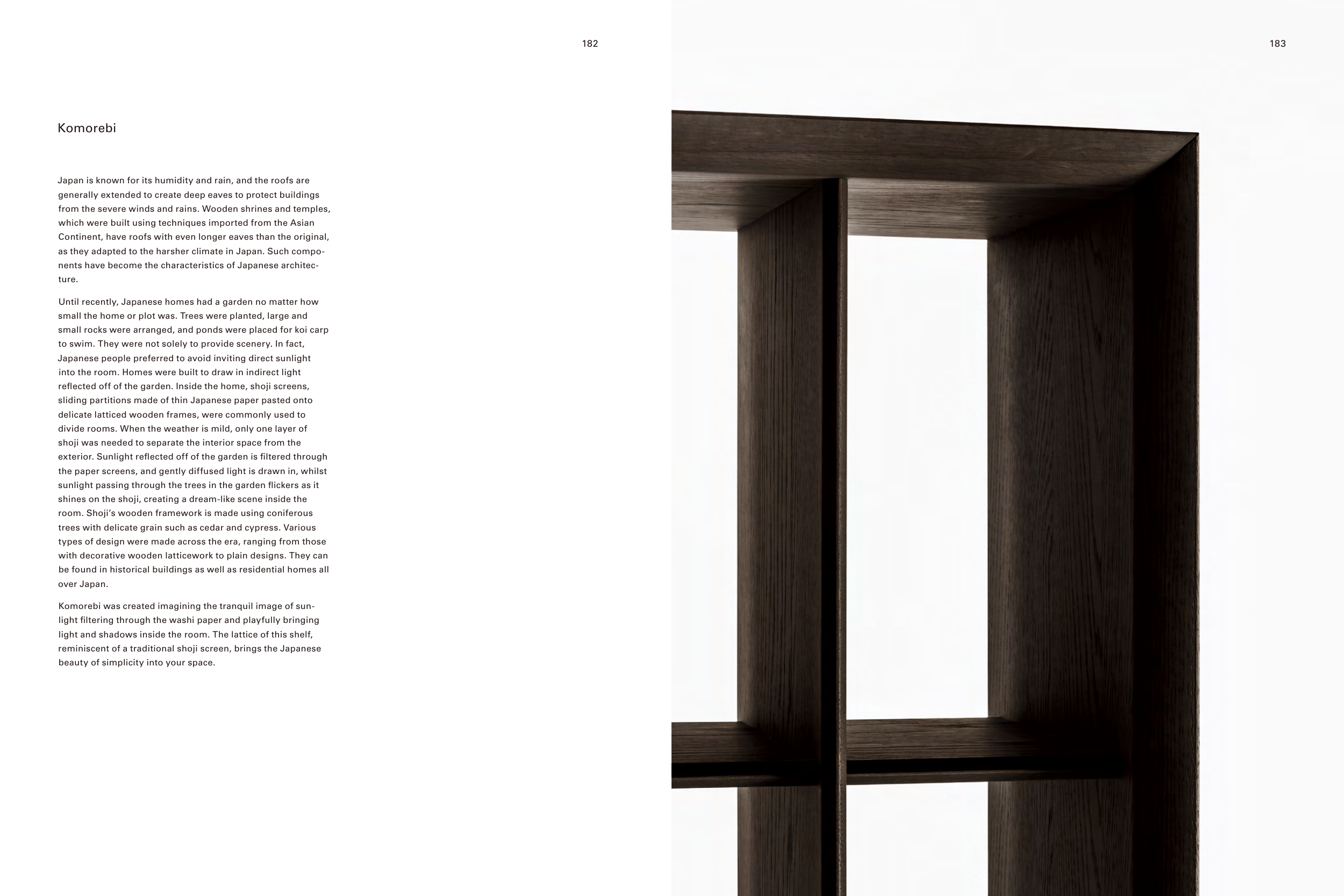
Komorebi was created imagining the tranquil image of sun-
light filtering through the washi paper and playfully bringing
light and shadows inside the room. The lattice of this shelf,
reminiscent of a traditional shoji screen, brings the Japanese
beauty of simplicity into your space.
182
183