Vertical layer
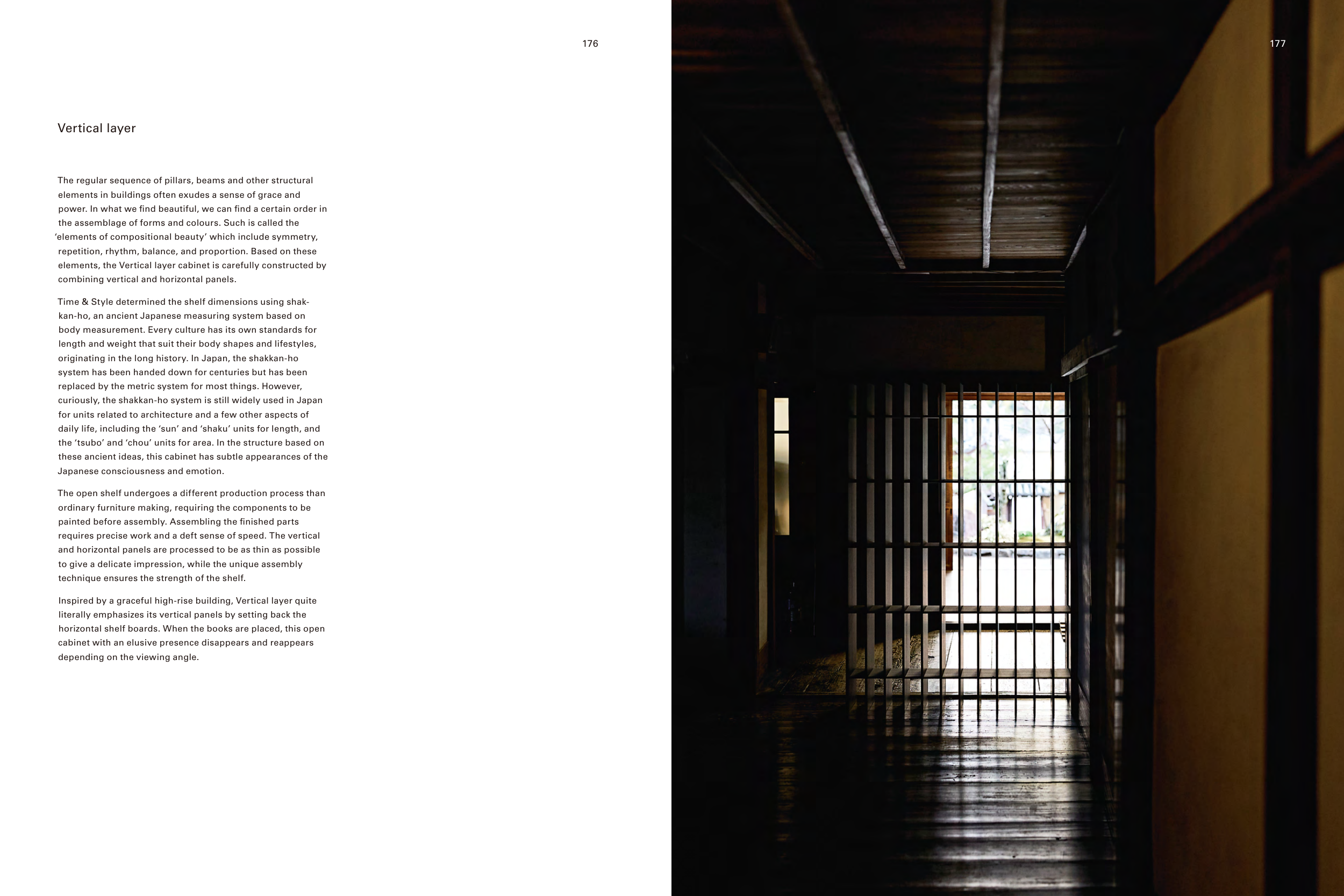
The regular sequence of pillars, beams and other structural
elements in buildings often exudes a sense of grace and
power. In what we find beautiful, we can find a certain order in
the assemblage of forms and colours. Such is called the
‘elements of compositional beauty’ which include symmetry,
repetition, rhythm, balance, and proportion. Based on these
elements, the Vertical layer cabinet is carefully constructed by
combining vertical and horizontal panels.
Time & Style determined the shelf dimensions using shak-
kan-ho, an ancient Japanese measuring system based on
body measurement. Every culture has its own standards for
length and weight that suit their body shapes and lifestyles,
originating in the long history. In Japan, the shakkan-ho
system has been handed down for centuries but has been
replaced by the metric system for most things. However,
curiously, the shakkan-ho system is still widely used in Japan
for units related to architecture and a few other aspects of
daily life, including the ‘sun’ and ‘shaku’ units for length, and
the ‘tsubo’ and ‘chou’ units for area. In the structure based on
these ancient ideas, this cabinet has subtle appearances of the
Japanese consciousness and emotion.
The open shelf undergoes a different production process than
ordinary furniture making, requiring the components to be
painted before assembly. Assembling the finished parts
requires precise work and a deft sense of speed. The vertical
and horizontal panels are processed to be as thin as possible
to give a delicate impression, while the unique assembly
technique ensures the strength of the shelf.
Inspired by a graceful high-rise building, Vertical layer quite
literally emphasizes its vertical panels by setting back the
horizontal shelf boards. When the books are placed, this open
cabinet with an elusive presence disappears and reappears
depending on the viewing angle.
176
177