Nagoya
Japanese people have been using a traditional Japanese light
fixture since around the 1600s (Edo period), which is normally
made of washi paper stretched over a wooden frame, and
candles and oil are used to create poetic shadows through the
washi paper. They could be carried from room to room.
Today, Japan is brightly lit even at night. However, in the olden
days, people lived with the passing time, letting natural light
into their rooms during the day and living with soft lights that
only illuminated their hands at night. Nagoya attempts to
bring such type of lighting, which embodies the Japanese
sense of beauty and nature, into modern life.
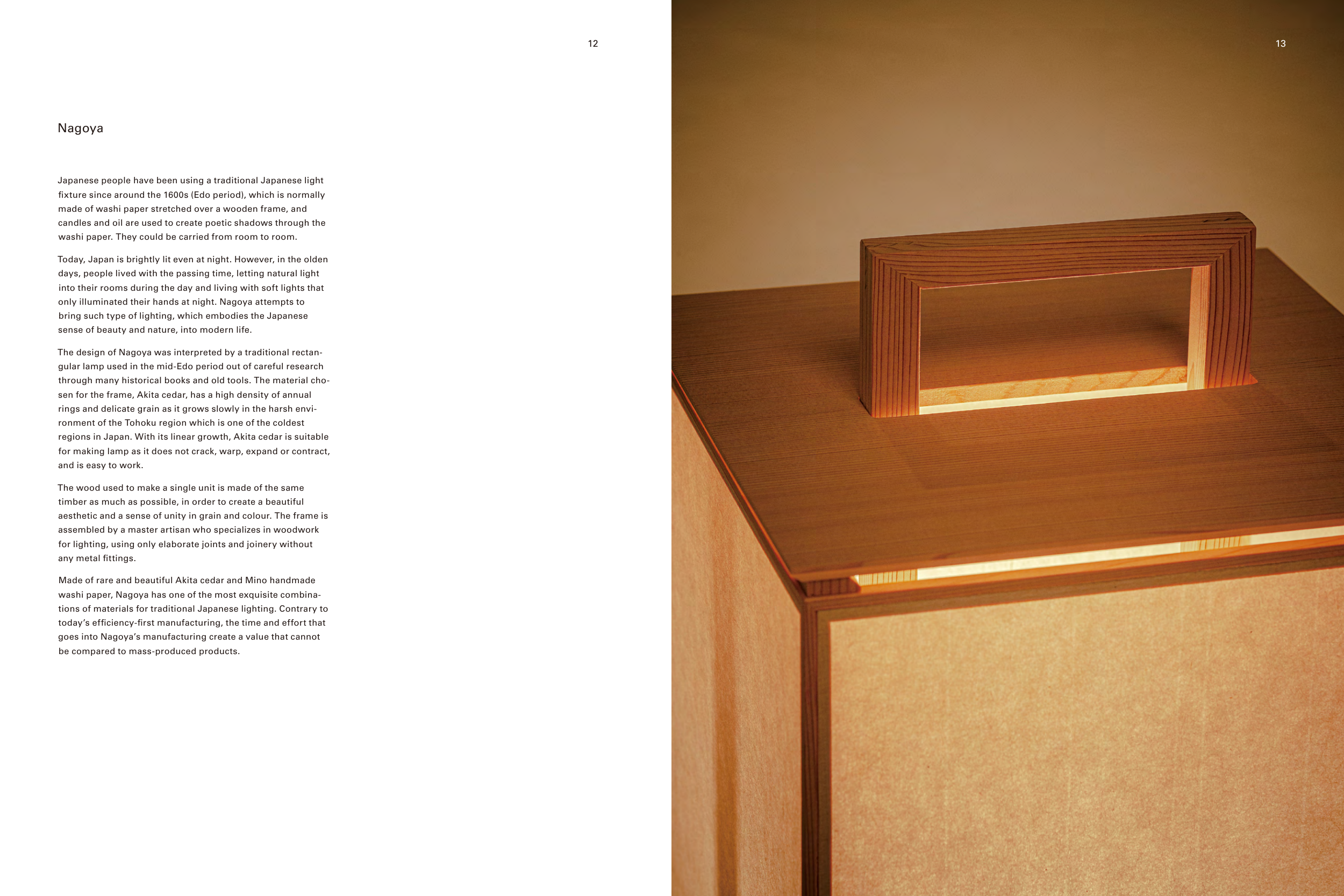
The design of Nagoya was interpreted by a traditional rectan-
gular lamp used in the mid-Edo period out of careful research
through many historical books and old tools. The material cho-
sen for the frame, Akita cedar, has a high density of annual
rings and delicate grain as it grows slowly in the harsh envi-
ronment of the Tohoku region which is one of the coldest
regions in Japan. With its linear growth, Akita cedar is suitable
for making lamp as it does not crack, warp, expand or contract,
and is easy to work.
The wood used to make a single unit is made of the same
timber as much as possible, in order to create a beautiful
aesthetic and a sense of unity in grain and colour. The frame is
assembled by a master artisan who specializes in woodwork
for lighting, using only elaborate joints and joinery without
any metal fittings.
Made of rare and beautiful Akita cedar and Mino handmade
washi paper, Nagoya has one of the most exquisite combina-
tions of materials for traditional Japanese lighting. Contrary to
today’s efficiency-first manufacturing, the time and effort that
goes into Nagoya’s manufacturing create a value that cannot
be compared to mass-produced products.
12
13