Moon
Perhaps the most widely used piece of furniture in modern
Japanese households is the zataku, a traditional low table. It
has been an indispensable part of Japanese culture, where
one would sit directly on a tatami floor to use it. Many zataku
designs came to Japan from Ming Dynasty China, in which
furniture for displaying bonsai and flower arrangements also
originated. Bonsai itself also has its roots in China, whilst a
uniquely Japanese bonsai culture subsequently took shape
here. Many aspects of Chinese culture made their way to
Japan to be evolved into new forms that we would call our
own.
Japanese-style houses have a large room with tatami flooring
called a zashiki for entertaining guests, and a zataku would
usually be placed in the center of this room. There typically is
also a small, raised space known as the tokonoma, which did
not serve any practical purpose but to display a beautiful
flower arrangement or perhaps a hanging scroll for guests to
admire. It has been a unique element of traditional Japanese
architecture that showcases the host’s taste and embodies a
message to the guest, whilst following the traditions of cher-
ishing the season. The choice of scroll, flowers, or bonsai
provided a window on the host’s character and sensitivity.
Today, most of the zataku have given way to Western dining
tables and chairs, and the role of the zashiki has shifted
towards living rooms with sofas. Some Japanese homes still
have one traditional tatami room, often solely for entertaining
guests.
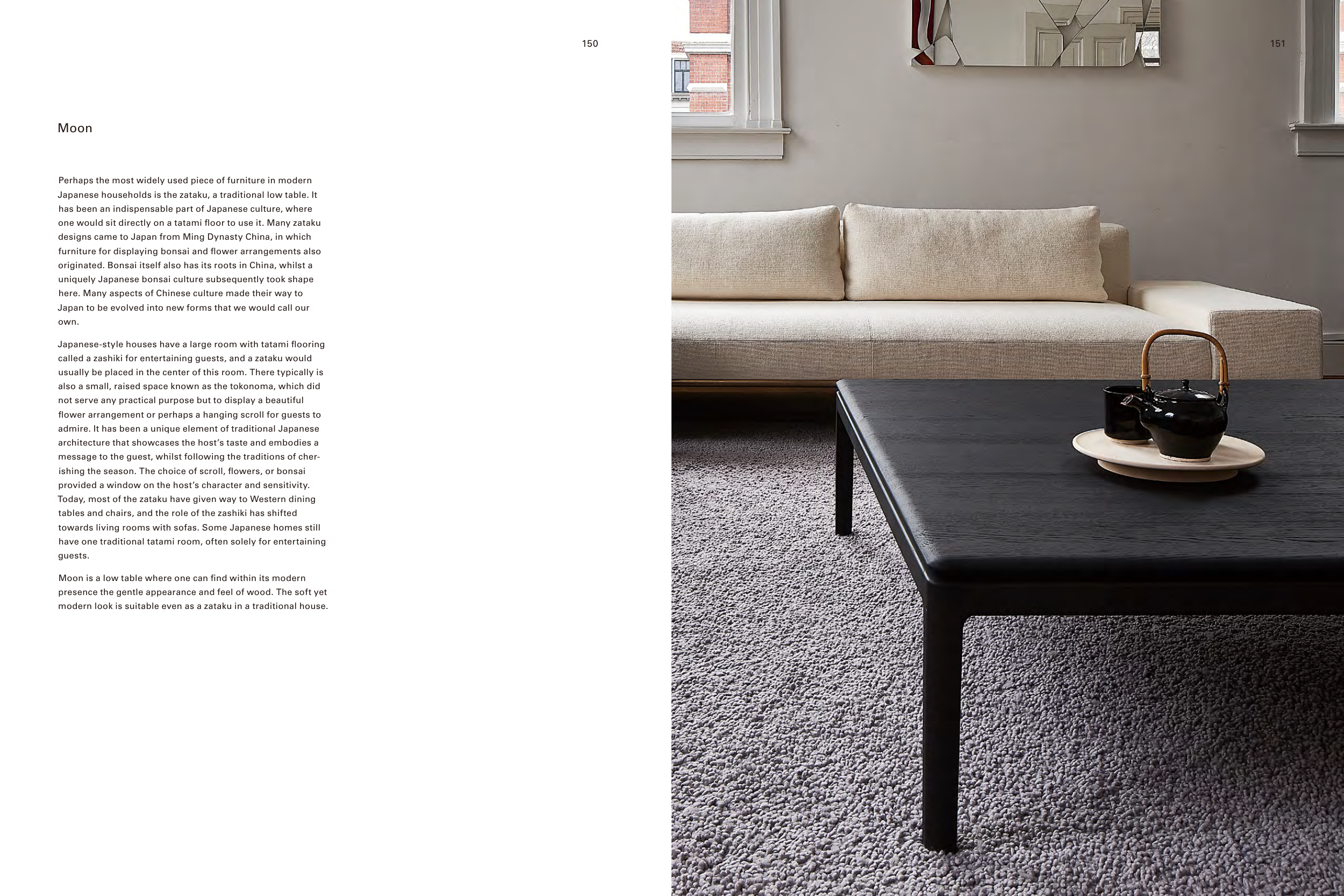
Moon is a low table where one can find within its modern
presence the gentle appearance and feel of wood. The soft yet
modern look is suitable even as a zataku in a traditional house.
150
151